
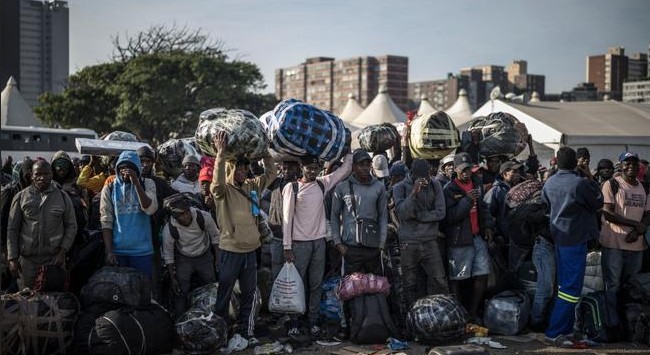
The National Assembly has suspended all official parliamentary visits and legislative engagements with South Africa following renewed waves of xenophobic violence against Nigerian citizens. The resolution, jointly endorsed by the Senate and the House of Representatives, orders federal lawmakers, committee secretariats, and legislative staff to boycott bilateral exchanges in Pretoria until further notice. This diplomatic freeze coincided directly with the arrival of fresh evacuation flights in Lagos, where state agencies processed dozens of displaced returnees whose commercial shops and residences in Gauteng were ransacked and burned.
Cancelling parliamentary trips and receiving traumatised citizens at tarmac reception desks treats only the visible symptoms of a chronic regional breakdown. The recurring cycle of violence in Johannesburg, Durban, and Pretoria has laid bare an institutional failure in Abuja’s foreign policy doctrine. By relying on moral appeals and symbolic parliamentary boycotts, Nigeria behaves like a powerless onlooker rather than an economic power with significant commercial leverage. Pretoria maintains a policy environment hostile to African migrants, while South African multinationals enjoy seamless profit repatriation, state protection, and market supremacy within Nigeria.
The Paralysis of Reciprocal Economic Leverage
The primary contradiction in Nigeria’s bilateral posture is the refusal to connect citizen safety to South African commercial operations. South African corporate giants generate billions of dollars in revenue from Nigeria’s consumer economy. MTN Nigeria controls the largest telecommunications market share in the country; MultiChoice extracts billions of naira in satellite television subscriptions from Nigerian living rooms; and firms across financial services and industrial supply chains operate unhindered in major commercial centres.
When Nigerian citizens face mob violence and targeted profiling in South African townships, the Ministry of Foreign Affairs retreats into diplomatic platitudes. Abuja issues statements reminding Pretoria of Nigeria’s financial and diplomatic contributions to the anti-apartheid struggle decades ago. This nostalgia carries no weight in contemporary South African domestic politics. South African political factions routinely exploit anti-migrant rhetoric to distract local electorates from domestic failures in housing, electricity supply, and youth unemployment.
Diplomatic protocol must reflect commercial reality. South African investments in Nigeria remain safe because the Nigerian state guarantees their operational security and access to capital markets. Yet, Abuja refuses to place these economic privileges on the negotiating table. Until Nigeria signals that South African corporate interests cannot operate in absolute separation from how Pretoria treats Nigerian lives and property, diplomatic protests will remain empty gestures. Sovereign respect is built on the willingness to deploy real economic deterrence.
The Domestic Push Factors: State Failure as an Emigration Driver
An honest assessment of the xenophobia crisis requires confronting the structural failures that drive Nigerians abroad. Citizens do not emigrate to hostile environments out of curiosity. They leave because the Nigerian state has consistently failed to provide physical security, economic predictability, and public services at home.
The Nigerian diaspora in South Africa comprises skilled medical doctors, academics, tech specialists, and thousands of informal traders. These individuals fled a home economy marked by currency depreciation, power sector failures, infrastructure deficits, and widespread insecurity. When a country fails to retain its professionals or protect its commercial middle class, it forces citizens to risk violence abroad rather than face despair at home.
Emergency airlifts and returnee stipends indict federal social policy, not an achievement. Flying eighty or ninety citizens home into an economy without basic social safety nets merely returns them to the very vulnerabilities that forced them out. Without major domestic economic reforms that expand formal employment, restore currency stability, and fund public infrastructure, the outflow of citizens to hostile territories will continue. Foreign governments know that Nigerian authorities lack the institutional capacity to reabsorb their diaspora, which weakens Abuja’s negotiating posture at the bilateral table.
Institutionalising Bilateral Labour Accords and Multilateral Accountability
Halting this cycle requires exiting from reactive crisis management toward enforceable institutional agreements. The Ministry of Foreign Affairs, working with the Federal Ministry of Labour and Employment, must abandon informal arrangements and negotiate a binding Bilateral Labour Mobility and Protection Agreement with Pretoria.
This accord must contain explicit mechanisms for consular access, expedited business visa issuance, and independent arbitral tribunals to assess damages when foreign businesses are attacked or looted. South Africa must be compelled to enforce legal accountability on perpetrators of xenophobic crimes. The persistent failure of the South African Police Service (SAPS) to prosecute individuals who organise xenophobic attacks creates an atmosphere of state-sanctioned impunity. An enforceable bilateral framework would link consular cooperation with verified protections, requiring South African police commands to maintain dedicated protection zones for foreign business clusters.
Nigeria must also take the issue directly to multilateral institutions. Abuja should formally petition the African Union Commission to invoke the African Charter on Human and Peoples’ Rights regarding the treatment of African migrants. South Africa is a signatory to the African Continental Free Trade Area (AfCFTA) and the AU Protocol on Free Movement of Persons. Pretoria cannot claim continental leadership while permitting violence against the citizens of the very states required to make African economic integration a reality. Nigeria must file state-to-state communications before the African Commission on Human and Peoples’ Rights in Banjul, establishing that systematic xenophobia constitutes a direct violation of continental treaty obligations.
Legislative boycotts offer momentary political satisfaction for politicians in Abuja, but they leave ordinary citizens on the streets of Johannesburg entirely unprotected. Nigeria must replace historic sentimentality with hard diplomatic reciprocity. Until Abuja directly ties the commercial security of South Africa’s capital within its borders to the physical safety and civil dignity of Nigerian citizens abroad, the evacuations will continue, statements will multiply, and the nation’s sovereign standing will remain compromised.