
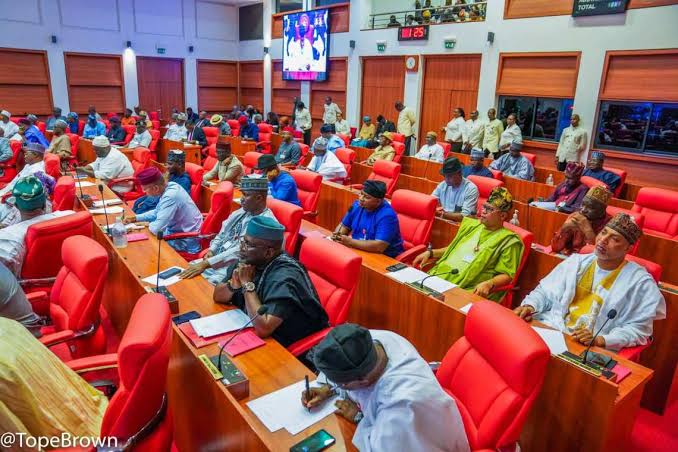
The Senate moves today toward one of the most far-reaching constitutional decisions in Nigeria’s democratic history, as lawmakers prepare to vote on a bill seeking to establish state police services across the federation, following President Bola Tinubu’s formal transmission of the proposed amendment.
The legislation, contained in a communication dated June 15, 2026, was read during plenary by Senate President Godswill Akpabio and is designed to provide a legal framework for a dual policing structure that allows states to establish and operate their own police services alongside the federal police. The bill was first read on Monday, June 15, 2026, and referred to the Senate Committee on the Review of the 1999 Constitution for expedited consideration.
The debate unfolds against the backdrop of a national security crisis. On November 26, 2025, President Tinubu declared a nationwide security emergency and directed the police and Armed Forces to recruit more personnel to confront escalating insecurity. The push for decentralised policing has gained traction as a response to persistent terrorism, banditry and kidnapping. The Nigeria Police Force had a staff strength of about 371,800 as of 2021, with plans to expand the force to 650,000. With Nigeria’s population projected to exceed 230 million by 2026, the current officer-to-citizen ratio remains far below United Nations recommendations, a gap supporters say state forces could help close.
Akpabio described the reform as historic. “Since 1960, Nigeria has not had the courage to decentralise policing, and this is the first time,” he said, urging full attendance because constitutional alterations require the support of at least two-thirds of members in each chamber. If passed by the National Assembly and approved by at least 24 of Nigeria’s 36 state Houses of Assembly, the amendment returns to the President for assent.
The President framed the measure as central to his agenda. Tinubu said it builds on work already done by both chambers and incorporates additional safeguards to ensure that a dual policing structure can address the nation’s evolving security challenges. Akpabio said the Constitution Review Committee, led by Deputy Senate President Barau Jibrin, had spent about two years on the bill and stressed that safeguards must be built in so that even serving governors who one day leave office “should not be afraid of the state police structure they helped create.”
Retired security chiefs remain divided. Retired Brigadier General Peter Aro argued that state police “should not be treated as a political slogan but as a structured security reform,” while retired Assistant Inspector General of Police Wilson Inalegwu warned that “the power they want is excessive power,” insisting on robust oversight modelled on the Police Service Commission. Governors, meanwhile, are demanding greater constitutional authority and guaranteed funding.
Tuesday’s proceedings were suspended after the death of a member of the House of Representatives representing the Kwami/Funakaye Federal Constituency of Gombe State. Reports differed on the spelling of his name, rendered as both Yaya and Yahaya Tongo.
The outcome of today’s sitting could determine whether Nigeria finally decentralises a policing system unchanged since independence.