
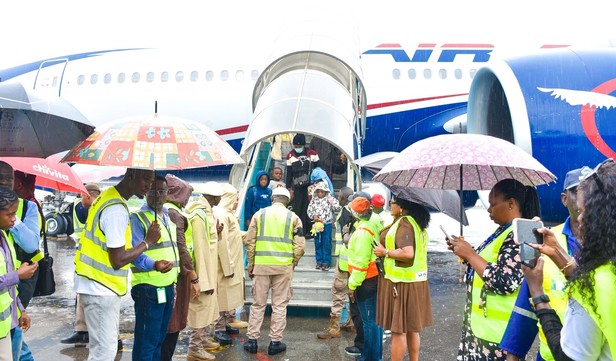
The federal government has completed the emergency evacuation of 801 Nigerian nationals from South Africa following an escalation in local anti-immigrant hostility. The final batch of 268 returnees landed at the Murtala Muhammed International Airport in Lagos aboard a chartered wide-body aircraft. Coordinated by the Ministry of Foreign Affairs, the emergency repatriation operation relied on a public-private partnership with Air Peace, a domestic commercial carrier. The intervention deployed three separate long-haul flights over three weeks to pull registered citizens out of volatile metropolitan areas. Returning passengers underwent immediate profiling, administrative documentation, and immigration checks upon arrival at the cargo terminal.
The emergency rescue operation follows a strict ultimatum issued by South African anti-immigration vigilante groups. These local networks demanded that undocumented foreign workers leave the territory immediately or face targeted community expulsions. The rising hostility triggered widespread panic among West African diaspora communities, prompting hundreds to seek immediate consular assistance. While the South African cabinet publicly condemned the vigilante declarations, the security forces struggled to guarantee the safety of foreign nationals in peripheral urban zones. This administrative failure forced the Nigerian state to move from quiet diplomacy to direct physical extraction.
The operation marks the sixteenth time the private carrier has underwritten emergency airlifts for the state. Air Peace deployed its flagship Boeing 777 fleet to run the Johannesburg route, absorbing the primary operational costs as a national service initiative. The carrier previously managed similar humanitarian flights during the Libyan migrant crisis and the Sudanese civil war. By using private aviation assets, Abuja avoided the lengthy legislative delays usually linked to military deployment. The partnership highlights how the state depends heavily on corporate infrastructure to manage its foreign policy emergencies.
Initial consular screening suggests that the scope of the crisis could widen significantly. More than one thousand Nigerians initially registered for the voluntary evacuation scheme at the diplomatic missions in Pretoria and Johannesburg. The Ministry of Foreign Affairs had to delay early flight schedules to cross-reference travel manifests with South African border agencies. Many returnees reported losing personal property, business assets, and legal documents during the hasty departure process. State welfare teams are currently distributing emergency palliatives, but long-term economic reintegration remains completely unaddressed.
The emergency return highlights a broader, recurring failure in continental diplomacy. Despite shared trade treaties under the African Union, economic rivalries frequently spark localized violence against migrant workers. South Africa’s domestic challenges with high unemployment and public service decay continue to make foreign merchants easy scapegoats for local politicians. Abuja’s reactive approach provides immediate relief but fails to alter the underlying drivers of regional xenophobia. The administration must secure firm legal protections for its diaspora rather than relying on periodic airlift operations.
Ultimately, the domestic economy will struggle to absorb these sudden returnees. The arrival of hundreds of displaced workers adds immediate pressure to a strained domestic labor market. While government officials welcomed the evacuees with patriotic rhetoric, the state lacks a structured program to rebuild their ruined livelihoods. Without concrete financial grants or job placement schemes, these citizens risk falling into extreme poverty at home. The successful airlift proves that the state can defend its people abroad, but its ability to sustain them at home remains unproven.