
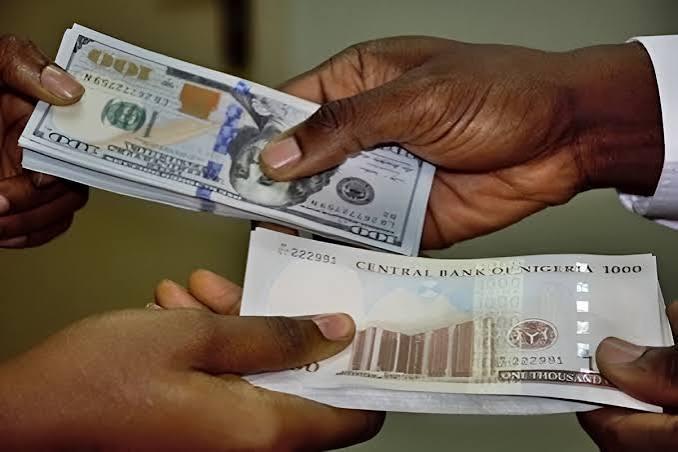
The naira eased further against the United States dollar on Tuesday, closing weaker in both the parallel and official windows as sustained demand for foreign currency continued to test the relative calm that has defined Nigeria’s foreign exchange market for much of 2026.
At the parallel market, the currency weakened to N1,405 per dollar, down from the N1,400 recorded on Monday. A similar movement played out at the official window, where the Central Bank of Nigeria’s Nigerian Foreign Exchange Market, NFEM, saw the indicative rate rise to N1,379 per dollar from N1,371 the previous day. That N8 shift translated to a marginal depreciation for the local unit in the formal market.
The twin movements had a notable effect on the spread between both segments. The gap between the parallel and official rates narrowed to N26 per dollar from N29 on Monday, a spread that remains strikingly tight by historical standards. For much of 2023 and 2024, that same margin ran into hundreds of naira, feeding the round-tripping and speculative activity that the apex bank has spent close to three years trying to squeeze out of the system. Trading activity at the official window, however, thinned out. Interbank turnover at the NFEM fell sharply by 24.4 per cent to N41.7 million on Tuesday, down from N54.2 million a day earlier, pointing to lighter deal flow rather than any dramatic supply shock.
Tuesday’s slip should be read against a broadly stable backdrop. Since the CBN rolled out the fourth edition of its Foreign Exchange Manual on June 1, market watchers have credited improved liquidity and clearer trading rules with keeping the naira largely range-bound around the N1,370 mark at the official window. The reform, which allows authorised dealers to settle spot transactions within a maximum of two business days, was designed to deepen transparency and tighten the very premium that narrowed again on Tuesday.
The external buffers behind that stability have rarely looked stronger in recent memory. Nigeria’s gross external reserves climbed to $51.45 billion as at June 30, 2026, according to figures published by the CBN, representing a rise of about $14.24 billion, or 38.27 per cent, from the $37.21 billion recorded in the corresponding period of 2025. The apex bank had, in its 2026 Macroeconomic Outlook, projected reserves of $51.04 billion for the year, a target the country has already crossed. Capital importation has reinforced the picture, with the National Bureau of Statistics reporting inflows of $10.37 billion in the first quarter of 2026, an 83.8 per cent jump from the $5.64 billion posted a year earlier as foreign investors returned to Nigerian bonds and money market instruments.
Even so, the pressure points remain familiar. Persistent demand from importers, manufacturers and individuals unable to source dollars through official channels continues to push activity into the parallel market. That demand sits alongside a mild inflation rebound, with headline inflation rising to 15.93 per cent in May 2026, its third straight monthly increase, though still far below the 26.06 per cent recorded in May 2025. The CBN, for its part, retained the Monetary Policy Rate at 26.5 per cent at its May meeting, holding a cautious line after a modest cut earlier in the year.
For now, the naira’s direction is likely to hinge on the balance of dollar liquidity, oil export earnings, portfolio inflows and diaspora remittances, the same variables that have carried the currency through a fragile but improving year. Tuesday’s dip, modest in scale, does little to alter that broader trajectory, but it is a reminder that the demand side of the market has not gone quiet.