
A businessman’s account of how he raised and transferred N400 million to a man he believed to be a serving federal director general has pulled the controversy surrounding the Presidential Foreign Investment Promotion Council into a new and more personal phase, shifting attention from budget lines and forged letterheads to the ordinary Nigerians who say they lost money to an entity the Presidency insists never legally existed.
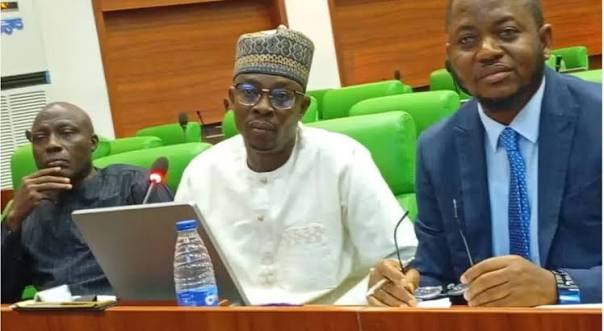
Gbenga Collins, Managing Director of Divine Dopacy Nigeria Limited, told the House of Representatives Ad hoc Committee investigating the alleged establishment and operations of the PFIPC on Tuesday that he paid the sum to Adeniyi Adeyemi, the purported Director General of the council, after being promised a contract to renovate and furnish what was presented to him as Adeyemi’s official residence.
Collins, a graduate of the Federal University of Agriculture, Abeokuta, said he first met Adeyemi, a fellow indigene of Ogbomoso, during a programme in their hometown in December 2024, and was invited to Abuja in early 2025 to discuss a business opportunity. He told lawmakers that the trappings of office left him with no reason to doubt the man’s status.
“When I arrived at the airport, he sent an official car to come and pick me up from the airport to his office at the Federal Secretariat, Abuja,” Collins said. “When I got to his office, I met him there. He is a well known man in Ogbomoso. I met a lot of people, very big dignitaries in his office, and I met a group of security officers guarding the office.”
He added, “I saw police officers with him. That was my first time coming to Abuja because I’m not familiar with Abuja very well. He sent his official car to pick me up from the airport. It had a Federal Government registration number attached to the Lexus SUV.”
According to Collins, Adeyemi introduced himself as Director General of both the Presidential Economic Advisory Council and the PFIPC, and later took him to inspect a property described as the official residence attached to the post. “He told me that he wanted to do refurbishment and renovation of the official house assigned to him as the DG of that agency and asked whether I would be able to handle the contract,” he said. “He took me to the house to show me the property because I slept in Abuja. We went there the following day with his staff. We went with more than four, five or six vehicles with security. They opened the house and took us round, showing me what they wanted to do.”
Collins told the panel that discussions ran until April 2025, when he was handed a contract award letter, a scope of work and an agreement between the purported council and his company. “I had to pay N400m for the facilitation of that project to show my strength that I would be able to handle the project. At the same time, he said it would fast track the mobilisation for the contract,” he said.
The payments, by his account, moved in two tranches. N380 million was paid in four instalments between May and June 2025 into a Guaranty Trust Bank account belonging to World Entrepreneurs Limited, while the balance of N20 million was paid on July 29, 2025 into an Access Bank account belonging to Sunshine Confectionery and Catering Services. He said the funds came from business associates who trusted his account of having visited the office in person.
Mobilisation, he said, was promised for August 2025, then deferred. “I continued calling him. He kept managing me, telling me they were handling security issues and that they would pay in November,” Collins told lawmakers, adding, “My lawyer was the first person who told me that I had been scammed.” A petition was filed with the Economic and Financial Crimes Commission on November 13, 2025, and adopted by him six days later.
Under questioning by the committee chairman, Yusuf Gagdi, Collins rejected the suggestion that the money amounted to a bribe, insisting it was presented to him as a facilitation and mobilisation requirement. He also admitted that he followed no formal procurement process. That admission carries weight. The Public Procurement Act, 2007 requires open competitive bidding for federal contracts and provides for mobilisation fees of up to 15 per cent to be paid by the procuring entity to the contractor, not the reverse. Under the Act’s framework, no genuine federal contract would require a contractor to demonstrate capacity by transferring money to an official.
The Collins testimony sits inside a far larger institutional puzzle. The PFIPC, referred to in some official statements as the Presidential Foreign Intervention Promotion Council, came into public focus on June 11, 2026, when the Office of the Chief of Staff to the President issued a disclaimer distancing the Presidency from the body and from Adeyemi. On July 7, 2026, President Bola Tinubu, through his Special Adviser on Information and Strategy, Bayo Onanuga, directed the Independent Corrupt Practices and Other Related Offences Commission to investigate the matter and report within 30 days, describing the council as fictitious and without basis in any law, presidential instrument or executive approval.
Yet the council carried an allocation of about N1.302 billion in the 2026 Appropriation Act under budget code 0111062001, covering personnel, overhead and roughly N300 million in capital expenditure. Testimonies before the Gagdi committee have progressively mapped how that happened. The Head of the Civil Service of the Federation, Didi Esther Walson Jack, admitted that her office failed to properly verify documents before issuing an authorised staff establishment covering about 300 personnel. The Central Bank of Nigeria confirmed that two foreign currency domiciliary accounts were opened for the body but never funded. The Accountant General of the Federation, Shamseldeen Ogunjimi, told the panel that not one naira of the personnel provision had been drawn. The Director General of the Budget Office, Tanimu Yakubu, maintained that his office did not create the council but processed submissions based on existing records and administrative codes. The Ministry of Foreign Affairs said it rejected the council’s requests after due diligence exposed inconsistencies.
Gagdi has said investigators identified 29 allegedly forged documents linked to the State House, the Office of the Head of the Civil Service, the Office of the Secretary to the Government of the Federation and the Federal Ministry of Finance, alongside a fabricated Act of Parliament. Police testimony indicated that signatures on documents purportedly from the Office of the Chief of Staff did not match authentic correspondence.
The figures in circulation remain contested. While official records point to about N1.3 billion, some accounts, including those cited by the human rights lawyer Femi Falana, have referenced allocations reported as high as N24 billion. That divergence has not been resolved in public documents.
The scandal broke open on June 25, 2026, when Adeyemi alleged at a press conference that the Chief of Staff to the President, Femi Gbajabiamila, demanded 48 per cent of a purported N27.3 billion take off grant, received N400 million through a proxy and sought a further N200 million to facilitate presidential approvals. Gbajabiamila has denied every element of the claim, stating that he never met, communicated with or authorised anyone to act for Adeyemi, and has filed a N15 billion defamation suit at the High Court of the Federal Capital Territory through a legal team led by Kemi Pinheiro, SAN, seeking N10 billion in general damages, N5 billion in aggravated damages and N200 million in costs. He appeared before the ICPC in Abuja on July 20, 2026. The coincidence of the N400 million figure in both Collins’s account and Adeyemi’s allegation has not been established by any investigating body as referring to the same funds.
The Presidency’s chronology traces the first alarm to October 2025, when the Nigerian Investment Promotion Commission complained that the PFIPC’s activities clashed with its statutory mandate. Gbajabiamila has said he petitioned the police and the Department of State Services at that point and describes himself as the whistleblower. Adeyemi was arrested and later arraigned before the Federal High Court on charges bordering on forgery, impersonation and obtaining money by false pretence.
Babatunde Dolapo Tanimola, whom Adeyemi named as the intermediary in his dealings, died in a hotel fire in Abuja on October 22, 2025, five days before Adeyemi’s arrest, according to police accounts verified through hospital and mortuary records, interviews with relatives and the hotel proprietor, and burial documentation. Falana, in a statement issued on Monday titled “These Deaths Must Not Be Swept Under the Carpet,” urged the Inspector General of Police, Olatunji Disu, to take over the case, noting that the hotel was subsequently demolished and that the ICPC’s terms of reference do not cover the death.
Adeyemi remains in police custody under a valid court order, which the IGP cited as the reason he could not be produced before lawmakers. His legal team, led by Festus Akhigbe, has requested administrative clearance for him to testify, arguing that any report without his evidence would be “fundamentally flawed” and pressing the question of how the Federal Secretariat, the Accountant General’s office and the CBN all acted on documents now described as crude forgeries.
Gagdi has said the committee will interrogate him at an undisclosed date and location to avoid prejudicing the work of the EFCC, ICPC and police. “For the benefit of the general public, we are not refusing to invite Prince Adeniyi here,” he told the hearing. “Whether he appears before this committee or this committee appears before him, the most important thing is to have an interaction with him to get some things clarified.”
The affair lands in a system already flagged for weak budget scrutiny. BudgIT’s analysis of National Assembly insertions in the 2025 budget identified 11,122 projects worth N6.93 trillion inserted without adequate justification, roughly 12.5 per cent of the N54.99 trillion appropriation. Advance fee fraud, meanwhile, remains among Nigeria’s most prevalent economic crimes. EFCC records show 15,724 petitions received in 2024, of which 12,928 were investigated and 5,081 filed in court, producing 4,111 convictions and recoveries of N364.5 billion alongside foreign currency and asset forfeitures.
The political response has split along institutional lines. The House adopted a motion to investigate the allocation and constituted a 12 member panel, while the Senate voted against a similar motion, with Deputy Senate President Barau Jibrin saying the chamber would await the ICPC’s findings.
For Collins, the outcome is more immediate. “I just want to beg the Chairman and the honourable members to help me talk to all the agencies involved because I have been frustrated, especially by those people who gave me the money. I have started selling my property. My business is not going well again,” he told the panel. He maintained that he acted in good faith, saying, “I did all this based on trust. When I went to his office, I met a lot of big dignitaries there, people waiting to see him and people he was discussing contracts with. I also did it because he is from my hometown.”
All allegations remain untested in court, and no finding of criminal liability has been made against any of the individuals named.