
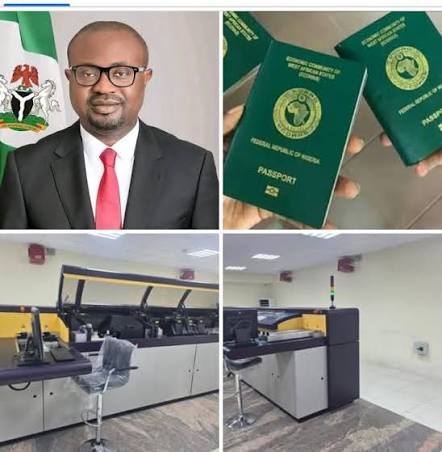
Ten additional passport offices across northern and southern Nigeria will have their booklets produced exclusively in Abuja from Monday, August 10, 2026, a shift that triggered fears of a service shutdown and forced the Nigeria Immigration Service into a public clarification on Wednesday.
The Service, in a post on its official X handle, dismissed suggestions that passport operations had been halted anywhere in the country. “The recent migration of additional passport branches to the Central Personalization Centre is a strategic administrative enhancement, rather than a suspension of services,” the NIS said.
It added that enrolment points remain open and functioning. “Applicants can still visit their local centers to complete biometric data capture seamlessly. This centralized production framework is designed to align with global security standards, streamline processing timelines, and significantly safeguard the integrity of the Nigerian passport,” the Service stated, further assuring that “citizens can rest assured that capturing centers remain fully operational, with physical booklets processed efficiently and returned to local commands within standard delivery windows.”
The clarification followed the circulation of an internal NIS memo dated August 3, 2026, signed by TO Olaiya, Assistant Comptroller General, Passport and Other Travel Documents, on behalf of the Comptroller General of Immigration. Addressed to affected Command Comptrollers, Passport Control Officers and Attaches, the circular listed 10 offices whose booklets will, from August 10, be personalised only at the Central Passport Personalization Centre in Abuja before being dispatched back for collection.
Six of the affected commands sit in the North: Farm Centre in Kano, Dawakin Kudu in Kano, Jalingo in Taraba, Gombe, Yola in Adamawa, and Bauchi. The remaining four are in the South South: Port Harcourt in Rivers, Uyo in Akwa Ibom, Calabar in Cross River, and Yenagoa in Bayelsa. Command Comptrollers were directed to ensure produced booklets are delivered directly to the respective centres.
The migration is the latest stage of a passport overhaul that began after President Bola Tinubu’s administration took office in 2023. Then Minister of Interior, Dr Olubunmi Tunji Ojo, ordered the NIS in September 2023 to clear a backlog of pending applications within two weeks. Speaking at a media parley in Abuja that October, he apologised that the exercise had spilled into a third week but confirmed that all 204,332 pending applications had been cleared as of October 1, 2023. He later disclosed that only about 94,000 of the printed booklets had been collected at the time, and appealed to applicants to pick them up.
Home delivery of passports was introduced from June 2024 in Lagos, Port Harcourt, Kano and Abuja, while contactless application, allowing renewal through the NIS mobile application without a physical visit, was rolled out to Canada in November 2024, the United Kingdom and Ireland in February 2025, and to the United States, Brazil, Jamaica and Mexico from April 2025.
The single largest structural change came on September 18, 2025, when Tunji Ojo, accompanied by the Permanent Secretary, Dr Magdalene Ajani, and Comptroller General Kemi Nanna Nandap, inspected the newly completed Centralised Passport Personalisation Centre at NIS headquarters in Abuja. He described the facility as the first of its kind in the 62 year history of the Service, which was established in 1963, and said it placed Nigeria alongside the United States, the United Kingdom, France, India and Bangladesh in adopting centralised personalisation. He also commended IRIS Smart Technologies Ltd, the government’s technical partner, saying the project “underscores our resolve to build enduring institutions rather than systems dependent on individuals.”
Official figures presented at that inspection put the old decentralised model at roughly 250 to 300 booklets per centre daily. The Abuja facility, according to the Minister, runs machines capable of personalising over 1,000 passports per hour, giving what he called “a potential output of 4,500 to 5,000 passports per day,” with printing within 24 hours of approval and nationwide delivery within one week.
Those figures have since been restated upward. Addressing the International Civil Service Conference in Abuja in May 2026, the Minister said the country could now produce “nothing less than 10,000 passports per hour,” describing a shift from a system that “could do 400 or 500 passports per hour.” The variation between the 2025 and 2026 figures has not been publicly reconciled by the Ministry, and the higher figure should be read as a claim of installed capacity rather than verified daily output.
The rollout has also been staged rather than instantaneous. Although reports in September 2025 indicated that decentralised personalisation centres were being decommissioned, the August 2026 circular confirms that individual commands are still being transferred in batches, which is precisely what fuelled the confusion this week.
The reform has run alongside two sharp fee increases. The Federal Government raised the 32 page, five year booklet from N35,000 to N50,000 and the 64 page, 10 year booklet from N70,000 to N100,000 with effect from September 1, 2024. A year later, in a statement signed by NIS spokesman ACI AS Akinlabi on August 28, 2025, the Service announced that from September 1, 2025 the same booklets would cost N100,000 and N200,000 respectively. Diaspora fees were left unchanged at $150 and $230.
Defending the review at the Ministry’s mid tenure performance retreat in Abuja on August 29, 2025, Tunji Ojo tied the increase to delivery targets. “Our target is very clear: within one week of enrolment, every Nigerian should have their passport in hand. Not just delivering quickly, but delivering quality passports that reflect our integrity as a nation,” he said.
The Socio Economic Rights and Accountability Project rejected that position. In a letter dated August 30, 2025 and signed by its deputy director, Kolawole Oluwadare, SERAP asked President Tinubu to direct the Minister and the Comptroller General to reverse what it called “arbitrary, unlawful, unjustified, and excessive” fees, arguing that the charges amounted to “a discriminatory denial of access to a passport to millions of socially and economically vulnerable Nigerians.” The context is stark: the 32 page booklet now costs more than double the N70,000 national minimum wage.
On document credibility, the NIS confirmed that the Comptroller General led an exercise at ICAO headquarters in Montreal on July 13, 2026, importing all of Nigeria’s Country Signing Certificate Authorities into the ICAO Public Key Directory, a step the Service said was taken to resolve passive authentication problems Nigerian travellers had faced at some foreign border posts.
Global mobility, however, remains largely unchanged. The July 2026 Henley Passport Index placed Nigeria 90th of 199 passports with a visa free score of 44, one place down from 89th in April 2026, and level with the Democratic Republic of Congo and Turkmenistan. Nigeria had climbed from 95th in January 2024, though its visa free count fell from 45 to 44 over the same window. South Africa remained Africa’s strongest at 49th with 101 destinations.
For applicants in Kano, Gombe, Bauchi, Yola, Jalingo, Port Harcourt, Uyo, Calabar and Yenagoa, the practical question from August 10 is whether the Abuja to command dispatch chain holds to the one week window the Ministry has promised. The NIS position, as stated, is that enrolment and collection continue at the same offices. Whether delivery timelines survive the added logistics leg will be the real test of the migration, and the clearest measure of whether centralisation has delivered the efficiency it was sold on.