
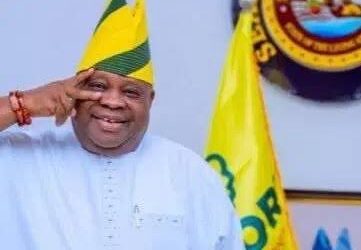

Adeleke Hails Osun People After INEC Confirms Re-Election
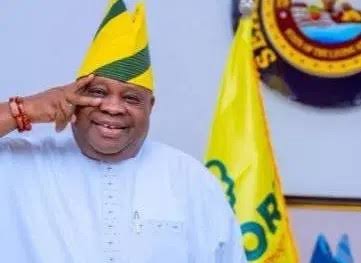
Governor Ademola Adeleke of Osun State has described his re-election as a triumph for democracy and a validation of his administration’s performance across key sectors, shortly after the Independent National Electoral Commission formally declared him winner of Saturday’s governorship election.
Speaking in a video address posted on Sunday morning, the governor thanked God and Osun residents for standing by him throughout the electoral contest. “I feel great. First of all, I thank God Almighty for what has happened today. It’s a victory for democracy in Nigeria. A victory for Osun people that stood by me and said, Imole, you have done a lot for us. You have given us dividend of democracy in terms of infrastructure, improving our education, agriculture, and so forth. So this is for Osun people saying, thank you, Mr Governor,” Adeleke said.
The governor’s remarks came moments after the State Returning Officer, Professor Joshua Olalekan Ogunwole, Vice-Chancellor of the Federal University, Oye-Ekiti, declared him the winner at the INEC state headquarters in Osogbo.
According to the final results announced by the electoral commission, Adeleke, who contested on the platform of the Accord Party, polled 511,067 votes to defeat his closest challenger, Bola Oyebamiji of the All Progressives Congress, who secured 444,815 votes. The African Democratic Congress candidate, Najeem Salaam, finished a distant third with 17,180 votes. The winning margin stood at 66,252 votes.
The total number of accredited voters was 1,010,604, with 985,079 valid votes cast and 20,721 votes rejected. The total number of ballots cast was 1,005,800.
A breakdown of the results showed that Adeleke won 19 of the state’s 30 local government areas, while Oyebamiji carried the remaining 11 councils. The governor recorded commanding victories in his political strongholds, including Ede North, where he polled 35,427 votes against Oyebamiji’s 10,283, and Ede South, where he secured 26,188 votes compared with 6,219 for the APC candidate.
His strongest individual performance came in Osogbo, the state capital, where he polled 36,480 votes against Oyebamiji’s 30,474. Other local government areas won by Adeleke included Ife East, Ife Central, Iwo, Oriade, Ifelodun, Odo-Otin, Egbedore, Ila, Ayedire, Orolu, Boluwaduro, Ifedayo, Ayedaade, Ejigbo, Ilesa West, Ife North and Ede South.
Oyebamiji, however, maintained dominance in several traditional APC strongholds, including Boripe, Obokun, Irepodun, Ilesa East, Atakumosa East, Atakumosa West, Ife South, Isokan, Olaoluwa and Irewole. His strongest performance came in Irewole, where he scored 29,972 votes against Adeleke’s 10,934. The closest contest of the election was recorded in Boluwaduro Local Government Area, where Adeleke edged the APC candidate by only 68 votes, polling 7,118 against 7,050.
The election, which featured 15 political parties, was conducted across 3,763 polling units spread over 332 registration areas. It attracted national attention following months of vigorous campaigns, political realignments and legal disputes among the major political parties.
Despite the largely peaceful conduct of the poll, the electoral process was marked by isolated incidents of violence and widespread allegations of vote-buying. The Centre for Democracy and Development, which monitored the election across the state, reported operational issues with the Bimodal Voter Accreditation System, including slow processing and difficulties with biometric verification. The centre also expressed concern over violent episodes reported in Ejigbo and Modakeke, as well as allegations of vote-buying in Ilesa East and Ola Oluwa local government areas.
The Socio-Economic Rights and Accountability Project called on INEC, the Economic and Financial Crimes Commission and the Independent Corrupt Practices and Other Related Offences Commission to investigate alleged vote-buying, financial inducement, violence and other electoral offences linked to the election.
The European Union Support to Democratic Governance in Nigeria Election Observation Hub, in its assessment, documented 323 cases of electoral offences, including 103 cases of vote trading, 85 cases of exposure of ballot papers, 31 cases of obstruction of voters, and 28 cases of inducement of polling and security officials.
Following the declaration, jubilation erupted in Osogbo as supporters of the governor took to the streets in celebration. Adeleke’s victory hands him a fresh four-year mandate and reinforces the Accord Party’s political dominance in Osun following months of intense campaigning.
The APC had yet to issue an official statement on the outcome at the time of this report. However, the party had earlier raised concerns over the conduct of the election in some areas, accusing Accord Party thugs of snatching a ballot box in Osogbo. The ADC had rejected the election during the collation process, describing it as a sham and calling on INEC to suspend further collation and cancel results from affected areas.
The declaration brings to a close one of Nigeria’s most closely watched off-cycle governorship elections. With the final figures now collated and officially announced, Adeleke is set to continue as Governor of Osun State for another four-year term.