
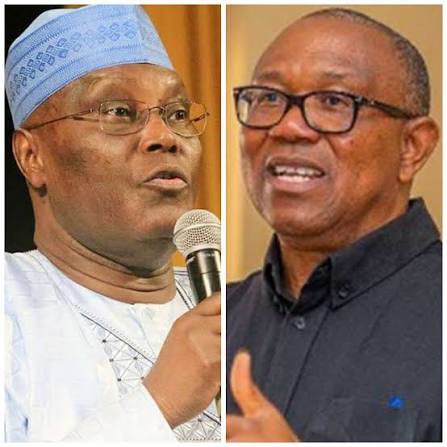
The renewed drive to unite Nigeria’s fractured opposition behind one candidate for the 2027 presidential election is running into resistance from the very leaders it seeks to bring together, even as its chief promoter insists the project remains alive.
Salihu Lukman, a former Director General of the Progressive Governors Forum and former National Vice Chairman (North West) of the All Progressives Congress, has said efforts are underway to unite former Vice President Atiku Abubakar, former Anambra State Governor Peter Obi and other opposition figures behind a single candidate against President Bola Tinubu and the APC. Speaking in an interview with Arise News, Lukman stressed that the choice could not be imposed. “The ultimate objective is that we want to have one candidate, but it cannot be by declaration. They have to sit down and agree on the criteria they are going to apply in determining that candidate,” he said.
Lukman, who convenes the pressure group known as the Group of 100 Nigerians, or G100, argued that the opposition’s real contest was with the ruling party rather than among its own leaders. “The primary opponent is the APC and President Bola Tinubu. So, when you now begin to pose the question as if the primary opponent is either former Vice President Atiku Abubakar or former Governor Peter Obi, you get it wrong,” he said. He framed the choice before opposition politicians in blunt terms, asking whether they merely wanted to be candidates or genuinely wanted to win and form the next government.
The intervention builds on a seven page open letter issued by the G100 on 2 August 2026, titled “The Doctrine of a Necessary Democratic Opposition.” Signed by about 100 people, including former lawmaker Nnenna Ukeje and Professor Anthony Kila, the letter warned that opposition leaders who pursued separate presidential ambitions could hand Tinubu another term. The group later announced a Summit of Opposition Parties, originally fixed for 18 August in Abuja. According to Lukman, the summit was postponed to 31 August to allow further consultations and to avoid clashing with the signing of a national peace accord.
The push is complicated by a realignment that has already produced two leading opposition candidates on separate platforms. Atiku is now the presidential candidate of the African Democratic Congress, ADC, while Obi emerged as the candidate of the Nigeria Democratic Congress, NDC, after resigning from the ADC on 2 May 2026 and being ratified by the NDC on 29 May 2026. Former Kano State Governor Rabiu Kwankwaso and former Rivers State Governor Rotimi Amaechi are also part of the wider conversation.
Both leading camps have publicly cooled on the single candidate idea. Atiku’s Senior Special Assistant on Public Communication, Phrank Shaibu, said the former Vice President had moved past the stage of opposition summits and was focused on presenting policy proposals to Nigerians, including his position on petroleum subsidy reform. Shaibu maintained that Atiku remained the best prepared opposition figure to lead the country.
The NDC welcomed the G100 initiative but disputed the premise that a lone candidate was a prerequisite for victory. The party’s spokesman argued that the 2015 election, in which a coalition unseated a sitting president without absorbing every opposition party, showed that a single ticket was not the only route to power. The party added that Obi remained its preferred choice for any consensus arrangement. On 20 August, a separate NDC figure went further, publicly urging Atiku to step down in Obi’s favour.
The Labour Party, on whose platform Obi contested in 2023, has taken a firmer line, rejecting the creation of any new coalition vehicle and inviting other opposition forces to unite under its existing structure instead. The disagreements echo the fate of the Ibadan Declaration of April 2026, an earlier unity attempt that generated goodwill but produced no binding agreement.
The case for consolidation rests largely on the numbers from the last election. According to figures declared by the Independent National Electoral Commission, Tinubu won the 2023 presidential poll with 8,794,726 votes, about 36.6 per cent of the total. Atiku, then on the Peoples Democratic Party ticket, polled 6,984,520, while Obi, on the Labour Party platform, secured 6,101,533. Kwankwaso, contesting for the New Nigeria Peoples Party, gathered 1,496,687.
Placed side by side, the combined tally of Atiku and Obi alone came to more than 13 million votes, well above Tinubu’s winning figure. Adding Kwankwaso’s share pushes the opposition total higher still. That distribution, in which the anti incumbent vote was split three ways, is the central evidence advanced by advocates of a single candidate. The election was also marked by historically low participation. Of about 93.5 million registered voters, only some 24.9 million valid votes were recorded, a turnout of roughly 27 per cent, the lowest since Nigeria returned to civil rule in 1999.
Whether a merged ticket would automatically inherit those combined votes is not settled. Voting patterns in 2023 were shaped by region, ethnicity and personality as much as by party, and there is no guarantee that supporters of one candidate would transfer their loyalty wholesale to another. Allies of the President have dismissed the coalition talks as an exercise in futility, arguing that the opposition remains too divided to mount a serious challenge.
For now, what is confirmed is that the G100 is pressing ahead with its rescheduled summit, that Atiku and Obi remain candidates on rival platforms, and that no consensus mechanism has been agreed. What remains uncertain is whether the leaders will attend, and whether the coalition can convert its stated goodwill into a binding arrangement before the campaign season begins in earnest.