
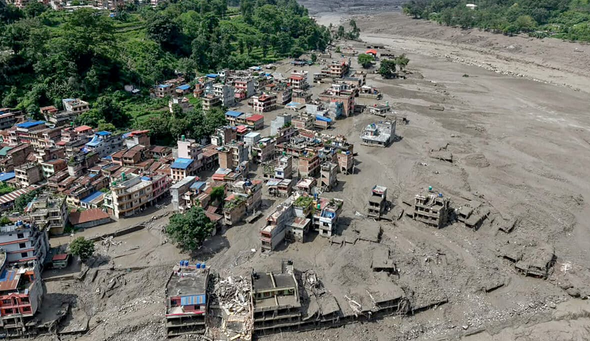
A massive glacial collapse along the Himalayan frontier between Nepal and China has claimed nearly eight hundred lives as rescue crews dig through metres of thick sludge. The disaster struck on Wednesday morning when an enormous mass of ice and rock sheared off high peaks near Langtang Lirung. The falling debris hit mountain river gorges at immense speed, triggering a violent flash flood that erased settlements across Nepal’s Rasuwa district and Tibet’s Gyirong County. By Sunday, 30 August 2026, recovered bodies numbered well over seven hundred across both territories, with roughly two thousand people still missing. Chinese authorities formally identified the nationalities of 261 foreign travellers lost on the Tibetan side of the border. Many of the missing were Hindu pilgrims returning from holy sites around Mount Kailash and Lake Mansarovar. High mountain valleys offer little warning when glaciers fail. Nature gives no second chances in narrow gorges.
The initial shockwave registered on regional seismographs as a magnitude 5.2 event before the muddy wave hit valley floors. Millions of tonnes of melted ice and pulverised stone tore down the Lhende Khola and Bhote Koshi rivers within minutes. Survivors near Timure Bazaar described a sudden change in air pressure followed by a deafening roar of liquid rock. Those who ran up mountain paths within fifteen seconds survived the crushing wave. Those who hesitated inside buildings were buried beneath walls of mud up to two metres deep. The torrent carried bodies and uprooted trees hundreds of kilometres downstream into low-lying plains. Mountain topographies amplify water velocity to terrifying destructive levels. Water mixed with rock behaves like fast-flowing liquid cement.
The timing of the collapse created maximum human carnage among international tour parties. Hundreds of tourists from India, the United States, Britain, Australia, and Canada stood in immigration lines at the Rasuwagadhi border post when the wave struck. The flood swept the entire customs complex away, leaving only twisted concrete pillars sticking out of the mud. Tour operators in Kathmandu and Lhasa lost radio contact with dozens of trekking convoys and bus groups. Consular officers in Nepal are setting up emergency desks to assist frantic families arriving on international flights. Many relatives still hope that their loved ones found shelter in high caves above the river line. Broken telecommunication towers and severed power cables make verification painfully slow. Foreign embassies now face days of grim identification work.
The logistical challenge facing rescue teams remains enormous across the entire border zone. Raging waters destroyed more than forty bridges and washed out over forty kilometres of paved mountain highways. The destruction severed overland trade between Kathmandu and Beijing, stranding hundreds of commercial cargo lorries. Military rescue helicopters from the Nepali Army must navigate thick monsoon cloud cover to reach isolated mountain hamlets. Relief teams at the Bidur army base fly round-the-clock sorties to evacuate injured survivors with broken limbs and head trauma. Meanwhile, unstable debris dams formed by the landslide continue to threaten secondary floods downstream. Rescuers had to halt operations temporarily on Friday when a blocked mountain lake began spilling over its banks. Unstable debris lakes turn rescue operations into perilous gambles.
The economic fallout from the flood will batter Nepal’s energy sector and tourism revenue for years. Swirling silt and heavy boulders smashed turbines at six major hydroelectric stations along the Trishuli River basin. The grid lost more than four hundred megawatts of clean generation capacity within hours, forcing industrial load shedding in central cities. Hydropower operators will spend months clearing grit from intake tunnels and replacing wrecked transmission lines. The loss of the Rasuwagadhi customs post also removes millions of dollars in weekly transit tariffs for the Nepali treasury. Local hotel owners in Langtang National Park face empty lodges just as the autumn climbing season opens. Mountain economies depend heavily on seasonal visitor footfall for cash flow. A single geological surge can erase years of infrastructure development.
The disaster exposes the acute vulnerability of high-altitude infrastructure in an era of rapid atmospheric warming. Regional research bodies note that Himalayan glaciers are retreating at rates never recorded in modern history. Rising summer temperatures weaken the rock joints that support heavy hanging glaciers above inhabited valleys. Despite these known physical risks, regional planners continue to build concrete highways and dams directly in historical run-off channels. Early warning networks and sensor systems along high-altitude lakes remain scarce and poorly maintained. Local authorities failed to issue radio warnings on Wednesday morning before the ice sheet collapsed. Planners cannot continue to treat predictable mountain hazards as random acts of fate. Modern engineering must respect the physical limits of fragile mountain slopes.
International aid agencies are rushing emergency food, water purification tablets, and temporary shelters to thousands of displaced villagers. The International Federation of the Red Cross estimates that at least 93,000 people need urgent humanitarian help across the affected districts. Mud-covered agricultural paddies and ruined irrigation canals will depress grain harvests in the upcoming autumn season. Chinese and Indian authorities have pledged emergency aid convoys and technical teams to help rebuild damaged transport links. However, the immediate task remains recovering the hundreds of bodies still trapped under deep silt before disease breaks out. As the grim recovery continues, the Himalayan frontier stands as a harsh reminder of ecological fragility. High mountains will always hold the ultimate veto over human enterprise.