
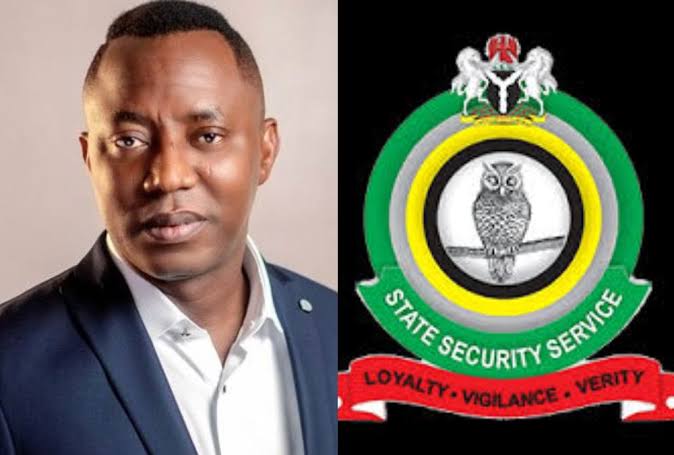
The Department of State Services’ reported decision to seek a pause in the cybercrime prosecution of African Action Congress presidential candidate Omoyele Sowore until after the 2027 election has reopened a legal and political question that goes beyond one defendant: what happens to a criminal case when the accused is also an opposition presidential candidate preparing for a national election?
The development is particularly significant because the case is not at its beginning. Nearly a year after the Federal High Court proceedings began, Sowore has pleaded not guilty, the prosecution has presented evidence, and the court in May ruled that the prosecution had established a prima facie case requiring him to enter a defence. The trial was still active as recently as July.
The latest development is also not yet a court ordered suspension. What has been reported is that the DSS has instructed its private counsel, Akinlolu Kehinde, SAN, to approach the court for an adjournment or suspension until after the 2027 presidential election. A source familiar with the legal team said the decision followed an August 20 meeting involving DSS Director General Tosin Ajayi, the senior lawyer and officials of the agency’s legal directorate.
That distinction is important because only the court can determine what happens to the pending proceedings.
The case originated from posts attributed to Sowore on August 25 and 26, 2025, concerning President Bola Tinubu.
The prosecution alleged that Sowore used his X and Facebook accounts to describe Tinubu as a “criminal” while commenting on the President’s remarks about corruption during an official trip to Brazil. The original case filed in September 2025 contained five counts, including two counts under the Cybercrimes Act and allegations under the Criminal Code. X and Meta were initially listed alongside Sowore.
The prosecution later amended the charge, reducing it from five counts to two and removing X and Meta as defendants. The amended charge, filed in December 2025 and marked FHC/ABJ/CR/484/2025, proceeded under the Cybercrimes (Prohibition, Prevention and Amendment) Act, 2024. Sowore pleaded not guilty.
The prosecution’s case centres on Section 24 of the amended Cybercrimes Act, which was changed by the 2024 amendment. The amended provision addresses knowingly sending false messages through computer systems where the purpose is, among other things, causing a breakdown of law and order or posing a threat to life.
The legal issue is therefore not simply whether Sowore insulted the President. The prosecution has alleged that the communications met the statutory requirements for a cybercrime offence. Sowore has denied the allegations and challenged the prosecution’s case.
One of the most important developments in the case came on May 8, 2026.
Justice Mohammed Umar of the Federal High Court in Abuja dismissed Sowore’s no case submission. The ruling meant that, at that stage, the court found the prosecution had produced sufficient evidence to require the defendant to enter a defence. It was not a conviction and did not establish that Sowore was guilty of the offences.
Earlier proceedings had seen the prosecution tender screenshots of Sowore’s social media posts, reactions to them and a video recording as evidence. The court admitted the prosecution’s materials after hearing objections from the defence.
By July, the case had reached the defence stage. The court rejected an application for a lengthy adjournment after the defence sought more time because Sowore’s lead lawyer was unavailable. The DSS opposed the request, pointing to previous adjournments. Justice Umar subsequently ordered the defence to continue.
The chronology makes the latest move notable. The prosecution that opposed further delays in July is now seeking to put the proceedings on hold because the defendant is a presidential candidate.
The election timetable gives the latest development its wider significance.
INEC currently lists January 16, 2027, for the presidential and National Assembly elections, with the governorship and State Houses of Assembly elections scheduled for February 6.
The DSS’s reported position is that pausing the case would enable Sowore to participate fully in the electioneering process without the proceedings becoming a hindrance.
That argument introduces an unusual procedural question. A pending criminal prosecution can have practical consequences for a political candidate, but postponing a case also affects the public interest in having criminal allegations determined within a reasonable period.
The Constitution protects freedom of expression under Section 39, while Section 36 guarantees fair hearing and provides for a trial within a reasonable time. These protections operate alongside laws that allow criminal conduct to be prosecuted. The existence of a constitutional right to expression does not, by itself, determine whether a particular communication falls within a criminal prohibition.
Consequently, the central legal question remains for the court to determine from the charge, evidence and applicable law.
The African Action Congress has rejected the reported suspension.
The party argues that the case should be completely discontinued rather than left pending until after the election. It has also demanded the return of Sowore’s international passport and electronic devices it says remain in government custody, as well as an end to what it describes as harassment of Sowore and his media assistant.
Those are political party positions and have not been established by the court as facts. The party has characterised the prosecution as political persecution, while the DSS has previously maintained that the case was intended to obtain judicial clarification on whether describing the President or another person as a criminal without a conviction could constitute an offence.
The distinction matters. Allegations by either side should not be treated as judicial findings.
The Sowore case is emerging at a time when social media has become central to political communication in Nigeria.
The case therefore raises an issue likely to extend beyond the 2027 election: where should the law draw the line between political criticism, offensive speech and criminal online conduct?
That question cannot be answered simply by whether a statement is harsh or politically controversial. The relevant legislation, evidence and constitutional protections must all be considered.
For now, the immediate issue is procedural. The DSS has reportedly decided that continuing the case during the election period may not be appropriate, but the Federal High Court has yet to determine whether to grant any such request.
Until then, the prosecution remains pending, Sowore remains presumed innocent unless proved guilty, and the May ruling establishing a prima facie case remains exactly that, a finding that he must answer the allegations, not a determination of guilt.
The case has consequently moved from being solely a dispute over a social media post into a broader test of how Nigeria’s criminal justice system handles politically sensitive digital speech when an accused person is simultaneously preparing to contest for the country’s highest elected office.