
By N’Mazi Obiomah O. IGBOKWE
Inspired by Alex La Guma’s A Walk in the Night
There are books that tell stories, and there are books that expose the conscience of a society. Alex La Guma’s A Walk in the Night belongs to the latter category. Through the experiences of Michael Adonis, a young man navigating the harsh realities of apartheid-era South Africa, La Guma presents a society in which poverty, racial discrimination, humiliation and institutional brutality combine to strip ordinary people of their dignity.
Although La Guma wrote against the background of apartheid, his narrative offers an uncomfortable mirror through which contemporary Nigeria can examine itself. The racial structures of apartheid may not define our political arrangement, but the machinery of exclusion, institutional injustice, economic exploitation and the abuse of public power have their own manifestations in Nigeria. Here, the colour of oppression is not necessarily racial; it is often economic, political and social.
Nigeria has perfected a peculiar system in which political office has increasingly become an avenue for privilege, while the ordinary citizen is left to negotiate survival in an unforgiving environment. The worker wakes up before dawn, struggles through congested roads, spends a substantial portion of his income on transportation, pays exorbitant rents, and returns home to confront the equally demanding responsibilities of feeding his family, educating his children and providing healthcare.
For this Nigerian worker, the end of the month is no longer a celebration of earned wages. It is a calculation of outstanding debts.
The Nigerian worker is perhaps one of the most abandoned participants in the country’s economic journey. He is expected to be productive in an environment where electricity is uncertain, transportation is expensive, healthcare is increasingly unaffordable, and inflation steadily erodes the purchasing power of his salary. Even when wages are reviewed, the increases are frequently overtaken by the rising cost of food, accommodation, fuel and other essentials.
The removal of the petrol subsidy brought a dramatic change to the economic circumstances of Nigerian households. Transportation costs rose, the prices of goods followed, and millions of workers found themselves earning salaries that could no longer sustain their previous standard of living. The introduction of a new national minimum wage was an important policy intervention, but the real test of such a policy is whether workers can actually afford the necessities of life.
What does it mean to earn a salary and remain perpetually poor? What does it mean to work for thirty days and discover that one’s income cannot adequately feed a family for two weeks?
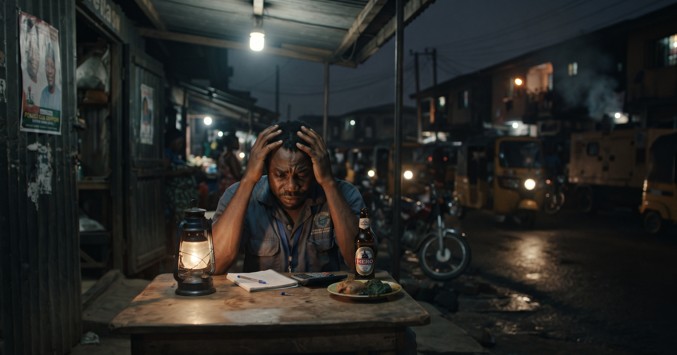
This is the Nigerian worker’s daily walk in the night.
La Guma’s Michael Adonis represents the individual whose dignity is progressively dismantled by a hostile social environment. In Nigeria, we encounter similar frustrations in the factory worker who spends hours commuting to work, the civil servant whose salary disappears into household expenses, the teacher who struggles to educate other people’s children while being unable to adequately provide for his own, and the healthcare worker who serves in a poorly equipped hospital while battling personal economic hardship.
There is also the graduate who has spent years acquiring qualifications only to wander from one unsuccessful job interview to another. For those fortunate enough to secure employment, the reality is often one of underpayment, delayed salaries, precarious working conditions and limited opportunities for advancement.
Yet, those entrusted with managing the country’s resources continue to operate within an entirely different economic universe.
The contrast is striking. While ordinary Nigerians are encouraged to make sacrifices, public expenditure and political privilege remain subjects of persistent public concern. Government officials move with security convoys, enjoy publicly funded privileges and operate within an environment largely insulated from the daily inconveniences confronting the people they govern.
The question is not whether public officeholders should enjoy legitimate privileges. It is whether those privileges can be justified in a country where millions struggle to afford necessities.
Corruption deepens this contradiction. Every diverted public resource represents a hospital that could have been better equipped, a road that could have been repaired, a school that could have received improved facilities, or a public institution that could have served citizens more effectively.
The tragedy of corruption is not merely the money stolen. It is the human suffering created by the opportunities denied to millions.
There is another disturbing connection between La Guma’s narrative and contemporary Nigeria: the relationship between institutional injustice and social violence. When young people repeatedly encounter unemployment, exclusion, humiliation and a justice system they perceive as inaccessible, frustration can become anger, and anger can sometimes find destructive expression.
This does not excuse criminality or violence. Rather, it reminds us that security cannot be achieved through policing alone. A society must also address the economic and institutional conditions that produce hopelessness.
The Nigerian police, judiciary, labour institutions and public service must command the confidence of citizens. Where citizens encounter intimidation, corruption or unequal treatment, trust in the state weakens.
Perhaps the greatest lesson of A Walk in the Night is that oppression does not always announce itself through grand political declarations. Sometimes, it is experienced in the humiliation of a worker who cannot feed his children, the despair of a young graduate without employment, or the helplessness of a family unable to afford medical treatment.
Nigeria must therefore confront a fundamental question: how long can a nation demand sacrifice from its working population without guaranteeing them dignity, security and a reasonable standard of living?
A country’s greatness cannot be measured by the number of billionaires it produces, the size of its political class or the grandeur of its government buildings. It must also be measured by the quality of life of its teachers, nurses, factory workers, civil servants, artisans, farmers and millions of citizens whose labour sustains the economy.
Alex La Guma wrote about people trapped in the darkness of a political system that denied them equality and dignity. Nigeria must be careful not to create its own version of that darkness through corruption, economic exclusion and the systematic indifference of those entrusted with public responsibility.
For the Nigerian worker, every morning is another attempt to escape yesterday’s hardship. Every salary is another battle against rising prices. Every journey to work is another reminder of how difficult ordinary life has become.
And as the night descends, millions return to homes where tomorrow’s problems are already waiting.
A WALK IN THE NIGHT is therefore not merely a story about apartheid-era South Africa. In the Nigerian context, it becomes a reflection on a nation where the working class continues to walk through darkness, waiting for the promise of independence, democracy and economic prosperity to finally translate into a life of dignity.