
Senate President Godswill Akpabio has offered one of his most candid political self-assessments yet, describing his years in the Peoples Democratic Party as time spent in the “wrong party” and insisting that his true political home has always been with the All Progressives Congress. The remark, delivered in Abuja on Friday, adds another layer to the deepening rivalry between Nigeria’s ruling party and a fractured opposition ahead of the 2027 general election.
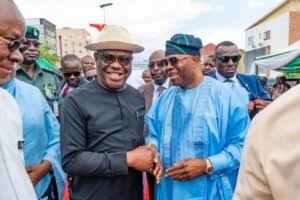
Akpabio spoke during the inauguration of access roads to the Renewed Hope Cities and Estates in the Karsana District of the Federal Capital Territory, one of several projects unveiled to mark President Bola Tinubu’s third year in office. His comments came in direct response to the Minister of the Federal Capital Territory, Nyesom Wike, who had introduced him as an “uncommon performer” from his days in the PDP.
Rather than accept the description on the opposition party’s terms, the Senate President moved quickly to reframe it. “Please ignore the comment of the honourable minister that I was an uncommon performer in PDP. He is not talking about PDP of today,” Akpabio said, drawing a line between the party he once served and its present condition.
He then explained his political journey through the lens of ideology. Recalling that he had already governed Akwa Ibom State for more than seven years before the APC was formed in 2014, Akpabio argued that his instincts had always been progressive. “A progressive-minded person like me should belong to a progressive family. And therefore, when APC came to be, I discovered that that was my group, that I was in the wrong party called PDP. So I took my exit early and joined the progressives,” he said.
The available public record offers a fuller timeline. Akpabio served as governor of Akwa Ibom State from 2007 to 2015 on the PDP platform, then won a Senate seat under the same party and was named Senate Minority Leader in July 2015. According to his official profiles and widely documented accounts, he did not formally defect to the APC until August 2018, when he resigned his position as Minority Leader. He lost his re-election bid in 2019, was appointed Minister of Niger Delta Affairs that same year, reclaimed his Senate seat in 2023, and was elected President of the 10th Senate in June 2023.
Akpabio’s Friday remarks were not limited to his own history. Turning to the state of the opposition, he acknowledged Wike as a dominant figure within what remains of the PDP. “Shortly after that, you now know what happened to PDP. They are fragmented. So, I don’t know how you are going to put it together, but I recognise you as a national leader, national leader of the winning faction of PDP because you are doing well,” he said.
That description reflects a party in visible disarray. The PDP has been split for months between a camp aligned with Wike, which backs the leadership of National Chairman Abdulrahman Mohammed and National Secretary Samuel Anyanwu recognised by the Independent National Electoral Commission, and a rival bloc associated with Oyo State Governor Seyi Makinde and operating through an Interim National Working Committee led by Tanimu Turaki. As recently as this week, both factions were reported to be locked in a fresh dispute over rival INEC nomination forms and conflicting candidate lists ahead of 2027.
The crisis traces back to the fallout from the 2023 election, when Wike’s G5 bloc worked against the PDP’s presidential candidate, former Vice President Atiku Abubakar, after Atiku declined to name Wike as his running mate. The internal wounds never healed. A convention held in Ibadan in November 2025 was nullified by the courts, and the Supreme Court compounded the uncertainty with rulings in April 2026 that unsettled both the PDP and the African Democratic Congress. Atiku has since defected to the ADC, where he submitted nomination forms in May 2026, while former Labour Party candidate Peter Obi has moved to the Nigerian Democratic Coalition.
Against that backdrop, Akpabio’s language has grown increasingly pointed. Two days before the Karsana event, at the inauguration of Akinwumi Ajibola Street in Abuja, the Senate President said he was surprised the PDP still existed and urged Wike to allow it “die.”
He also used Friday’s platform to trade friendly praise with the FCT minister. Recalling Wike’s visit to Akwa Ibom during his governorship, Akpabio said the then-visitor had toured an underground drainage project and vowed he would “perform miracles” if given the chance to govern Rivers State. The Senate President said Wike delivered on that promise as Rivers governor, joking that he had supported him “not to surpass what I did” and had urged him to “take it easy.” Delivering infrastructure, he added, had since become part of Wike’s “DNA.”
The exchange underscores a striking feature of the current political moment: a serving Senate President of the ruling party and a former opposition governor now serving as a federal minister, publicly celebrating each other while the party they both once belonged to struggles to hold itself together. With the 2027 contest drawing nearer, such realignments and the barbs that accompany them are likely to intensify, particularly as the APC seeks to consolidate its advantage and the opposition works to resolve who, if anyone, can speak for it.