
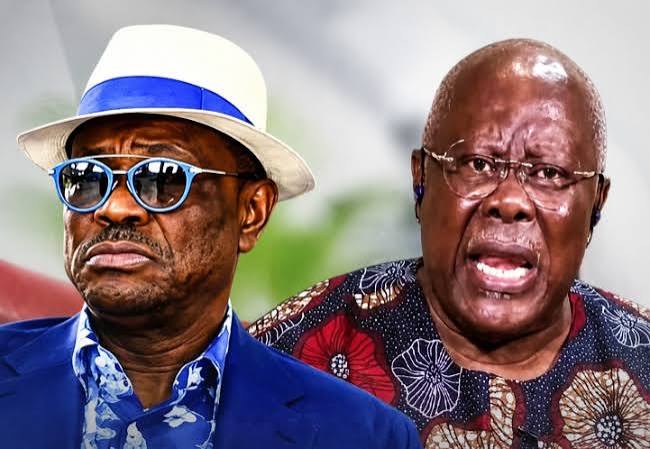
A political quarrel that began as a passing remark at a ministerial media chat has hardened into a formal dispute over property, reputation and legal exposure, with the Federal Capital Territory Minister’s media aide insisting that the source of funds used to acquire Chief Bode George’s Abuja residence, and not the identity of the seller, is the question the elder statesman must answer.
Lere Olayinka, Senior Special Assistant on Public Communications and Social Media to the FCT Minister, Nyesom Wike, said in a statement issued on Thursday that the minister was standing by his earlier claim on the matter. “Wike was clear. He said Bode George’s Abuja house was acquired with funds from Rivers State, and he stands by this. Bode George said he bought the property from a private owner through an agent. That is not the issue. Wike’s statement was never about who the property was purchased from or through. Rather, what he said was that the money with which the property was acquired came from Rivers State, and this is the question Bode George must answer,” Olayinka said.
The exchange traces to Wike’s monthly media briefing in Abuja on Tuesday, August 4, 2026, where the minister, responding to criticism of his role in the Peoples Democratic Party and to allegations that he had influenced judicial outcomes, turned on the Lagos based PDP leader. “This man from Lagos, Bode George, when they talk about corruption, ask him about the house he is living in Maitama, is it not Rivers State money?” Wike was quoted as saying at the briefing, adding that “people like you are the fathers of corruption.” Reports of the session also quoted him as challenging George to disprove the assertion.
Chief George responded on TVC News on Wednesday night, rejecting the claim outright and announcing his intention to seek redress in court. “How was my house in Abuja bought with Rivers fund? I’m going to take him to court. I’m sure he was high on something,” he was quoted as saying. He further stated: “He is talking absolute rubbish. I didn’t even build a house, I bought the house and it is still there. Am I from Rivers State that I will go there and collect funds? I’m not like him.” He also made pointed remarks about the minister’s family history, saying, “He is just the same age as my first child.”
The PDP’s national publicity secretary, Odianarewo, defended the elder statesman in a separate statement, invoking the outcome of his best known legal battle. “Wike hypocritically labels a man who was categorically exonerated by the Supreme Court, the highest court of the land, from all corrupt allegations during his tenure as Chairman of the Nigerian Ports Authority Board,” he said, adding, “Mr Minister, focus on your responsibilities in the FCT and keep Chief Bode George’s name out of your political attacks.”
The documentary trail on that case is unambiguous. Justice Olubunmi Oyewole of the Lagos State High Court, Ikeja, convicted George alongside five other former NPA board members on October 26, 2009, finding them guilty on 47 of 68 counts brought by the Economic and Financial Crimes Commission over contract inflation and contract splitting. They were sentenced to 30 months imprisonment under Sections 104, 203 and 517 of the Criminal Code Laws of Lagos State, 2003, and the Court of Appeal affirmed that judgment on January 21, 2011.
The Supreme Court reversed it on December 13, 2013. A panel led by Justice John Afolabi Fabiyi discharged and acquitted George and his co appellants, holding that the offence of contract splitting was unknown to Nigerian law at the material time, since the Public Procurement Act that criminalised it was enacted in 2007, well after his tenure at the NPA. Justice Fabiyi held that intention to defraud had not been proved, noting that the contracts had been appraised by NPA’s own experts, none of whom the prosecution called as witnesses. Justice Kumai Bayang Aka’ahs, in separate judgments, struck down the charges under Sections 104 and 203 as inconsistent with Section 36(12) of the Constitution.
The verdict remains contested in legal commentary. Human rights lawyer Femi Falana, in a published opinion piece at the end of December 2013, argued that the appellants had in fact been tried and convicted for abuse of office and disobedience to lawful orders rather than for contract splitting, and described the reasoning as carrying serious implications for Nigeria’s criminal jurisprudence. That disagreement, however, does not alter the operative legal position: the conviction was set aside and the acquittal stands.
Olayinka’s second line of attack was electoral, and it rests on a record that is measurable. “Since 1999, he has not won his polling unit for the PDP. Unlike Lagos State, we have had PDP governors in Ogun, Ondo, Ekiti, Oyo and Osun States. Methinks rather than doing ‘cho cho cho’ all the time, Bode George needs to tell Nigerians why PDP has remained at the sideline in the politics of Lagos State since 1999,” he said.
The state level data supports the broader point. The PDP has never won a governorship election in Lagos across the seven cycles from 1999 to 2023, with the seat held successively by the Alliance for Democracy, Action Congress, Action Congress of Nigeria and All Progressives Congress. Even in 2003, when the PDP swept the South West, Lagos was the sole holdout. By 2023 the party’s position in the state had collapsed to third place. Babajide Sanwo Olu of the APC polled 762,134 votes, roughly 65 per cent of ballots cast, ahead of the Labour Party’s Gbadebo Rhodes Vivour with 312,329 votes, or about 26.6 per cent, while the PDP’s Abdulazeez Adediran finished with 62,449 votes, some 5.3 per cent. Sanwo Olu carried 19 of the 20 local government areas, Rhodes Vivour took one, and the PDP won none. The Supreme Court later affirmed that outcome, dismissing appeals by both the LP and the PDP.
Olayinka also anchored his argument in Yoruba custom. “In Yorubaland, it is a strict cultural and traditional rule to respect elders. However, this respect is not automatic, it is conditional and the major condition is that an elder must avoid disrespecting himself,” he said, before listing occasions on which George publicly pledged to leave Nigeria or renounce his citizenship should Bola Tinubu become president.
“In 2015, ahead of the presidential election, Bode George promised to go on exile if APC emerged victorious in the presidential election,” Olayinka said. “In February 2020, he said he will disown Nigeria to take the citizenship of Togo or any other country if Tinubu is elected president. On May 7, 2021, on Arise News, Bode George echoed his stand that he will cease to be a Nigerian should Tinubu get the presidency. Also in 2021, while featuring on Arise News, Bode George said he will review and renounce his citizenship of Nigeria if Tinubu becomes president. In January 2022, after Tinubu had announced his bid to contest for president, Bode George said he will move away from Nigeria.”
He cited a March 19, 2022 press briefing in which George was quoted as saying, “If by whatever chance he (Tinubu) gets to the villa, I won’t be part of this country. And I am not joking. I can go to Ghana and be watching with binoculars from afar.” Olayinka concluded: “Now, it is more than three years of Tinubu as President and he (Bode George) has failed to honour his own words. Should such an elder still be regarded as honourable?” President Tinubu was sworn in on May 29, 2023, placing the administration at three years and two months as of this week.
The aide also invoked seniority in reverse. “For someone who was Military Governor of the old Ondo State in 1988 (38 years ago), some level of decorum and maturity is expected. But it is becoming an embarrassment the way a man like Chief Bode George, who should be acting like an elder statesman, is jumping from one television station to the other to malign people who are young enough to be his children,” he said.
Born on November 21, 1945 in Lagos, George is 80. A retired Navy Commodore and a graduate of the University of Lagos, he served as Military Governor of the old Ondo State from July 1988 to September 1990 under General Ibrahim Babangida, later serving as Principal Staff Officer to the then Chief of General Staff, General Oladipo Diya, between 1993 and 1997. He chaired the NPA board from 1999 to 2003, became PDP National Vice Chairman for the South West in 2001, and rose to Deputy National Chairman, South.
Wike, by contrast, governed Rivers State from 2015 to 2023 and has served as FCT Minister since August 2023 under an APC led federal government, despite retaining PDP membership. That crossing of party lines sits at the centre of the bitterness between the two men.
The property dispute is a surface expression of a deeper contest for control of the PDP. On July 17, 2026, Justice Salim Ibrahim of the Federal High Court in Abuja struck out a suit filed by the Adolphus Wabara led Board of Trustees seeking to compel the Independent National Electoral Commission to recognise the Kabiru Tanimu Turaki led Interim National Working Committee. The judge held the suit was an abuse of court process, awarded costs of N140 million against the plaintiffs, and ordered their counsel, Chief Chris Uche, SAN, to personally pay N10 million, relying on Section 83(6)(b) of the Electoral Act, 2026.
George was listed as the fourth plaintiff in that suit, alongside Wabara, former Niger State Governor Muazu Babangida Aliyu, Professor Jerry Gana, Maryam Ciroma, Zainab Maina and Esther Uduehi. He subsequently petitioned the National Judicial Council over the judgment, prompting Wike’s remark at the media chat that politicians only discover judicial corruption after losing cases. “Each time you lose a case, the judiciary is corrupt. Until when you win, that’s only when the judiciary is not corrupt,” the minister said. He also denied hosting the Chief Judge of the Federal High Court to influence proceedings, saying, “It is unfair to make such allegations without proof. If anyone has evidence that I met with the Chief Judge to influence court decisions, let them bring it forward.”
The PDP now has two rival structures. INEC recognises the Abdulrahman Mohammed led National Working Committee, while the Turaki led interim leadership, backed by the Wabara BoT, has appealed the July judgment and says it manually submitted former President Goodluck Jonathan as its presidential candidate for 2027 after being denied electronic access codes. Its publicity secretary, Ini Ememobong, has accused the commission of bias, saying the faction was “exhausting every constitutional, legal and democratic avenue to ensure that our Party is not hijacked or annexed to the ruling party.”
Neither side has placed documentary evidence before the public. No anti corruption agency has announced any inquiry into the Maitama property, and the minister’s allegation currently rests on assertion, as does the denial. Should George proceed with the defamation action he has threatened, the burden would fall on the defence to justify the statement, a threshold Nigerian courts have historically set high in libel actions involving public figures.
With candidate lists for the 2027 general elections already in contention and an appeal pending at the Court of Appeal, the dispute over one house in Maitama is unlikely to be settled on television. Whether it is settled in court, or simply absorbed into the larger struggle over who owns Nigeria’s oldest opposition party, remains the open question.