
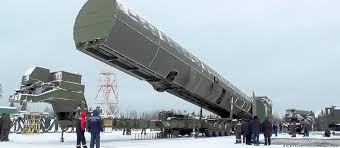
Nuclear-armed states are pulling warheads out of storage and mounting them on delivery systems, researchers warned on Monday, as weapons of mass destruction take on a sharper role in global politics at a moment when arms control frameworks are crumbling.
The Stockholm International Peace Research Institute said the world’s nuclear powers held an estimated 12,187 warheads in January 2026, with about 9,745 of them in military stockpiles for potential use. The figure marked a marginal decline from the previous year, continuing a post-Cold War pattern in which old warheads have generally been dismantled faster than new ones are deployed.
“The more worrying news is that even though we have lower numbers of nuclear weapons, the level of nuclear dangers and nuclear risks are rising,” SIPRI director Karim Haggag told AFP.
The institute cautioned that the long decline is set to reverse. It said the trend was likely to be undone in the coming years “as the pace of dismantlement is slowing, while the deployment of new nuclear weapons is accelerating.” Haggag pointed to a breakdown in strategic arms control agreements and intensifying competition among great powers as central drivers of the heightened risk.
A further concern, he said, was the movement of arsenals from storage into active service. “States that have nuclear weapons are taking them out of storage and deploying them on nuclear-capable delivery systems. And so we see more deployed nuclear weapons,” he said. SIPRI estimated that 4,012 warheads were deployed with missiles and aircraft, with between 2,100 and 2,200 kept on high operational alert.
The United States and Russia together account for around 83 percent of the global stockpile, holding more than 5,000 warheads each. Both are modernising their arsenals, but each has stumbled. SIPRI said the American programme had run into “planning and funding challenges that are likely to further delay and significantly increase the cost.” Russia’s effort has been dented by failed intercontinental ballistic missile tests, economic sanctions, and competing demands tied to the war in Ukraine.
China is expanding faster than any other state. “Intensifying geopolitical competition means a very strong incentive on the part of China to increase its reliance on nuclear weapons,” Haggag said. SIPRI estimates Beijing now holds around 620 warheads and could field as many ICBMs as the US or Russia by 2030, though even at 1,000 warheads that would still amount to only about a quarter of either rival’s stockpile.
In Europe, France and the United Kingdom held steady at 290 and 225 warheads respectively, though London’s stockpile is expected to grow following a 2021 review that raised its ceiling, and President Emmanuel Macron ordered an increase in the French arsenal in March. SIPRI believes India has slightly expanded its holdings to 190, while Pakistan remained at 170 but continued accumulating fissile material, suggesting future growth. North Korea is pursuing what SIPRI described as “exponential” expansion, estimated at about 60 warheads, while Israel, which does not acknowledge its arsenal, is believed to be modernising an estimated 90 warheads.