
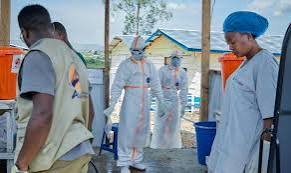
The doctors and nurses standing between Ebola and the population of eastern Democratic Republic of Congo are now fighting on two fronts, one against a virus with no cure and another against a government that has not paid them since the outbreak began. At the Ebola treatment centre in Rwampara, one of the worst hit areas at the heart of the epidemic in Ituri province, health workers burned tyres in protest earlier this week and briefly blocked access to the facility, a striking image of a response effort straining under the weight of its own neglect.
The warning from the front line is blunt. Doctors at the centre said that unless authorities meet a 48 hour ultimatum for the payment of salaries and bonuses, they will down tools completely, with no minimum service left in place. “We’ve been treating Ebola patients without pay since May 15. We continue to do so because that is our oath but we are working in very difficult conditions,” Dr Pascal Bahoya told AFP. In a formal notice to the government, workers both inside and outside the hospitals complained of unpaid benefits, poor salaries, inadequate supplies, and what they described as the excessive use of labour drawn from other provinces at the expense of local hands in Ituri.
The stakes could hardly be higher. The Bundibugyo strain driving this epidemic has no approved vaccine and no licensed treatment, a critical difference from earlier Congolese outbreaks caused by the Zaire strain, for which effective vaccines such as Ervebo already exist. As of the reporting through 11 July, DR Congo had recorded 1,926 confirmed cases and 702 deaths, with 318 recoveries, according to figures released by the country’s Ministry of Communication and Media. Ituri remains the epicentre, accounting for the overwhelming majority of infections and fatalities.
At least 112 healthcare workers have been infected and 35 have died, according to the national public health institute, a toll that underlines why morale on the ground has collapsed. Health Minister Samuel Roger Kamba, during a visit to Ituri, acknowledged what he called delays in payment and gave assurances that the organisational problem behind the crisis would be resolved. For workers who have gone two months without wages, those assurances have so far changed little.
Beyond the payment dispute lies a harder truth about the numbers themselves. The World Health Organization has cautioned that the true scale of the outbreak is far larger than the confirmed tally suggests. WHO modelling indicates the epidemic is at least two to four times bigger than recorded, with estimates in July pointing to somewhere between 4,000 and 8,000 actual cases. The virus, believed to have been circulating quietly since around January or February before its official declaration on May 15, has already earned a grim distinction. The United States Centres for Disease Control has described it as the fastest growing Ebola epidemic on record in Africa, crossing 1,000 confirmed cases within 40 days of the response being activated, a threshold that took 235 days during the 2018 North Kivu outbreak.
The geography of the crisis is widening. What began in the mining town of Mongbwalu in Ituri, where early case fatality reached above 50 per cent, has now spread across five provinces, reaching North Kivu, South Kivu, Haut-Uele and Tshopo, whose capital Kisangani ranks among Congo’s largest cities and serves as a major river transport hub. Across the border, Uganda has reported 20 confirmed cases including two deaths, though no new infection has surfaced there since 21 June. Imported cases have also reached Germany and France, both traced to travellers from the affected zone.
Context makes the situation more combustible. Mineral rich eastern Congo has endured three decades of conflict, and the current response is unfolding against fierce fighting between government forces and the AFC/M23 rebel coalition, alongside allied militias, across the same provinces battling the virus. Many people displaced by the violence live in camps that the United Nations says lack clean water and sanitation, ideal conditions for a disease that spreads through contact with bodily fluids. WHO representatives have said they cannot yet claim the outbreak is stabilising.
There are, however, slivers of progress. A clinical trial testing two candidate therapies for the Bundibugyo strain began earlier this month, with more than 1,200 treatment doses available and room to add further options as evidence emerges. WHO has also granted emergency use authorisation for the first molecular diagnostic test for the virus. The international community has raised 1.5 billion dollars to support a healthcare system that remains chronically underfunded. Whether that money reaches the doctors burning tyres in Rwampara, before their patience runs out, may prove decisive for the weeks ahead.