
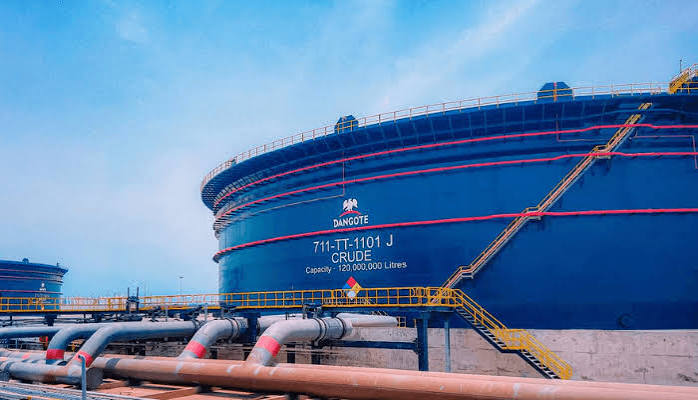
Petroleum marketers returned to naira transactions at the Dangote Petroleum Refinery on Wednesday after a week of dollar denominated pricing that unsettled Nigeria’s downstream market, but the relief arrived with a higher bill, as the refinery lifted its ex depot petrol price by N140 per litre.
A notice issued by the refinery’s commercial department, titled PMS Price Change Communication, informed customers that the gantry price of Premium Motor Spirit had moved from N1,075 per litre to N1,215 per litre, an increase of 13.02 per cent. The coastal loading price rose from N1,441,575 per metric tonne to N1,602,495 per metric tonne, a jump of about N160,920 or 11.16 per cent. The notice stated that the revised rates took immediate effect.
“Please be advised that all unloaded gantry volumes will be subject to repricing at the new price, which is effective 22nd July 2026,” the communication read. “Kindly proceed with placing your order. Should you require any further clarification, please do not hesitate to contact us.”
The industry pricing platform Petroleumprice.ng independently confirmed the reversal. “Yes, the refinery has returned to pricing its product in naira,” the platform’s Chief Executive Officer, Jeremiah Olatide, said, adding that customers had been notified of the resumption of gantry operations under the revised naira template and that dollar sales had been suspended for now.
The dispute traces to a notice dated July 13, 2026, in which the 650,000 barrels per day facility informed marketers that all previously issued naira Proforma Invoices and deal recaps for gantry and coastal transactions were invalid. Under the replacement template, petrol was benchmarked at 0.779 dollars per litre, Automotive Gas Oil at 1.087 dollars per litre and Jet A1 aviation fuel at 0.942 dollars per litre, while coastal petrol deliveries were fixed at 1,044.62 dollars per metric tonne. Liquefied Petroleum Gas transactions were excluded from the framework.
On July 15, the refinery suspended both gantry and coastal loading. Independent marketers stopped lifting product from the plant, saying they could not source the foreign exchange required to transact. Marketers were pushed toward private depots, where supply tightened and prices moved sharply. The average ex depot price of petrol at private depots climbed from about N1,075 per litre to roughly N1,275 per litre during the suspension, an increase of about N200 or 18.6 per cent. Some depots raised petrol loading prices by as much as N113 per litre within 48 hours of the dollar announcement, while diesel rose by up to N150 per litre in certain locations.
Operators warned at the time that the arrangement would inflate demand for scarce foreign exchange. Based on national petrol consumption of about 50 million litres daily, marketers were projected to require roughly 40 million dollars a day, translating to more than 14 billion dollars annually, to sustain purchases at the refinery gate under a dollar regime.
The refinery attributed its temporary migration to dollar pricing to insufficient crude allocation under the Federal Government’s naira for crude initiative, which took effect on October 1, 2024 and was designed to let domestic refiners buy Nigerian crude in local currency, easing pressure on foreign exchange.
A top management official of the Dangote Group, quoted by The PUNCH on condition of anonymity, said crude supply under the arrangement had been limited to about four million barrels monthly despite improved national production. “We are getting just four million barrels monthly,” the official said, adding that the plant would account for every barrel received against naira payment by supplying equivalent refined products in naira through the NNPC.
The Nigerian National Petroleum Company Limited rejected any suggestion that it had withheld cargoes. Its spokesman, Andy Odeh, said the company had fully discharged its obligations. “Under the naira denominated crude supply arrangement, NNPC Limited has allocated 100 per cent of all available naira crude cargoes to DPRP in 2026. There has been no withholding on our part,” he said. Odeh noted that NNPC holds a 7.25 per cent equity stake in the refinery and added that actual off take in any period is shaped by crude availability, nomination timelines and the refinery’s own operational scheduling. “NNPC Limited has met its 2026 supply obligations to the refinery. Our engagement with DPRP management remains constructive, and where any gaps exist, we are resolving them together,” he said.
The figures at the heart of the disagreement remain contested. Speaking on ARISE News earlier in the year, the refinery’s Chief Executive Officer, David Bird, said the plant required between 13 and 15 cargoes monthly to meet Nigeria’s domestic fuel requirement but was then receiving only five. “That’s an underperformance against that pre agreed volume contract,” he said. NNPC subsequently moved to raise allocation to seven cargoes in May 2026. Reports this week indicated the refinery had put the shortfall in sharper terms, placing deliveries at a fraction of contracted volumes, a claim NNPC disputes.
Dangote’s ex depot petrol price has moved repeatedly through 2026. The refinery opened the year at N699 per litre before raising it to N799 on January 27. A N25 cut on February 10 took the price to N774, alongside the closure of its PMS lifting bonus window. Data tracked by Petroleumprice.ng showed nine revisions between January and March, six of them increases, lifting the gantry price to about N1,200 by March 26 after peaking near N1,285.
A downward run followed. From May 30, the refinery trimmed prices by a cumulative N200 per litre, closing with a N50 reduction on July 2 that brought the rate to N1,075, and a further N1 adjustment days later. The company said at the time that its pricing reflected actual production economics and inventory costs rather than daily crude fluctuations, and that it had absorbed a substantial share of higher crude costs to limit inflationary pressure.
That cushion has now thinned. Brent crude, the benchmark against which Nigerian grades are priced, surged about 4 per cent to above 94 dollars per barrel on Wednesday, its highest since June 8, as an eleventh consecutive night of United States strikes on Iranian military facilities deepened fears over shipping through the Strait of Hormuz. Threats to Red Sea traffic and attacks on the Caspian Pipeline Consortium terminal added further risk premium. Brent settled above 100 dollars in March for the first time since 2022 and traded around 71 dollars as recently as February, illustrating the swing importers and refiners have absorbed this year.
Regulatory data points to a market already shifting. The Nigerian Midstream and Downstream Petroleum Regulatory Authority reported in its June 2026 fact sheet that average daily petrol imports rose from 5.9 million litres in May to 18.1 million litres in June, an increase of 206.8 per cent. Domestic receipts fell from 41.5 million litres per day to 32.5 million litres, a decline of 21.7 per cent, while total receipts still rose to 50.6 million litres daily from 47.4 million. The country had entered 2026 with domestic supply at 40.1 million litres per day, about 61.8 per cent of total supply.
For households, the National Bureau of Statistics recorded an average retail petrol price of N1,596.25 per litre in May 2026, up 55.31 per cent from N1,027.76 in May 2025, with diesel rising 86.4 per cent year on year to N3,277.47. Headline inflation eased marginally to 15.91 per cent in June from 15.93 per cent in May, with transport contributing 1.70 percentage points. The Central Bank of Nigeria retained the benchmark interest rate at 26.50 per cent at its 306th Monetary Policy Committee meeting on July 21, while the naira closed at N1,375.31 to the dollar in the official window and traded between N1,410 and N1,425 in the parallel market. External reserves stood at 52.02 billion dollars as of July 20.
Marketers pressed hard for intervention during the standoff. The National President of the Petroleum Products Retail Outlets Owners Association of Nigeria, Billy Gillis Harry, described dollar pricing as a step toward dollarisation of the economy. “The Federal Government’s intervention is key. The Federal Government should step in over Dangote Refinery’s resumption of refined products sales in dollars. Most of our members are unable to load products in dollars,” he said. The Independent Petroleum Marketers Association of Nigeria appealed to President Bola Tinubu to sustain the crude for naira arrangement, with its National Publicity Secretary, Chinedu Ukadike, warning that pump prices would be exposed to exchange rate volatility. He also questioned import licensing, saying some importers were pricing petrol at about N1,350 per litre.
A senior regulatory official quoted by The PUNCH said the refinery had not breached the Petroleum Industry Act by pricing in dollars. “The naira for crude deal is not to Dangote’s advantage right now because the company is sourcing crude in dollars. He has absorbed a lot. But maybe he has got to a breaking point. So he has to do stuff to recover costs. And that’s why he wants to share that burden with off takers,” the official said.
The refinery’s revised naira price of N1,215 per litre still sits below the N1,274 to N1,275 quoted by several depot owners handling imported cargoes, preserving a competitive gap that has anchored the market since the plant became the reference price setter. Retail outlets in Abuja raised pump prices twice within a week, reaching between N1,275 and N1,280 by July 20, while stations in Lagos dispensed above N1,300 on Wednesday. Some MRS and NNPC Limited outlets shut after running out of product during the disruption.
Discussions between the Dangote Group and the Federal Government over the naira for crude arrangement remain ongoing. Market operators expect the return to naira transactions to restore normal product evacuation and ease the distribution bottlenecks of the past week, though they caution that the higher ex depot price could feed into further depot and pump increases unless competition intensifies or international crude prices moderate. With Brent volatility tied to an unresolved Gulf conflict and crude allocation still disputed, the durability of Wednesday’s reversal will depend less on the notice itself than on how many barrels reach Ibeju Lekki in naira over the coming weeks.