
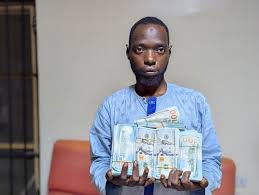
The Economic and Financial Crimes Commission says it has opened an investigation into a man arrested in Kano with counterfeit United States banknotes valued at 212,200 dollars, in a case that has revived attention on the flow of fake foreign currency through northern Nigeria.
According to a statement issued by the commission through its Kano Zonal Directorate, the suspect, Usaini Ibrahim, was arrested on 3 September 2026 by operatives of the National Drug Law Enforcement Agency along Maiduguri Road in Kano after the suspected fake dollars were found in his possession. The commission said the notes and the suspect were later handed over to the EFCC for further investigation and possible prosecution.
The commission said the formal handover took place at its Kano office, where the acting zonal director, Assistant Commander of the EFCC Friday S. Ebelo, received Ibrahim and the exhibits. It added that Ibrahim remained in its custody and would be arraigned once investigations were concluded.
A representative of the NDLEA, Deputy Superintendent of Narcotics Yahaya Labaran, was quoted by the commission as commending the continued cooperation between the two agencies in protecting the country’s financial system. Ebelo, in turn, said the EFCC was committed to tackling the circulation of counterfeit currency and other fraudulent schemes.
Ebelo also used the handover to warn the public against so called money doubling schemes, which he said are often carried out using counterfeit notes. “Such fake currencies coming into the economy do not paint a good picture of us,” he said, according to the commission, urging Nigerians to be wary of anyone offering to double money or promising quick financial gains.
At the official exchange rate of about 1,329 naira to the dollar recorded by the Central Bank of Nigeria in mid September, the seized sum of 212,200 dollars would carry a face value of roughly 282 million naira if the notes were genuine. That figure is an indication of scale only, since counterfeit notes have no lawful value and the amount recovered is what the commission says it is still verifying.
The case falls under a body of law that treats currency counterfeiting as one of the more serious economic offences in the country. The Counterfeit Currency (Special Provisions) Act, re-enacted in 1984 and retained in the 2004 Laws of the Federation, prescribes life imprisonment on conviction for making, importing, dealing in or being in possession of counterfeit notes, and its provisions apply whether the currency is legal tender in Nigeria or in another country. The Central Bank of Nigeria Act of 2007 also criminalises the falsification of the naira. A charge, where one is eventually filed, would still have to be proved in court, and no allegation against Ibrahim has yet been tested in evidence.
The arrest points to a wider pattern in cross border commerce in the North West. Kano, as the commercial hub of the region and a major node for trade with the Niger Republic and beyond, has featured in several counterfeit currency cases in recent years, often involving foreign notes rather than naira. Law enforcement agencies have repeatedly linked the circulation of fake dollars to fraudulent investment and money doubling scams, in which victims are shown apparently large sums to persuade them to part with genuine funds.
The involvement of the NDLEA, an agency whose primary mandate is narcotics rather than financial crime, reflects a practice that has become common among Nigerian enforcement bodies, where seizures made during one operation are transferred to the agency with the relevant statutory mandate. In this instance the drug agency made the arrest but referred the currency aspect to the EFCC, which is charged with investigating and prosecuting economic and financial crimes.
For now the commission has confirmed only the arrest, the handover and the opening of an investigation. It has not stated where the notes were produced, how they entered the country, whether Ibrahim acted alone or the denominations involved, and those questions are what the inquiry is expected to address. The EFCC spokesman, Dele Oyewale, confirmed that the suspect remained in custody and would be taken to court after the investigation.
What happens next will depend on the strength of the evidence the commission is able to assemble. Counterfeit currency cases can be difficult to prosecute where investigators cannot establish the source of the notes or a suspect’s knowledge that they were fake, and the burden in several respects rests on the accused under the governing law. Any charge, trial and verdict would follow the normal judicial process, and the outcome cannot be assumed at this stage.