
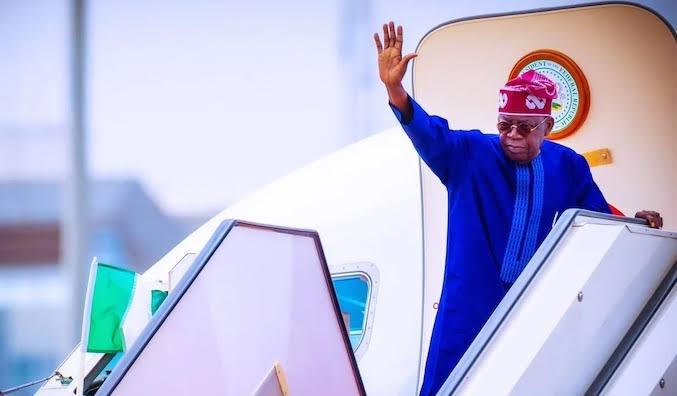
President Bola Tinubu’s three week European leave has arrived at a politically significant moment, with the 2027 presidential campaign already underway and the constitutional question of how presidential powers are handled during a vacation once again relevant to public scrutiny.
Tinubu left Abuja on Sunday, August 30, for a three week annual leave, with London, United Kingdom, announced as his first destination. Presidential spokesperson Bayo Onanuga said the President would return after the working vacation to join campaign activities ahead of the January 2027 election. The Presidency did not disclose his full European itinerary.
The timing is important. Nigeria is now less than five months away from the presidential and National Assembly elections scheduled for January 16, 2027, according to the Independent National Electoral Commission. The statutory campaign period for those elections began on August 19, meaning Tinubu’s absence from Abuja coincides with the formal opening of the presidential campaign season.
The development therefore goes beyond the question of whether a president is entitled to take annual leave. The more consequential issue is how the constitutional machinery of government operates when the President is outside the country.
Section 145 of Nigeria’s Constitution provides a specific procedure for presidential absence.
It states that whenever the President proceeds on vacation or is otherwise unable to discharge the functions of his office, he is to transmit a written declaration to the President of the Senate and the Speaker of the House of Representatives. Until the President transmits a written declaration that he has resumed his functions, the Vice President performs those functions as Acting President.
The same provision says that if the President fails to transmit the declaration within 21 days, the National Assembly may, by a simple majority in each chamber, mandate the Vice President to perform the functions of the office as Acting President.
The constitutional provision was strengthened by the 2010 First Alteration to the Constitution, following the institutional problems exposed by the prolonged illness of former President Umaru Musa Yar’Adua. The amendment established the 21 day mechanism and clarified the process for temporary presidential absence.
For Tinubu’s current trip, however, the publicly announced information does not establish whether a written declaration under Section 145 has been transmitted to the presiding officers of the National Assembly. The Presidency’s announcement confirmed the vacation and said Tinubu would remain engaged with government affairs, receiving briefings from ministers and security chiefs, but it did not publicly state that Vice President Kashim Shettima had assumed the functions of Acting President.
That distinction is important because being able to receive briefings while abroad is not necessarily the same constitutional question as formally transferring presidential functions.
There is no suggestion from the available information that the President has ceased to be President or that government has stopped functioning. Rather, the constitutional issue concerns who formally performs presidential functions during a temporary absence.
Tinubu’s leave comes only 18 days after Vice President Kashim Shettima returned from his own two week vacation.
Shettima commenced his leave on August 6, with his office saying the period would provide time for study, reflection and intellectual renewal. He returned on August 18, two days ahead of the previously announced date.
Tinubu’s departure therefore creates an unusual sequence in which both the President and Vice President have taken leave within the same month, although the two absences do not overlap.
More importantly, the political environment has changed significantly since the President’s previous annual leave.
Nigeria’s electoral calendar is now active. INEC’s revised timetable places the presidential and National Assembly elections on January 16, 2027, followed by governorship and State House of Assembly elections on February 6. Campaigns for the first set of elections began on August 19 and are required to end 24 hours before polling day.
This means Tinubu’s three week absence falls entirely within the opening phase of the formal presidential campaign period.
The Presidency has itself linked his return to the campaign, saying he is expected back after the working vacation to join the campaign for the 2027 election.
That makes the leave both an administrative and political development, although the two roles should not be confused. The President remains responsible for governing the country, while his political activities as a candidate or party figure operate within Nigeria’s electoral laws.
The explanation from Presidential Adviser on Media and Public Communications, Sunday Dare, was that the President needed to “refuel” after months of handling matters of state.
Dare said Tinubu had spent six or seven months dealing with security, economic and other government decisions and would remain engaged with government affairs while abroad.
He said the President would receive briefings from ministers, service chiefs and other officials responsible for important government decisions.
Such arrangements are not unusual for a modern presidency, particularly when communication technology allows senior officials to receive briefings and communicate with government from outside the country.
But the constitutional framework remains relevant because presidential functions involve more than receiving information. Executive powers, appointments, approvals and other constitutional responsibilities must continue to operate through legally recognised channels.
That is why Section 145 exists.
Tinubu also took an annual working vacation in September 2025.
The State House announced that he would spend 10 working days in France and the United Kingdom. He eventually cut that trip short and returned to Abuja on September 16, 2025, after departing on September 4. During the trip, he also held a private meeting with French President Emmanuel Macron in Paris.
The 2026 leave is considerably longer at three weeks.
The difference is also significant because Nigeria is now much closer to another general election. The 2027 electoral timetable was revised by INEC in February, with the presidential and National Assembly elections moved to January 16, 2027, from the earlier February date.
The electoral process has since progressed through party primaries, candidate nominations and the commencement of public campaigns.
The immediate issue is not whether Tinubu is permitted to take leave. The Constitution clearly contemplates presidential vacations.
The important institutional question is whether the constitutional arrangements governing temporary presidential absence have been properly activated and communicated where required.
The 21 day provision is particularly relevant. Tinubu’s announced vacation is for three weeks, which is exactly 21 days, although the Constitution’s wording is based on the President transmitting the required declaration and does not establish that every vacation of a particular duration automatically produces the same constitutional consequences.
Nigeria faces continuing economic, security and administrative challenges, while political activity is intensifying ahead of the 2027 elections. The Presidency says Tinubu will continue receiving briefings while abroad, but transparency over the constitutional arrangements can help distinguish routine presidential travel from a formal transfer of presidential functions.
The bigger lesson is institutional rather than personal. Nigeria’s Constitution already provides a mechanism for handling presidential absence. The value of that mechanism lies in ensuring that government continuity does not depend on assumptions about where the President is, how accessible he is or how frequently he receives briefings.
Tinubu’s current European leave will end in September, well before the January 2027 presidential election. By then, the campaign will have moved deeper into the electoral cycle.
For now, the President’s absence from Abuja is temporary. The constitutional responsibilities of the Nigerian presidency, however, do not go on holiday.