
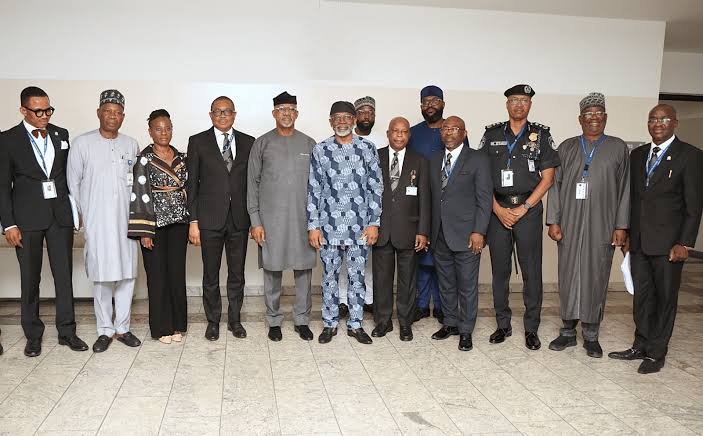
The Presidential Working Group on the National Policing Bill has scheduled presentation of its Executive Bill package to President Bola Tinubu on 3 September 2026, setting a clear timeline for the next phase of Nigeria’s proposed dual policing structure.
Chief of Staff to the President and Chairman of the Working Group, Femi Gbajabiamila, disclosed the timeline on Monday after the group’s inaugural meeting at the Presidential Villa in Abuja. He said the approved work programme is a seven week, milestone driven exercise running from 27 July to 14 September 2026. The resulting package is due for presentation to the President on 3 September. Subject to approval, a national consultation on the completed draft will follow, after which the text and supporting materials will be revised and prepared for formal transmission to the National Assembly.
Gbajabiamila described the timetable as demanding but not a shortcut. He called for memoranda, position papers and practical proposals from stakeholders, noting that the national consultation would allow Nigerians to engage with the actual clauses, safeguards, funding proposals and transition arrangements.
President Tinubu inaugurated the Working Group in early July 2026 to prepare the legal framework for implementing state police. The move followed passage of the Constitution Alteration (State Police) Bill, 2026, by both chambers of the National Assembly. The Senate approved the constitutional proposal on 24 June 2026, while the House of Representatives passed its version on 23 July 2026. The amendment seeks a dual structure comprising a Federal Police Service and 36 State Police Services. It still requires approval by at least 24 of the 36 state Houses of Assembly before it can take effect.
Gbajabiamila emphasised that the constitutional amendment creates the broad architecture for dual policing but does not by itself provide the complete operating framework. Critical issues such as recruitment, training, funding, command structures, jurisdiction, pensions, firearms regulation, data management, complaints mechanisms and inter agency cooperation remain to be addressed in the National Policing Bill and consequential legislation. The Working Group’s mandate includes producing an implementation ready draft, reviewing the Police Act 2020, the Police Service Commission framework and other affected laws. The final package is expected to include schedules, an explanatory memorandum, a legal audit, a consequential amendments matrix, clause by clause analysis, a state readiness framework, a fiscal and implementation note, an implementation work plan, a validation report, a risk register and a controlled digital archive.
The debate over state police has spanned decades. Nigeria operated both federal and regional police forces at independence in 1960. The military intervention of 1966 abolished the regional forces, citing political abuse, and subsequent constitutions, including the 1999 Constitution, entrenched a single federal Nigeria Police Force under Section 214. Successive administrations and national conferences revisited the idea amid rising insecurity, but progress remained limited until the current legislative push.
Security challenges continue to shape the urgency of the reform. Independent monitors and official data have recorded thousands of fatalities and widespread displacement in recent years linked to banditry, terrorism, kidnapping and communal violence. The Nigeria Police Force currently fields approximately 370,000 personnel for a population exceeding 200 million, well below recommended ratios in many jurisdictions. The force has faced longstanding constraints of underfunding, limited stations and equipment shortages.
Members of the Working Group include the Attorney General of the Federation, the President of the Nigerian Bar Association, the Chairman of the Nigeria Governors’ Forum, the National Security Adviser, the Inspector General of Police and the Chairman of the NGF Committee on State Police. A Policy Advisory Committee led by Justice Mohamed Abulai Liman has also been approved to review proposals, test assumptions and validate the legislative package.
Gbajabiamila stressed that no state police service currently operates in Nigeria. The Nigeria Police Force remains the sole constitutionally recognised policing institution until the amendment process is completed and implementing laws are enacted. The Working Group’s task is to ensure that once the constitutional threshold is crossed, the operational, fiscal and accountability frameworks are ready.
The presentation of the Executive Bill package on 3 September will mark a significant step in translating the constitutional amendment into practical legislation. The subsequent national consultation and revision process will determine the final text transmitted to the National Assembly. The outcome will shape how Nigeria balances decentralised response capacity with federal oversight, human rights safeguards and sustainable funding in the years ahead.