
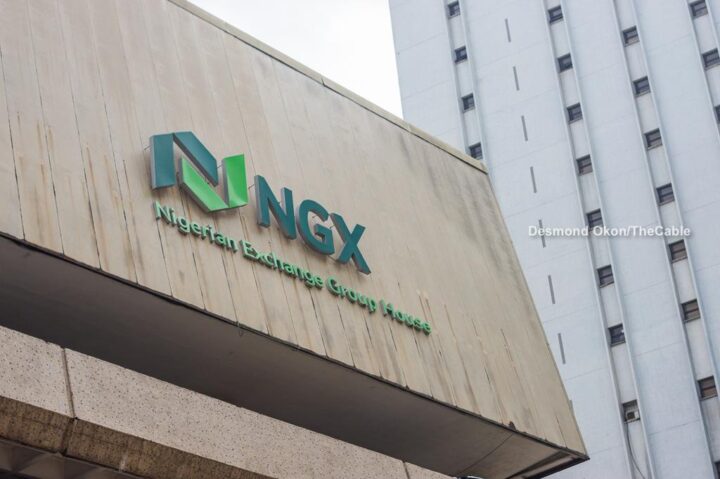
The Nigerian Exchange opened the trading week in positive territory on Monday, 14 September 2026, adding about N160bn in value on the same day Aliko Dangote sounded the gong to launch the largest public share offer in the country’s history, an event that has dominated market attention for weeks and continues to shape how investors are positioning their money.
The benchmark All-Share Index rose 246.50 points, or 0.10 per cent, to close at 243,299.24, while market capitalisation climbed to N157.747tn. According to figures published by the Nigerian Exchange, gains in Nestle Nigeria and 19 other stocks drove the advance, led at the top by Royal Exchange and Nigerian Exchange Group, which each rose the daily maximum of 10 per cent to close at 99 kobo and N162.80 respectively. RT Briscoe added 9.88 per cent to N8.90, Secure Electronic Technology gained 7.69 per cent to 70 kobo, and Prestige Assurance rose 7.19 per cent to N1.49.
The headline gain, however, sat on a narrow and cautious base. Market breadth closed negative, with 28 stocks losing value against 19 that gained, meaning more shares fell than rose even as the index advanced. That pattern, where a handful of medium and large capitalised stocks lift the index while the broader list weakens, has recurred through September. John Holt led the losers, shedding the full 10 per cent to N8.10, followed by DAAR Communications and Ellah Lakes, each down 9.80 per cent to N1.38 and N9.20. Regency Alliance Insurance fell 8.97 per cent to 71 kobo and Learn Africa slid 8.67 per cent to N7.90.
Activity was thin. Total volume fell 22.4 per cent to 428.97 million shares worth N20.52bn in 54,592 deals, a drop that points to investors holding back cash rather than committing fresh funds to equities. Sterling Financial Holdings led by volume with 78.05 million shares valued at N588.87m, followed by Mutual Benefits Assurance with 42.11 million shares and Chams Holding with 28.50 million shares. Access Holdings and Fidelity Bank recorded the heaviest value at N613.81m and N497.82m respectively.
The subdued turnover is directly linked to the day’s main event. The Dangote Petroleum Refinery and Petrochemicals offer opened on the same Monday, comprising 4.1 billion new ordinary shares priced at N525 each, with the company targeting about N2.15tn, equivalent to roughly 1.6 billion dollars. The minimum subscription was set at 10 shares, or N5,250, and the offer runs until 13 October. Dangote, who described it as a “People’s IPO” at the opening ceremony in Lagos, said the pricing was designed to let ordinary Nigerians and other African investors take a stake, and the offer carries a greenshoe option of up to 30 per cent to absorb excess demand. Data from the Exchange indicated subscriptions of about N1.5tn within the first hour of trading, though those figures are early and remain subject to final allotment.
That competing demand for cash helps explain the market’s recent behaviour. Equities had run hard for most of the year before the offer approached. Capitalisation crossed N100tn on 5 January, the index broke 200,000 points for the first time in March and moved past 250,000 in May before easing. Much of that momentum followed the completion of the banking recapitalisation exercise on 31 March, which the Securities and Exchange Commission has characterised as a structural reset of the sector, alongside renewed interest from foreign portfolio investors as the naira stabilised.
The approach of the Dangote offer then triggered a visible rotation. On Monday, 8 September, the index reached 247,699.78 and capitalisation reclaimed the N160tn mark, close to the record 248,529.75 points and N160.42tn set on 10 August. The gains did not hold. Over the following two sessions the market shed a combined N3.55tn as investors trimmed positions, with Nestle, BUA Cement, Cadbury and others among the most sold, before a modest recovery set in. By the close of the previous week on Friday, 11 September, the index stood at 243,052.74 and capitalisation at N157.587tn, down 1.60 and 1.24 per cent respectively over the week. Stockbrokers have attributed the selling to profit taking after months of record gains and to investors raising cash ahead of the offer.
Monday’s small rise therefore represented a steadying rather than a return to the earlier rally. The N160bn added over the session should be read against the far larger swings of the preceding fortnight, and against a year-to-date return that the Exchange still put at about 56 per cent despite the recent pullback.
For ordinary Nigerians, the wider significance lies in what the offer is testing. The refinery has said the transaction is aimed at broadening ownership, with the low entry point intended to draw first-time retail investors into the capital market. Whether that ambition translates into sustained participation, rather than a short surge of interest around a single high-profile listing, will only become clear after the offer closes and the shares begin trading. The listing of a refinery for public subscription is itself a first in the Exchange’s history.
The market opened the week higher on selective demand for a small group of large stocks, and the Dangote offer opened to strong early interest. What remains uncertain is how the offer will affect secondary market liquidity over the coming weeks, and whether the negative breadth seen on Monday signals continued caution or a temporary diversion of funds. The behaviour of the index through the offer window, and the eventual allotment figures, will provide the first firm evidence either way.