
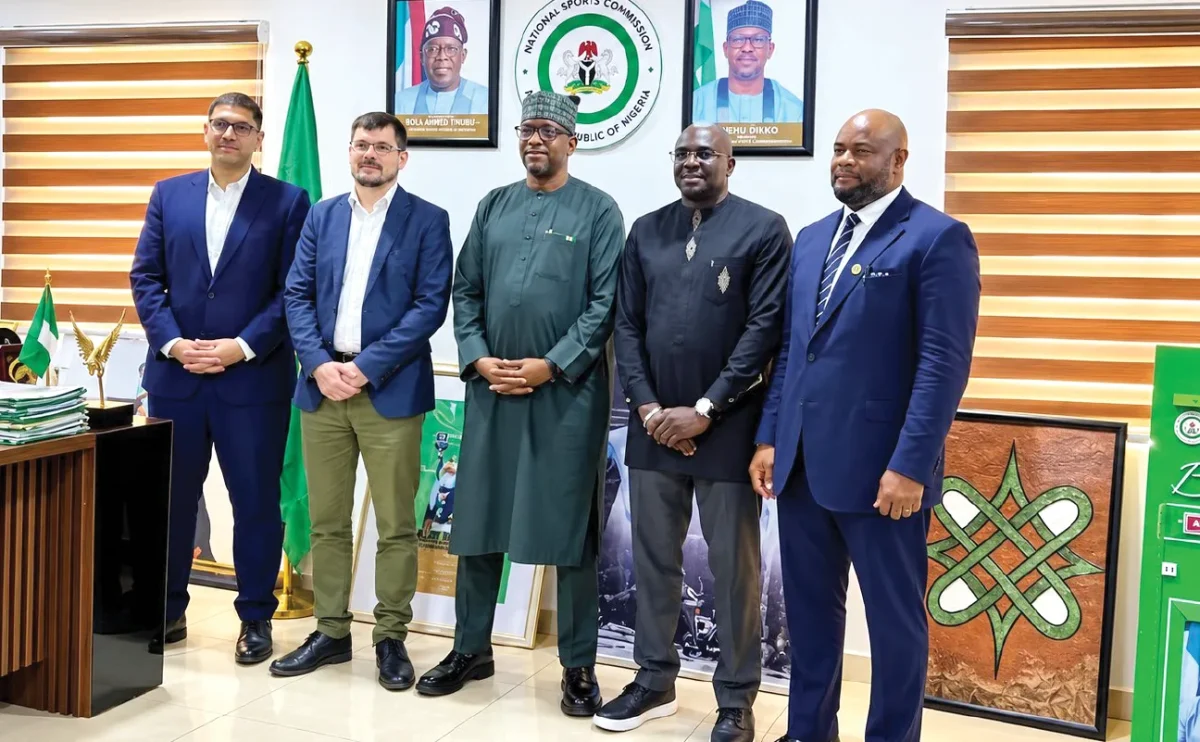
A joint FIFA and CAF delegation opened a two day assessment of the leadership crisis inside the Nigeria Football Federation in Abuja on Monday, holding its first talks with the National Sports Commission chairman, Shehu Dikko, and members of the federation’s federating units as world football’s governing bodies weigh how to return the NFF to a lawful and functioning congress.
The mission, scheduled for 14 and 15 September at the Abuja Continental Hotel, follows the mass resignation of NFF president Ibrahim Musa Gusau, general secretary Mohammed Sanusi and members of the executive committee on 27 August 2026. Gusau stepped down 34 days before the scheduled end of his four year tenure, which was due to run until September 2026, and the departures created a leadership vacuum at the top of the federation. In the aftermath, the National Sports Commission endorsed Emmanuel Ikpeme to oversee the NFF secretariat as acting general secretary, with Ademola Olajire named acting deputy general secretary.
The visiting delegation comprised the FIFA Member Association Governance Services team lead, Ahmed Harraz, FIFA head of member association governance, Rolf Tanner, the head of the FIFA regional office for West Africa, El Hadj Wack Diop, and CAF legal manager Nnaemeka Olu. Dikko first met the officials to brief them on the government’s proposed reform agenda for the sports sector before other members of the NFF congress joined the engagement.
According to a FIFA letter dated 7 September and signed by its chief member associations officer, Elkhan Mammadov, addressed to Ikpeme and copied to CAF, the two bodies are assessing the legal, governance, administrative and electoral implications arising from the current circumstances within the NFF. The letter said the review would consider the relevant facts, the NFF regulatory framework and the positions presented by the various stakeholders. It also directed that no further steps be taken in the electoral process until the assessment is complete, effectively placing the elective congress, earlier fixed for 27 September in Lafia, Nasarawa State, on hold to preserve the status quo. FIFA stated that the outcome remained open and that no assumptions should be made about any action it and CAF may or may not take.
The intervention has its roots in months of pressure over results on the pitch. The Super Eagles failed to reach the 2026 World Cup after losing the African playoff final to DR Congo in Rabat on 16 November 2025, drawing 1-1 after extra time before going down 4-3 on penalties, with Calvin Bassey, Moses Simon and Semi Ajayi among those who missed from the spot. It was the second successive World Cup Nigeria had missed, following the away goals defeat to Ghana ahead of Qatar 2022, and the first time the three time African champions had failed to qualify for back to back tournaments since their debut appearance in 1994. An NFF petition to FIFA alleging that DR Congo fielded ineligible players was effectively closed in March 2026 when FIFA listed the Leopards among the six teams for the intercontinental playoff.
The women’s game deepened the sense of decline. The Super Falcons were eliminated from the Women’s African Cup of Nations at the quarter final stage by Cameroon in the 2026 edition, a result that denied them an automatic route to the Women’s World Cup through a semi final place. Taken together, the exits of both the senior men’s and women’s teams from their respective global competitions became the backdrop against which calls for wholesale change at the federation grew louder.
There had also been friction over player welfare. Ahead of the decisive playoff window, the Super Eagles squad and technical staff boycotted a training session in Rabat in protest at unpaid bonuses and allowances, a dispute that drew public criticism of the federation and the government. Demands for the board to go had been building since late 2025, when a former NFF vice president, Gabriel Chukwuma, publicly urged President Bola Tinubu to compel the entire board to resign after the World Cup miss.
The governance question now before FIFA and CAF is not new. The composition of the NFF congress, the federation’s statutes and its electoral process have long been sources of dispute among stakeholders, and disagreements have tended to surface most sharply around election periods. Gusau himself emerged in September 2022 through a contested vote, polling 21 of 41 ballots in the first round before winning a run off, and the recurring controversy around who is eligible to vote and stand has fed persistent agitation for a more inclusive federation. That history is central to what the delegation has been asked to examine, alongside the circumstances of the mass resignation, the drive to restructure governance and a new timetable for the elective congress.
The role of government is likely to be one of the more delicate strands of the review. On the day Gusau resigned, President Tinubu directed a comprehensive reform of Nigerian football covering governance, administration, stakeholder representation, development pathways, domestic competitions and accountability, and instructed the National Sports Commission to work with the federation and other stakeholders while engaging FIFA and CAF. FIFA statutes require member associations to manage their affairs independently and without undue third party interference, and the extent of state involvement in the current process is among the matters the assessment is understood to be weighing. A meeting at FIFA House in Zurich on 1 September, involving FIFA, CAF, the interim NFF administration and representatives of the Federal Government led by Dikko, preceded the decision to send the mission to Abuja.
What happens next remains genuinely open. FIFA said last week that it had received various communications from Nigerian stakeholders but had reached no decision, and that the assessment would precede any recommendations to its decision making bodies. Once the review is complete, the two organisations will determine whether any proposals should go before the competent committees within FIFA and CAF in line with their respective statutes. Options available in comparable cases have ranged from endorsing a fresh electoral timetable to installing a normalisation committee, though FIFA has been careful not to signal any preferred path. For now, the suspended congress, the shape of the promised reforms and the identity of the federation’s next substantive leadership all await the outcome of the two day engagement and the wider process that follows it.