
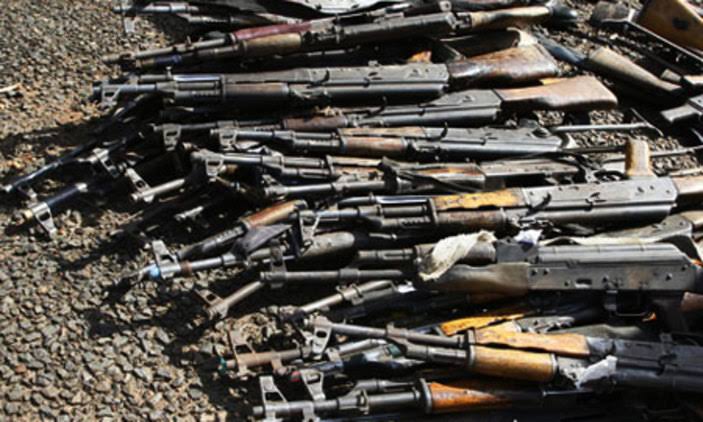
Nigeria’s spending on imported arms and ammunition rose sharply in the first half of 2026, climbing to N55.06bn from N26.95bn in the same period of 2025, a 104.31 per cent increase that arrives less than five months before the country returns to the polls.
The figures are drawn from the National Bureau of Statistics foreign trade report for the second quarter of 2026. The Independent National Electoral Commission has fixed 16 January 2027 for the presidential and National Assembly elections and 6 February 2027 for the governorship and state assembly polls, dates the commission adopted after the Electoral Act 2026 replaced the 2022 law and shortened the statutory timelines. Campaigning for the presidential race opened on 19 August 2026.
The increase is real but should be read against a volatile record rather than a steady climb. NBS data show arms imports of about N29.24bn in 2020, rising to N72.50bn in 2021, falling to N28.24bn in 2022, then climbing to N127.16bn in 2023. The single largest year was 2024, when the bill reached roughly N520bn, driven overwhelmingly by a fourth quarter figure of about N483.85bn. Spending then fell steeply through 2025 before recovering in 2026. Cumulatively, the country spent in the region of N827bn on arms and ammunition, including parts, between 2020 and September 2025. The pattern suggests procurement tied to contract cycles, budget releases and shifting security priorities rather than a smooth annual trend, which is why a doubling from one half year to the next, while notable, does not by itself establish a sustained upward trajectory.
There is also a point of caution on the quarterly breakdown. The headline N55.06bn covers legally declared imports captured in official trade statistics. Some reviews of the same NBS data have placed first quarter 2026 imports at about N32.5bn and the second quarter at about N22.5bn. The half year total is consistent across accounts, but the split between the two quarters is not uniformly reported, and readers should treat the quarterly figures as approximate pending the full disaggregated tables.
What gives the numbers weight now is the electoral calendar and a parallel record of illicit weapons that never appear in trade statistics at all. The Nigeria Customs Service intercepted about 603 firearms entering the country between January and August 2026, according to figures published by Punch. Those seizures came in two operations at the Tin Can Island Port in Lagos. The first, flagged by the Customs risk management system after the MV Velika arrived on 8 July, yielded 399 Jojeff pump action rifles and 535 assorted components once dismantled parts were reassembled. The second, aboard the MV Algeciras Express from Turkey and examined on 18 August, produced 204 rifles concealed among declared household goods including furniture, refrigerators, solar panels and detergent. In both cases the weapons were handed to the National Centre for the Control of Small Arms and Light Weapons, which operates under the Office of the National Security Adviser, and suspects were arrested and charged. The Comptroller General of Customs, Adewale Adeniyi, described the interceptions as significant given the country’s security situation.
The distinction matters. Declared imports are largely state procurement for the armed forces and police, moving through official channels. The Customs seizures represent attempts to move weapons into the country outside the law, and it is this second category that security analysts most directly link to electoral risk. The two records are separate, and neither is a complete measure of how many weapons are in circulation.
Evidence from the most recent off cycle poll offers a partial picture of what is at stake. The CLEEN Foundation, which has monitored security conduct at Nigerian elections for over two decades, deployed observers to the Osun State governorship election of 15 August 2026. Its assessment of conduct at the close of polls, a stage it describes as decisive for the credibility of results, found sustained security presence in the large majority of polling units monitored, with the number of officers rated adequate in all reports. Officers were nonetheless reported to have left their posts for some period in 6 per cent of cases, and 2 per cent of polling stations were left entirely unattended. Officers were visibly armed in 37 per cent of locations, a figure the Foundation described as broadly consistent with standard deployment. Force was reported used in 2 per cent of locations, and threat incidents in 12 per cent of monitored units. On the chain of custody, officials provided cover for moving ballot boxes in 86 per cent of monitored units, while the remaining 14 per cent could not be independently confirmed.
The Foundation flagged the final hours of voting and the immediate aftermath, when queues clear and ballot boxes are prepared for movement, as the window in which opportunistic interference is most likely. Its review of election day media reports identified six locations with alleged violence, including gunfire near a traditional ruler’s palace and thug related disruption at a polling unit, but it stressed that most of these accounts came from unconfirmed party allegations rather than verified incidents. It recommended that security agencies sustain rather than relax vigilance through collation and result transmission, and urged the Federal Government to fast track legislation creating a dedicated judicial process for electoral offenders, describing the current enforcement gap as a climate of impunity.
The broader concern about weapons and elections is not new. Customs recovered 844 rifles and 112,500 rounds of live ammunition at Onne Port, Rivers State, in June 2024, and successive administrations have established the National Centre and given it statutory backing to coordinate the control of small arms. Nigeria has no constitutional right to bear arms, so civilian possession outside licensed hunting and sport is illegal.
What is confirmed is that declared arms spending doubled year on year in the first half of 2026, that Customs stopped hundreds of illegally imported firearms in the same window, and that both developments coincide with the run up to the 2027 vote. What remains unestablished is any direct link between these specific consignments and any plan to disrupt the elections. The full year trade figures, further Customs interceptions and the conduct of security agencies during the January and February polls will be the clearest measures of whether the current concern is borne out.