
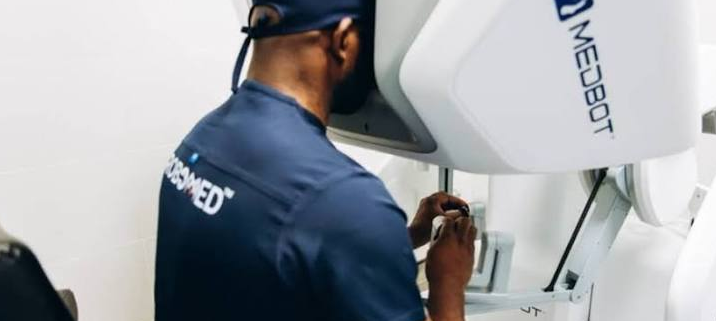
A surgeon sitting behind a Toumai console at Redeemer’s Health Village in Ogun State removed a cancerous kidney from a patient lying inside an operating theatre in Abuja on Saturday. The three-hour procedure spanned roughly 500 kilometres across Nigerian airspace. Professor Obi Ekwenna-Davis, a transplantation specialist and co-founder of RoboMed Global, directed the right radical nephrectomy while local teams at Nisa Premier Hospital monitored the patient. The clinical gamble worked. The patient achieved rapid stability and was discharged within twenty-four hours.
Distance often dictates survival in Nigerian medicine. Wealthy citizens buy flights to London or Delhi for complex cancer excisions, while poorer households manage with overburdened domestic clinics. This remote operation shows an alternative path forward through cooperation among domestic institutions. It proves that scarce medical expertise can travel across domestic fibre cables rather than international departure lounges.
Technical friction remains the real barrier to scaling such technology across a nation plagued by erratic power and unstable bandwidth. The surgical team managed brief pauses during the operation to maintain device calibration and data integrity. Dr Adedamola Dada, who runs Redeemer’s Health Village, insists robust backup channels handled the data loads safely. Yet hospital wards in provincial towns still struggle to keep diesel generators running. The machine requires pristine infrastructure.
The project aims to construct a permanent pipeline of domestic operating talent rather than run one-off demonstrations. The partners plan to run a robotic training academy to train 150 local surgeons over the next two years. Nisa Premier Hospital founder Dr Ibrahim Wada noted that his facility has housed robotic gear since late 2025. Hardware alone changes very little without a large cadre of trained biomedical engineers and scrub nurses.
Federal health officials have endorsed the training agenda, though state treasuries have yet to commit substantial capital subsidies to it. Private clinics will likely shoulder the initial bill for importing these Chinese-manufactured systems and paying the licensing fees. If Abuja wishes to stop the annual drain of foreign exchange spent on overseas medical trips, it must offer tariff relief on specialised clinical robotics. The tool is ready. The state must now fund the network.