
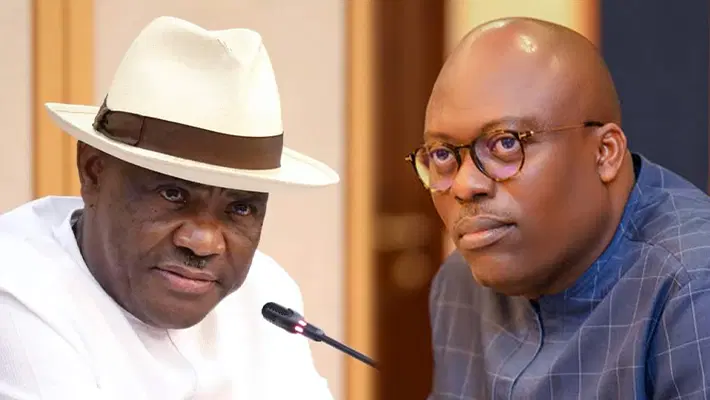
Rivers State Governor Siminalayi Fubara did nothing wrong by reconciling with the political camp that produced him, the Minister of the Federal Capital Territory, Nyesom Wike, has declared, insisting that “there is no sin in politics” as the two men close the book on a rift that plunged the oil rich state into more than a year of turmoil.
Wike, who governed Rivers between 2015 and 2023 before handing power to Fubara, spoke on Tuesday in Abuja after inspecting road projects across the territory. His comments followed the governor’s public endorsement last week of the Wike led Rainbow Coalition, President Bola Tinubu’s second term bid, and Kingsley Chinda as the coalition’s preferred governorship candidate for 2027.
“I don’t know what you mean by sin. In politics, there is no sin,” Wike said, responding to suggestions that he had forgiven the governor. “If someone realises they made a mistake and decides to correct it, there is nothing wrong with that. What matters is recognising that you were on the wrong path and making the right decision.”
The minister said he had anticipated the reconciliation. “I said during my last media chat that he had no other choice but to return to the same political family that produced him,” he stated, adding that the coalition’s doors remained open and that Fubara’s declaration would help “deliver the votes President Tinubu needs for his re-election.”
Fubara, speaking last week at the groundbreaking of the Riven Medical Industries project in Obio/Akpor Local Government Area, told supporters the period of conflict was over. “The time of war is over. It is now time for peace, and this peace is taking us to another level,” he said, urging his backers to support every candidate on the coalition platform.
The rapprochement caps a crisis that repeatedly tested Nigeria’s federal structure. The feud erupted months after Fubara took office in May 2023 on the platform of the Peoples Democratic Party, pitting him against Wike loyalists who dominated the State House of Assembly. It escalated into a prolonged standoff over control of the legislature, the local government system and the state’s finances.
On March 18, 2025, Tinubu declared a state of emergency in Rivers, suspending Fubara, his deputy, Ngozi Odu, and the 32 member Assembly, and installing a retired naval chief, Vice Admiral Ibok-Ete Ibas, as sole administrator. The presidency cited a “total paralysis of governance,” security concerns over pipeline vandalism and a legislative deadlock. The action drew more than 40 court challenges over its constitutionality and became one of the most contested executive decisions of Tinubu’s tenure.
The emergency ran its full six months. During that window, the administrator conducted local government elections on August 30, 2025, in which the All Progressives Congress won 20 of the 23 councils, tightening the party’s grip ahead of 2027. Tinubu lifted the emergency and reinstated the elected officials on September 18, 2025.
Fubara’s realignment has since gathered pace. He formally joined the APC in December 2025, then withdrew from the party’s governorship primary in May 2026 after the national secretariat declined to clear him, paving the way for Chinda to secure the ticket. His endorsement of the coalition now places the governor and his predecessor on the same side for the first time since 2023.
On his core assignment, Wike said work on the ISEX Road Corridor and the Apo-Karshi Road was progressing, with the ISEX contractor targeting a December commissioning if funding is released. “Good leadership is continuing projects that are vital to the development of the city,” he said, defending the administration’s decision to complete inherited works.