
A proposed law to place every foreign grant entering Nigeria under a single new regulator has hardened into one of the sharpest civil liberties disputes of the current National Assembly, with rights advocates now threatening to go to court if the bill becomes law.
The Socio-Economic Rights and Accountability Project, SERAP, and the Nigerian Guild of Editors, NGE, have warned that they will pursue legal action should lawmakers pass the Foreign Aids (Regulation, Transparency and Disclosure) Bill, 2026, listed as SB.1034. According to a joint open letter dated 29 August and signed by SERAP Deputy Director Kolawole Oluwadare and NGE General Secretary Onuoha Ukeh, the two bodies asked the Senate President and the Speaker of the House of Representatives to reject and withdraw the bill, describing it as “unnecessary, unlawful, unconstitutional.”
The bill, sponsored by Senator Ibrahim Dankwambo of Gombe North, was introduced in May and passed second reading in the Senate in July. It seeks to create a Foreign Aid Regulatory Commission with authority to register organisations that receive foreign assistance, inspect their records, audit their activities, suspend approvals and revoke registrations. Under its provisions, foreign aid must be declared within 30 days of receipt, implementing partners and funded projects must be published in a national register, and defaulting organisations face a minimum fine of N20 million alongside possible loss of their operating licences. Individuals could face fines and imprisonment.
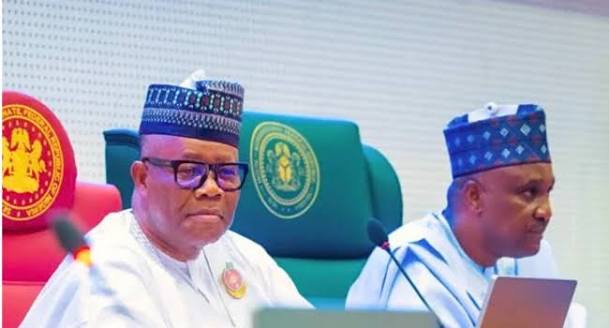
Presenting the bill, Senator Dankwambo argued that foreign aid, once received and spent in Nigeria, amounts to public money and should therefore fall under constitutional oversight. He anchored the proposal on Sections 80 to 83 of the 1999 Constitution and the Fiscal Responsibility Act of 2007, saying the country’s aid system remained fragmented and poorly coordinated. The Senate President, Godswill Akpabio, backed the measure, saying foreign funds needed monitoring to prevent misuse and to protect the nation’s image.
SERAP and NGE reject that reasoning. They argue that Nigeria already has a dense web of regulators capable of tracking money and enforcing disclosure, naming the Corporate Affairs Commission, the Economic and Financial Crimes Commission, the Special Control Unit against Money Laundering, the Nigerian Financial Intelligence Unit and the Federal Inland Revenue Service. Nothing in the bill, they said, shows that these institutions cannot do their work or that a fresh regulator with overlapping powers is required. They also faulted the bill for using vague terms such as “foreign aid,” “national priorities” and “public interest” without clear legal definition, which they said fails the constitutional tests of legality, necessity and proportionality.
The organisations tied their objection to press freedom, warning that investigative journalism, fact checking, journalist safety and media development in Nigeria depend heavily on foreign grants. Placing independent media and civil society under an additional regulator controlled by the executive, they argued, would increase government leverage over their operations and push organisations toward censoring themselves. They cited Sections 39 and 40 of the Constitution, which guarantee freedom of expression and association, and pointed to the African Charter on Human and Peoples’ Rights and the International Covenant on Civil and Political Rights.
The two groups are not alone. Earlier in August, a coalition of about 90 civil society organisations urged the National Assembly to drop the bill, and a separate alliance of human rights bodies warned that it contradicts commitments Nigeria made during its fourth Universal Periodic Review at the United Nations to protect a safe environment for human rights defenders.
The dispute matters because it lands at a moment when the money at its centre is already shrinking. Nigeria received about 3.6 billion dollars in net official development assistance in 2023, according to World Bank data. The United States alone provided roughly 7.8 billion dollars in aid to Nigeria between 2015 and 2024, funding health, security and development work. That flow has since contracted sharply. After an executive order by President Donald Trump in January 2025 froze most foreign assistance, the Mo Ibrahim Foundation reported that USAID had suspended about 23 per cent of its programmes in Nigeria by late March 2025. Health interventions were among the hardest hit, including a project that had been treating millions of malnourished children and women.
For a sector already absorbing steep funding losses, a new compliance regime carrying N20 million penalties raises the cost of operating still further. Supporters present the bill as overdue accountability for donor money that has long escaped scrutiny. Critics see it as a control mechanism dressed as transparency. Both sides invoke the same word, transparency, to opposite ends.
The timing has sharpened the argument. SERAP and NGE linked their concerns directly to the 2027 general elections, warning that a shrinking civic space ahead of the polls threatens democratic participation and media freedom. Nigerian election cycles have long relied on civil society for voter education, monitoring and independent reporting, much of it funded by donors.
The bill has passed second reading and awaits further legislative steps, including committee scrutiny and a possible public hearing, before any third reading or transmission for assent. What remains uncertain is whether the National Assembly will amend the most contested clauses, withdraw the bill, or press ahead. The sponsors have defended it as lawful oversight. The opposing groups have signalled that passage in its current form would move the contest from the floor of parliament to the courts.