
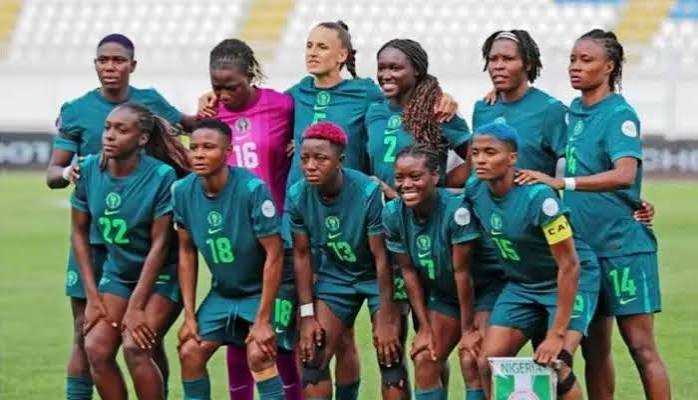
Ninety minutes at the Stade Olympique de Rabat tonight will determine whether the most decorated team in African women’s football survives a group stage it has never before failed to clear. Nigeria’s Super Falcons meet Egypt at 9:00 p.m. Nigerian time in the final round of Group C fixtures at the 2026 Women’s Africa Cup of Nations, needing a win to keep alive both their defence of the continental crown and their route to the 2027 FIFA Women’s World Cup in Brazil.
Group C stands finely poised. Malawi, playing at their first WAFCON, lead with six points and a goal difference of plus three. Zambia and Nigeria each have three points, with the Copper Queens holding a superior goal difference of plus five against Nigeria’s zero, though Nigeria occupy second place on the strength of their head to head win over Zambia. Egypt sit bottom without a point and a goal difference of minus eight.
The arithmetic is unforgiving. Nigeria have scored three goals and conceded three in two matches. Zambia have scored six and conceded one. Malawi have scored six and conceded three. Egypt have managed a single goal while shipping nine.
Head coach Justin Madugu, speaking ahead of the fixture, said his technical crew had studied every permutation. “We have looked at all the possible qualification scenarios and understand what we need to do,” he said. “Our objective is to ensure our destiny remains in our own hands by winning the match.” He added: “The players are motivated and well prepared. Everyone understands what is at stake, and we are working hard to get the result that will take us into the next round of the competition.”
The stakes carry historical weight. Since the tournament assumed its full format in 1998, Nigeria have won 10 of the 13 editions staged, in 1998, 2000, 2002, 2004, 2006, 2010, 2014, 2016, 2018 and 2024. They have contested 10 finals and won all 10. Only Equatorial Guinea, champions in 2008 and 2012, and South Africa, winners in 2022, have interrupted that dominance. Crucially, the Super Falcons have reached at least the semi-finals of every previous WAFCON and have never been eliminated at the group stage.
That record is now genuinely exposed. Nigeria opened their campaign on July 28 at the Al Madina Stadium in Rabat with a 3-2 defeat to debutants Malawi, a result CAF itself described as one of the biggest shocks in the competition’s history. The match was goalless at the interval before Temwa Chawinga broke the deadlock in the second half and her sister Tabitha Chawinga doubled the lead minutes later. Captain Rasheedat Ajibade converted a stoppage time penalty, Temwa Chawinga restored the two goal cushion, and substitute Uchenna Kanu pulled one back deep into added time. The defeat ended Nigeria’s unbeaten run against WAFCON debutants stretching back to 1998.
The response came on August 1. Madugu made five changes, restoring Asisat Oshoala, Deborah Abiodun, Christy Ucheibe, Uchenna Kanu and Rofiat Imuran to the starting eleven. Oshoala struck in the eighth minute after her initial effort rebounded off the Zambian goalkeeper, her 15th career WAFCON goal. Nigeria then played roughly an hour with 10 players after Oluwatosin Demehin was shown a straight red card in the 40th minute, following a VAR review, for bringing down Zambia captain Barbra Banda.
Reflecting on that win, Madugu said: “I think what made the difference was our determination to ensure that we picked the three points, knowing fully well the result of the last game.” He explained his in game adjustment: “When the red card happened, the natural thing was to adjust within the team without making immediate substitutions. We didn’t want to sit back and invite pressure. We wanted to keep playing, keep believing, keep possession, and look for opportunities.”
Nigeria are without Demehin, suspended for the red card, and midfielder Jennifer Echegini, ruled out after accumulating two yellow cards across the Malawi and Zambia fixtures. Both suspensions were confirmed by CAF.
Ucheibe, who filled in at centre back after Demehin’s dismissal, is expected to partner Osinachi Ohale, with Toni Payne, Ajibade and Halimatu Ayinde among the options in midfield. Shukurat Oladipo, introduced early in the second half against Zambia, impressed at left back after Imuran struggled. Madugu addressed criticism of his selections by stressing that choices are tactical. “Sometimes selection of players is dependent on what you see or analyse about the opposition,” he said. “When you come up with your own strategy, who will be able to do this? This is what we have seen of the opposition, there are their strengths and weaknesses.”
Egypt arrive with nothing but pride at stake. Ranked 99th in the world in the FIFA Women’s ranking update of 21 April 2026, they are appearing at the WAFCON for the first time in a decade, having qualified only through the repechage after CAF expanded the field from 12 to 16 teams and readmitted four of the highest ranked eliminated sides. Their previous appearances came in 1998 and 2016, with group stage exits on both occasions.
The Cleopatras were beaten 6-0 by Zambia in their opener, with Banda scoring four, then lost 3-1 to Malawi. Their heaviest ever international defeat remains a 6-0 loss to Nigeria in Kaduna on 23 October 1998.
Nigeria, ranked 36th in the world and the highest placed African side in the standings, are heavy favourites on paper. Both matches, however, are being staged in Rabat, so neither team enjoys a home advantage.
WAFCON 2026 doubles as Africa’s qualification pathway to Brazil 2027. All four semi finalists earn automatic World Cup places. The four losing quarter finalists will contest classification matches on 13 August for two slots in the FIFA inter confederation play off tournament, meaning Africa could ultimately send as many as six teams to Brazil.
Nigeria have appeared at all nine editions of the Women’s World Cup, with a quarter final finish in 1999 their best result and a round of 16 exit on penalties to England in 2023 their strongest modern showing. Missing Brazil 2027 would be unprecedented.
There is money involved too. CAF raised the total prize pool by 67 per cent to 5.8 million dollars. The champions take 2 million dollars, double the previous edition, runners up 750,000 dollars and the third placed side 350,000 dollars. Each of the 16 teams receives 150,000 dollars in participation funding, up from 125,000 dollars.
Victory over Egypt takes Nigeria to six points and, in every realistic scenario, into the last eight. Should Zambia beat Malawi in the simultaneous fixture, three teams would finish level on six points, and the tie would be settled first by results among the tied sides and, if still level, by overall goal difference, which is why the margin of victory matters. A draw would leave Nigeria dependent on Zambia failing to win. Defeat would almost certainly end the title defence.
Morocco, Algeria, Cameroon, Ivory Coast and South Africa have already secured quarter final places. The knockout rounds begin on 8 August, the semi finals follow on 12 August, and the final is scheduled for 16 August in Rabat.