
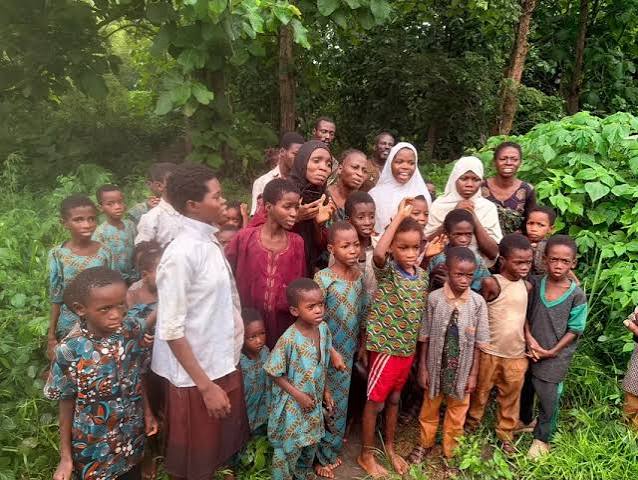
Bello Hassan was seated in his classroom with a pen in hand, writing a test, when armed men stormed his school in Oriire Local Government Area of Oyo State and marched him into the forest at gunpoint. Fifty six days later, the 15 year old walked out of captivity carrying an unexpected message. “Since my return, I am not afraid. If God wills, I will return to school in the area,” he told journalists in Ogbomoso on Wednesday, shortly after he and other freed victims were discharged from the Ladoke Akintola University of Technology Teaching Hospital, where they had received medical care and psychological support.
His account, delivered in the calm voice of a boy who had lived under trees for nearly two months, offered the clearest window yet into an ordeal that gripped the nation and, for the first time, brought the spectre of mass school abduction into South West Nigeria.
By Hassan’s telling, the captives trekked for an entire day before reaching the kidnappers’ first camp at about 7 p.m., after which they were shuffled from one location to another. “We didn’t know where they took us, and we trekked for a day. They moved us from one location to another for days,” he said. The abductors, he recalled, sheltered the children with nylon sheets whenever rain threatened, and shifted the cooking duties. “They asked the females among us to cook for us, and later they started cooking for us,” he said. The pupils, he added, were not beaten, though the teachers were regularly flogged. “The gunmen didn’t beat us, but only flogged our teachers. They didn’t allow us to play around or do whatever we liked,” he said. He said the captors communicated in English, Hausa and other languages, and that he did not witness the killing of two teachers because they were killed elsewhere.
The nightmare began on the morning of May 15, 2026, when gunmen simultaneously raided three schools in the Ahoro Esiele and Yawota communities of Oriire: Community Grammar School, Baptist Nursery and Primary School, and L.A. Primary School. According to official accounts, 39 pupils and seven teachers were seized. The assistant headmaster of L.A. Primary School, Joel Adesiyan, was killed during the raid while trying to escape. A day later, one of the captured teachers, Michael Oyedokun, was beheaded in a recorded act meant to deter pursuing security forces. A second teacher, Deacon John Olaleye, later died in captivity. The military attributed the attack to Jama’atu Ansarul Muslimina fi Biladis Sudan, commonly known as Ansaru.
Freedom came on July 10, 2026. In a statement issued by the acting Deputy Director, 2 Division Army Public Relations, Lt. Col. Danjuma Danjuma, the Nigerian Army said troops led by the General Officer Commanding 2 Division, Major General C.R. Nnebeife, rescued 44 pupils and teachers after an intelligence guided operation that swept the Old Oyo National Park and other locations. The mission drew on the Office of the National Security Adviser through its National Counter Terrorism Centre, the Defence Headquarters, special forces of the Army, Navy and Air Force, the Nigeria Police, the Department of State Services, the National Intelligence Agency, the Nigeria Security and Civil Defence Corps, and the Amotekun Corps working with local hunters and vigilantes. The Army said eight suspects were arrested and are in DSS custody, while several others were neutralised.
President Bola Tinubu, in a statement by his Special Adviser on Information and Strategy, Bayo Onanuga, said the captives were freed “alive and unharmed,” and stressed that “no ransom was paid” and “no concession was made,” even as the abductors had demanded the release of a Boko Haram figure standing trial for terrorism. There remains a discrepancy in the figures that authorities have not fully reconciled. While the Army put the number of rescued victims at 44, earlier official tallies indicated that at least 46 people were taken. It is not immediately clear whether the Army’s figure excludes the two teachers killed.
The Oriire case stands out not only for its brutality but for its geography. For more than a decade, mass school abductions had been treated largely as a northern affliction, a grim signature of Boko Haram, the Islamic State West Africa Province and the armed groups loosely termed bandits. The modern wave traces back to April 14, 2014, when 276 girls were seized from Government Secondary School, Chibok, in Borno State. About 90 of them remain unaccounted for. Dapchi followed in February 2018 with 110 girls, of whom five died. The 2020 and 2021 stretch industrialised the tactic, from more than 300 boys in Kankara, Katsina, to 317 girls in Jangebe, Zamfara. In March 2024, roughly 287 pupils were taken from Kuriga in Kaduna, and in November 2025, gunmen seized 315 pupils and staff from a Catholic school in Papiri, Niger State, in the single largest school abduction since Chibok.
The scale of the wider crisis is captured in the numbers. Data compiled by the International Centre for Investigative Reporting shows Nigeria recorded 26 major school attacks between April 2014 and May 2026, with at least 2,416 students abducted. Save the Children has put the figure of abducted students since 2014 at more than 1,680. Beyond schools, SBM Intelligence estimated that at least 7,568 people were kidnapped nationwide in 1,130 incidents between July 2023 and June 2024 alone, with abductors demanding about 11 billion naira in ransom during that period. The educational cost is heavy. UNICEF has repeatedly warned that roughly one in three Nigerian children is already out of school, and a 2024 assessment found that only 37 percent of schools across ten surveyed states had early warning systems to detect threats.
The Oriire rescue also opened a political fault line. Oyo State Governor Seyi Makinde, in a statewide broadcast on Monday, called on the United Nations and international human rights bodies to investigate the abduction and the circumstances of its resolution, insisting Nigerians “deserve a full and transparent account of what happened, who was responsible, whether there were institutional failures, negligence or collusion.” He had earlier alleged, during a visit to Bauchi State, that the attacks were the work of people opposed to his reported 2027 presidential ambition. The Oyo State House of Assembly backed his demand. The Senate, the Secretary to the Government of the Federation, George Akume, and the Presidency rejected it, with Senator Adams Oshiomhole describing the call as unnecessary and capable of diminishing the achievements of the security forces, and Onanuga suggesting it implied a lack of confidence in Nigeria’s security institutions.
For the affected communities, the response has moved from mourning to prevention. During the captivity, the Nigeria Union of Teachers in Oyo embarked on industrial action, warning that continued attacks could push educators to withdraw their services, while civil society groups staged protests in Ibadan. A federal delegation announced that President Tinubu had approved the recruitment of 1,000 forest guards for Oyo State to help secure forest belts that have become havens for armed groups, and Makinde pledged tighter surveillance of access routes into the Old Oyo National Park. The Army has said further operations are ongoing, an indication that the cell behind the Oriire attack has not been fully dismantled.
Days after the same May 15 assault, gunmen also struck schools in the Askira Uba area of Borno State. Those victims, unlike the Oriire captives, are yet to regain their freedom, a reminder, as the Christian Association of Nigeria noted, that “there are mothers and fathers in Borno, Niger, and other parts of our country who will still go to bed praying.” For Bello Hassan, the fear that trailed him into the forest has, in his words, given way to resolve. Whether the classrooms he hopes to return to can be kept safe remains the harder national question.