
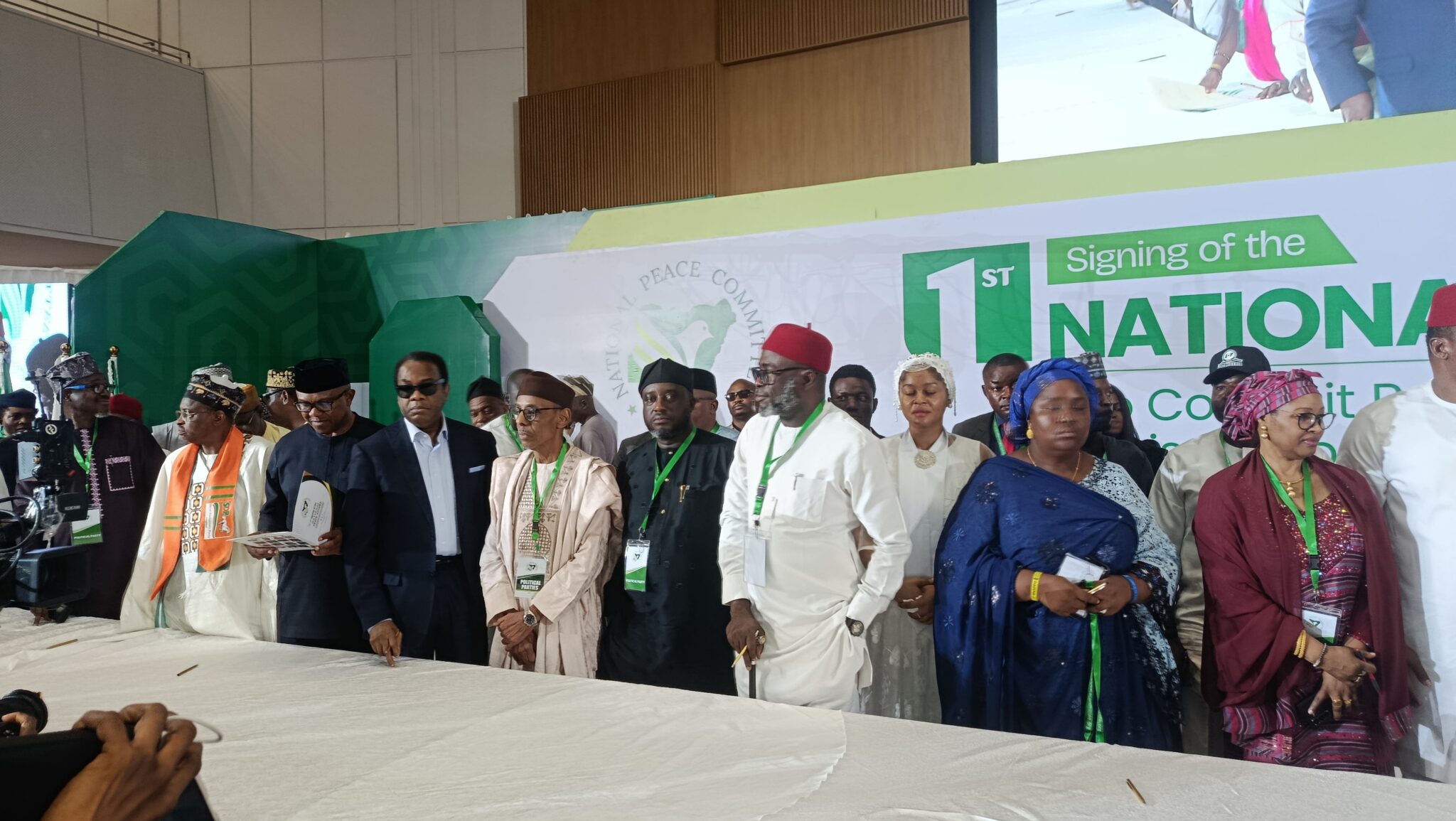
Nigeria’s 2027 general election entered its most consequential phase on Wednesday, with the official commencement of presidential and National Assembly campaigns coinciding with a National Peace Accord signed a day earlier by candidates who remain divided over whether the pact can actually restrain the violence that has already trailed the electoral cycle.
Under the Independent National Electoral Commission’s (INEC) revised timetable, released in March in line with the Electoral Act 2026, presidential and National Assembly campaigns run from 19 August 2026 to 15 January 2027, ahead of polls scheduled for 16 January, the first presidential election held in January since Nigeria’s return to democracy in 1999. Governorship and State Assembly campaigns follow on 9 September, with those elections fixed for 6 February 2027.
The peace accord, signed Tuesday at the Bola Ahmed Tinubu International Conference Centre in Abuja, was facilitated by the National Peace Committee, chaired by former Head of State Gen. Abdulsalami Abubakar, in partnership with The Kukah Centre. President Bola Tinubu, represented by Secretary to the Government of the Federation George Akume, signed for the All Progressives Congress, alongside Peter Obi of the Nigeria Democratic Congress, Omoyele Sowore of the African Action Congress, Adewole Adebayo of the Social Democratic Party, Donald Duke of the Peoples Redemption Party, Ambassador Aliyu Bin Abbas of the Action Democratic Party and Chibuzo Okereke of the Labour Party. Atiku Abubakar of the African Democratic Congress, running with Rotimi Amaechi, was notably absent.
Tinubu told the gathering the election “must not be treated as a do-or-die affair,” pointing to improvements in electoral technology, including the Permanent Voter’s Card and Bimodal Voter Accreditation System, as evidence that Nigeria’s electoral management had matured since 1999.
Obi questioned the value of a signed pact if candidates would not honour it in conduct, arguing that voters, not documents, should punish violators at the ballot box. Adebayo went further, saying no accord could substitute for a government respecting its constitutional duties, and accused the state of responsibility for most electoral problems. Sowore said he signed not out of confidence in the accord but to “bring faith into the system,” and proposed a companion “Justice Accord” with enforceable penalties for violations, arguing that previous pacts had not stopped bloodshed.
That scepticism is grounded in recent, documented experience. The Osun State governorship election of 15 August, the last off-cycle poll before 2027, was preceded by a documented surge in political violence. The Centre for Journalism Innovation and Development’s Conflict Tracker recorded 34 violent incidents and 18 deaths in the state from May 2026, while a separate Kimpact Development Initiative assessment put the figures at 73 incidents and 29 deaths since October 2025, with more than half occurring in May and June alone. The Nigeria Police Force separately documented at least 30 politically motivated killings, and YIAGA Africa cited figures exceeding 34 deaths. Sowore’s claim at the accord signing that 50 people died in Osun exceeds all of these independently tracked figures and has not been corroborated by police, civil society trackers or INEC. Accord’s Ademola Adeleke was ultimately declared winner and has since received congratulatory messages from rivals including Atiku.
Abdulsalami, represented by Gen. Martin Luther Agwai, said the Peace Committee had brokered 30 accords since 2015, including five at national level, and had set up an Election Security Information Hub and faith-based peace structures in 23 states. INEC Chairman Prof. Joash Amupitan pledged neutrality, saying the commission would deploy roughly 1.4 million ad-hoc staff across more than 176,000 polling units, applying lessons from the Anambra, FCT, Ekiti and Osun polls.
Whether Tuesday’s accord holds firmer than its predecessors will be tested over the coming five months, as 19 presidential candidates and their parties take their campaigns nationwide, with the Osun casualty figures standing as a documented benchmark against which the sincerity of the pledge will be measured.