
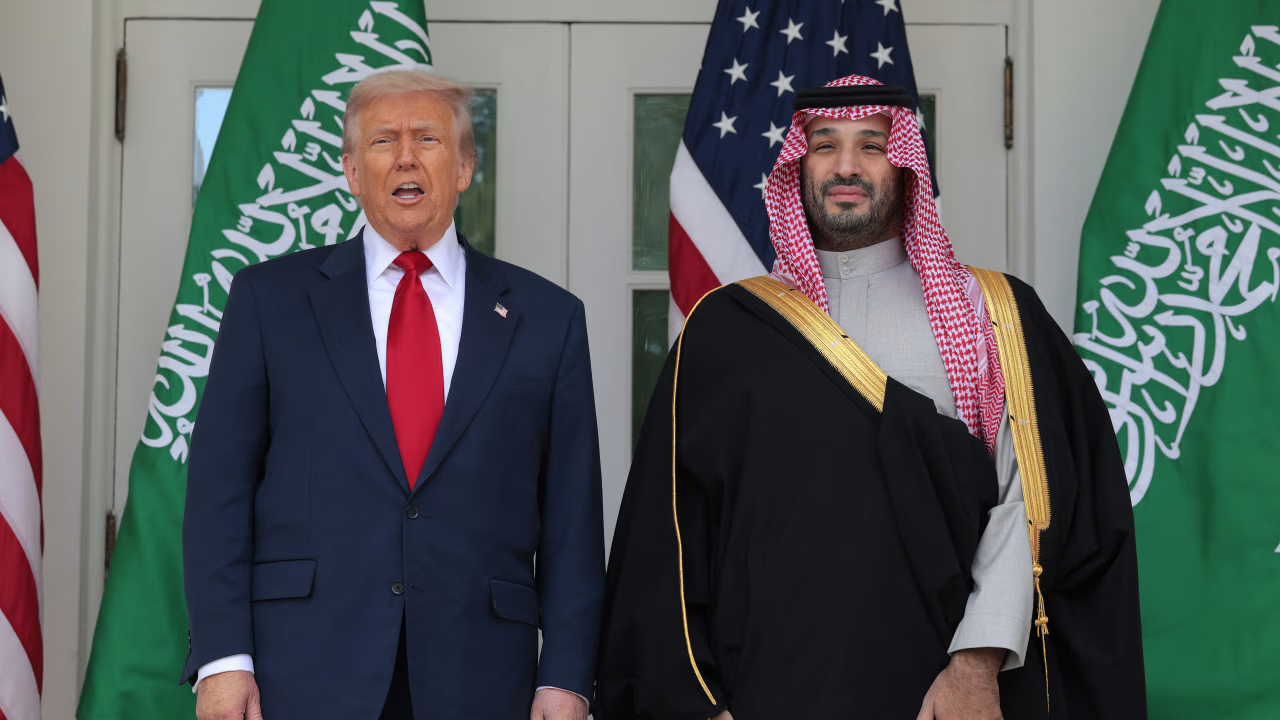
President Donald Trump has approved a sweeping nuclear cooperation agreement with Saudi Arabia that could eventually hand the kingdom the ability to enrich uranium on its own soil, a decision landing at the most volatile moment in Gulf security in years and one that has already drawn resistance from lawmakers in Washington and officials in Israel.
The agreement, expected to last 30 years and to involve United States firms in developing the program, was first reported by The Wall Street Journal and later confirmed by the Associated Press through two people familiar with the matter who were not authorised to speak publicly. The deal could allow for the building of a uranium enrichment facility in Saudi Arabia following a joint study by both governments. Officials indicated it could be announced formally as early as Wednesday, July 22, though the White House had not issued an official comment when reports emerged.
At the centre of the arrangement is what Washington calls a 123 Agreement, named after Section 123 of the United States Atomic Energy Act of 1954, which sets the legal framework for peaceful nuclear cooperation between America and another state. According to reports, the document is to be signed by US Energy Secretary Chris Wright and Saudi Energy Minister Abdulaziz bin Salman, building on a preliminary understanding reached in Riyadh and on a commitment the two sides made during Crown Prince Mohammed bin Salman’s visit to the White House in November 2025. Reporting indicated that the core negotiations had actually concluded in October 2025, with the draft accord sitting unsigned for months as the war with Iran complicated the politics around it.
What makes the deal contentious is what it leaves out. Lawmakers and arms control experts have objected that the agreement omits the so called gold standard of nuclear nonproliferation, which bars a country from enriching uranium or reprocessing spent fuel, both of which are steps on the road to a weapon. The contrast with a close neighbour is instructive. When Washington struck a comparable 123 Agreement with the United Arab Emirates, which took effect in 2009, Abu Dhabi agreed to permanently give up producing its own fuel, ruling out the infrastructure needed to build a bomb. That plant, Barakah, was built with South Korean assistance and remains the Arab world’s only operating nuclear power facility. A drone reportedly struck a generator near the site in May, causing a fire, an incident that underlined how exposed such installations have become. Analysts have also flagged that the Saudi accord does not appear to include the International Atomic Energy Agency’s Additional Protocol, a measure that widens inspectors’ access and would tighten oversight.
The timing is the sharpest part of the story. The agreement surfaces in the middle of a war that began on 28 February 2026, when the United States and Israel launched surprise airstrikes on Iran, targeting military and government sites and killing Supreme Leader Ali Khamenei, opening the 2026 Iran war. Trump has said the campaign was waged, in part, to stop Tehran from turning enriched uranium into a weapon, while Iran has consistently maintained that its own program is peaceful. That framing now sits awkwardly beside a decision that could place enrichment technology in the hands of Iran’s chief regional rival.
The conflict has already reordered global energy flows. After the strikes, Iran blocked the Strait of Hormuz, through which roughly 25 percent of the world’s seaborne oil trade and about 20 percent of its liquefied natural gas normally pass. Washington answered with an aerial campaign from mid March and, from 13 April, a naval blockade of Iran that the US says has intercepted scores of vessels, a squeeze American officials estimate is costing Tehran heavily each day. Brent crude vaulted past 100 dollars a barrel at the height of the disruption in March, and prices have stayed elevated and jumpy through the summer.
Now a new front is opening at sea. This week, the Iran aligned Houthis in Yemen declared a blockade of the Bab el Mandeb Strait and accused Saudi Arabia of striking an airport while an Iranian official was passing through. The threat matters because Bab el Mandeb has become even more important for Saudi Arabia now that the Strait of Hormuz has been effectively closed by the war, giving the kingdom a route to move millions of barrels a day to the open ocean. Rystad Energy has warned that the Houthi threat puts roughly 2.5 million barrels per day of Saudi oil at risk, and ship trackers have already reported tankers rerouting away from Saudi departure points. Mediators, meanwhile, are said to be circulating a proposal for a short ceasefire, even as Trump warned on social media that Iran would “pay” many times over for the death of any American soldier.
Opposition to the nuclear pact has been swift and crosses the usual dividing lines. In the United States, the agreement marks a clear break from the nonproliferation safeguards upheld by previous administrations and has revived fears of an arms race in an already unstable region. Senator Edward Markey, a Massachusetts Democrat who has campaigned against Saudi enrichment for years, has argued that granting the capability could inflame the very confrontation with Iran that Washington is fighting. In Israel, opposition figures were blunt. Avigdor Liberman, the former defence minister who leads the hawkish Yisrael Beytenu party, said allowing enrichment on Saudi soil crosses a red line and called on pro Israel groups to press Congress to vote the deal down even at the cost of a rift with Trump. Former Prime Minister Ehud Barak read the absence of any Saudi normalisation with Israel in the package as a sign of strained trust between the two governments.
Regional signals have deepened the anxiety. Riyadh has entered a mutual defence pact with nuclear armed Pakistan, and Islamabad’s defence minister has suggested that Pakistan’s nuclear umbrella could be extended to the kingdom if circumstances demanded. Saudi leaders have long insisted on their right to a civilian nuclear program, and the crown prince has previously stated that the kingdom would move to acquire a weapon if Iran ever did.
The path ahead runs through Congress, though the outcome may already be tilted. The administration intends to submit the agreement within days, after which lawmakers will have a continuous 90 day window to review it under the Atomic Energy Act. Yet blocking it is difficult by design. Congress would have to pass a joint resolution of disapproval and then assemble a veto proof, two thirds majority to override an almost certain presidential veto, a threshold rarely met. Reports also point to two confidential side letters attached to the deal, which some members may demand be made public before they vote.
For now, the administration is holding its language carefully. US Secretary of State Marco Rubio, speaking in Manila, declined to confirm the deal and deferred to the White House, while insisting that Washington would not enter any agreement that raises the risk of proliferation. Whether that assurance survives contact with a Gulf already at war, and with an oil market bracing for the next disruption, is the question that will define the months ahead.