
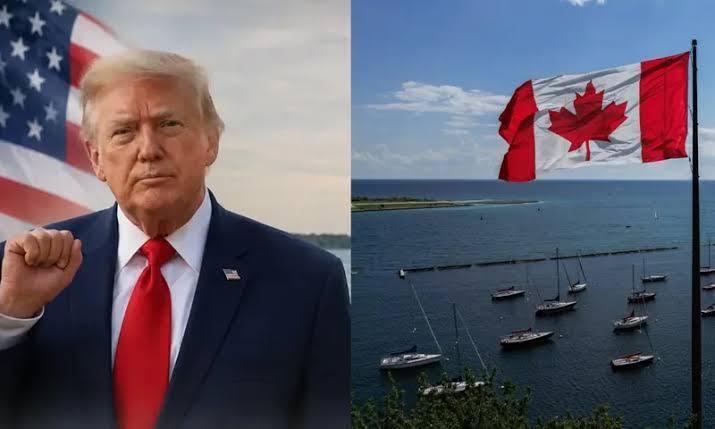
A body of water that has carried the same name for centuries has become the newest front in the deepening quarrel between the United States and Canada, after President Donald Trump signed an executive order renaming Lake Ontario as “Lake America” in American federal records.
The order, signed at the Oval Office on Thursday, 27 August 2026, directs the US Department of the Interior, under Secretary Doug Burgum, to work with the Board on Geographic Names to update the Geographic Names Information System, the official federal repository for domestic place names, and to remove references to Lake Ontario within 30 days. Trump told reporters the change was “effective immediately,” although the text of the order allows a month for the update. He later posted a letter attributed to the director of the US Geological Survey stating that the change had been made and would begin appearing in printed documents over the following days.
Asked what message the decision was meant to send to Canada, Trump said “No message,” before adding that Canada “has been ripping us off for a long time on trade.” At the signing he remarked that the country now had “a gulf and a lake,” a reference to his earlier renaming of the Gulf of Mexico, and joked that an ocean might be next.
The reach of the order is narrower than its language suggests. It binds only the US federal government. It carries no authority over Canadian maps, over international bodies, or over private companies and media organisations, none of which are obliged to adopt the new name. The international boundary runs through the middle of Lake Ontario, dividing the American state of New York from the Canadian province of Ontario, which means the two governments will now hold different official names for the same lake.
That division creates a practical complication that did not arise with the Gulf renaming. Digital mapping services that display names according to a user’s location are likely to show “Lake America” on the southern shore and “Lake Ontario” on the northern shore of a single body of water. There is no global authority that fixes the names of shared international waters, so the outcome rests largely on which name each institution chooses to recognise.
Canadian officials have rejected the move firmly. Prime Minister Mark Carney said Canadians know that “naming reality means calling it Lake Ontario,” now and always, and noted that the name predates both the Canadian Confederation of 1867 and the American Declaration of Independence of 1776. He pointed to the lake’s Indigenous origins. Four of the five Great Lakes, Ontario, Huron, Michigan and Erie, carry names derived from Indigenous languages, while Superior takes its name from an anglicised French word. Lake Ontario is the smallest of the five.
Ontario Premier Doug Ford responded by unveiling a large sign on the Canadian shoreline reading “Lake Ontario. Now and Always.” According to Ford, “Long before President Trump, this lake was called Lake Ontario. Long after President Trump is gone, it will still be called Lake Ontario.” Nova Scotia Premier Tim Houston dismissed the order more bluntly, saying “It’s Lake Ontario, buddy.”
The renaming is inseparable from the collapse of trade talks between the two countries. Negotiations in Washington broke down on 21 August 2026, after which the Canadian government withdrew from what it described as a bad deal. Washington then imposed tariffs of 50 per cent on about $20 billion worth of Canadian goods, a figure representing roughly 5.5 per cent of Canadian exports to the United States, with duties on items such as wine and dairy taking effect first. The administration followed this with an announcement of 50 per cent tariffs on all Canadian steel and vehicle imports from 1 January 2027.
Ottawa has promised to match the measures. The Canadian government said it would begin imposing retaliatory tariffs of up to 50 per cent on billions of dollars of American products from 8 September, covering goods including dairy, steel, household appliances and agricultural equipment. Trump has warned of consequences “far worse” if Canada does not, in his words, fall in line.
The Lake Ontario order is the second time in Trump’s current term that he has moved against the name of an internationally recognised body of water. On his first day back in office in January 2025, he signed an order renaming the Gulf of Mexico as the “Gulf of America.” US federal agencies, including the Coast Guard, adopted the term, but other governments did not. Mexico rejected the change, arguing that a single country cannot rename a shared body of international water.
The earlier episode showed both the limits and the friction such orders create. A major mapping service settled on a split arrangement, showing “Gulf of America” to users in the United States, “Gulf of Mexico” to users in Mexico, and both names elsewhere. The White House also restricted access for a news agency that continued to use the original name, a decision a federal court later found unconstitutional. Trump has separately sought to restore the name Mount McKinley to the peak known as Denali.
Seen against that record, the Lake Ontario order functions less as a settled fact of geography than as a lever of pressure. What is confirmed is that the name has changed in American federal records and that Canada will continue to call the lake Lake Ontario. What remains open is how far the label travels beyond Washington’s own paperwork. On the evidence of the Gulf dispute, the most likely result is not a single new name but a divided map, on which the same water answers to two names depending on who is looking, and from which side of the border.