
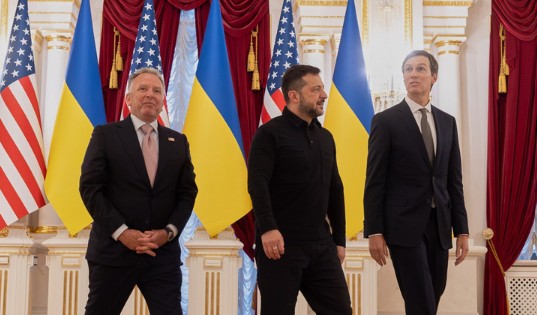
American envoys Steve Witkoff and Jared Kushner held substantive peace talks with Ukrainian President Volodymyr Zelenskyy in Kyiv on Sunday, 6 September 2026, marking their first official mission to the war-torn capital. The delegates arrived by train after Russian authorities refused to guarantee safe air transit into Ukrainian airports. The journey followed a three-hour session with Russian President Vladimir Putin in Moscow a day earlier. United States President Donald Trump had sent both men with an explicit proposal to halt Europe’s deadliest conflict since the Second World War. Zelenskyy greeted the visitors at Saint Sophia Square before leading them into hours of private discussions. Washington hopes to revive a formal peace process that stalled when the Gulf crisis erupted in late February. Personal emissaries carry heavy political burdens when frontlines refuse to settle. Rail travel brought reality straight to American negotiators.
The diplomatic mission relied on a fragile, three-day truce that barred air raids on Kyiv and Moscow. That temporary calm in the capitals did not stop heavy fighting across the wider theatre of war. Ukrainian forces struck the Ryazan oil refinery deep inside Russian territory with long-range attack drones overnight. Russian air wings retaliated by launching 108 missiles and drones against Ukrainian troop staging sites and supply depots. Russian defence officials claimed their surface-to-air batteries destroyed roughly 400 Ukrainian drones within a single 24-hour cycle. The violence shows that both sides intend to fight while talking. Neither military command wants to appear exhausted before foreign mediators. Truces in city centres do not quiet regional artillery batteries. Gunfire continues to dictate the terms of diplomacy.
In the meeting room, the Ukrainian side pressed for binding security guarantees rather than vague paper promises. Zelenskyy told reporters that his country needs an ironclad pact that Moscow cannot break in future years. He insisted that real security requires a well-equipped standing army and substantial funds for economic rebuilding. The Ukrainian leader warned that he expects the war to grind through another harsh winter. He asked the American team to guarantee consistent weapons deliveries and energy equipment to heat civilian homes. Kyiv fears that any premature ceasefire will allow the Kremlin to rearm and strike again. Security guarantees remain the central obstacle in every negotiation room. Paper treaties never stopped tanks from rolling across borders.
The status of the eastern Donbas region remains the sharpest point of disagreement between the combatants. During his three-hour meeting with the American team, Putin reiterated that Ukraine must surrender a belt of fortified towns in the east. The Russian leader pointed to battlefield gains, insisting that Moscow will achieve its primary military goals by force if talks collapse. Zelenskyy flatly rejected any demand to abandon defensive positions that Ukrainian soldiers have held for years. Kyiv argues that surrendering fortified ground invites an immediate Russian drive toward the Dnipro River. Neither leader can cede territory without facing political fury at home. The Kremlin demands land while the Ukrainian presidency defends sovereign soil. Stubborn territorial claims make rapid compromises nearly impossible to sell.
The White House sees personal diplomacy as a quick way to bypass traditional institutional bottlenecks. Witkoff called the Kyiv discussions meaningful and encouraging, while Kushner passed warm personal regards from Trump. The property developer and the former presidential adviser have handled several delicate foreign missions for the administration. Yet seasoned diplomats doubt whether private real estate skills can resolve deep historical hatreds. European allies worry that Trump will trade Ukrainian sovereignty to secure a swift personal triumph before the American midterm elections. European envoys joined the Kyiv talks to protect their own security interests on the continent. A rushed settlement could leave eastern Europe exposed to future military adventures. Commercial dealmakers do not always understand the logic of trench warfare.
The talks in Kyiv also exposed the wider geopolitical strain that complicates American foreign policy today. Washington’s military confrontation with Iran in the Gulf has drained attention and air defence resources away from Europe. The Pentagon has burned through precious interceptor missiles in the Middle East while Ukraine begs for basic Patriot batteries. Ukrainian commanders know that American factories cannot supply two high-intensity wars at the same time. The Trump administration wants to close down the European front to focus its military power on the Gulf. That strategic pivot alarms Ukrainian commanders who depend on American satellite intelligence and artillery shells. Washington cannot manage two wars on opposite ends of the globe. Distracted patrons often force bad deals on dependent clients.
Ordinary residents in Kyiv watched the high-profile American delegation with cautious hope and dark scepticism. Military veterans and shop workers who survived weeks of drone sirens want the war to end. Yet few citizens believe the Kremlin will honour a peace deal brokered by property tycoons from New York. Trump plans to hold separate telephone calls with Putin and Zelenskyy on Monday to review the weekend findings. Those calls will reveal whether the gap between the two sides has narrowed even an inch. If the talks fail, both armies will dig deeper trenches and wait for the winter mud to freeze. The visiting Americans left Kyiv by rail, heading back to air-conditioned offices. Ukrainian citizens remain behind to face the sirens alone.