
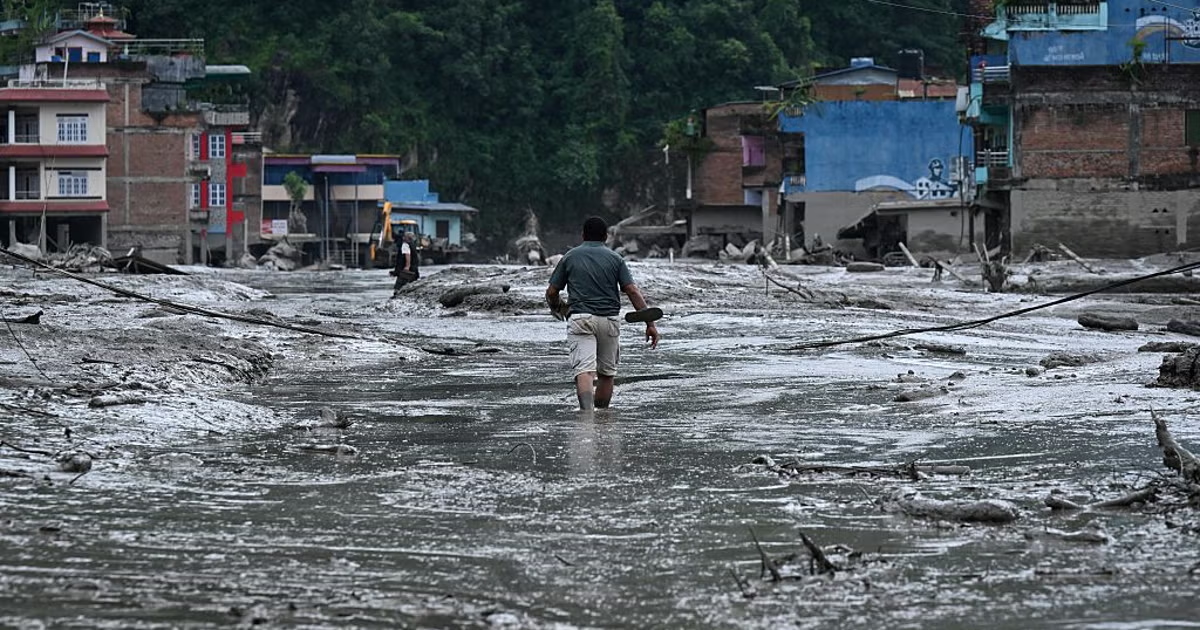
The death toll from the catastrophic floods that struck Nepal and China’s Tibet region has climbed sharply, but the more important story emerging from the disaster is what it reveals about the growing vulnerability of communities, hydropower infrastructure and mountain economies to sudden climate and geological hazards.
At least 626 people have been confirmed dead in Nepal, with another seven reported dead in Tibet, while 2,426 people remain missing in Nepal and 554 in Tibet, according to figures reported by authorities on Saturday. More than 3,700 people had been rescued in Nepal, but poor weather and the threat of additional flooding continued to complicate search operations.
The disaster began on August 26 when a sudden collapse of ice and rock in the Himalayas generated a massive debris flow that surged into the river system along the Nepal China border. Initial reports mistakenly associated the event with an earthquake, but analysis by the United States Geological Survey indicated that the seismic signal was generated by the collapse itself and the subsequent movement of ice, rock and debris.
That distinction matters because this was not simply another monsoon flood.
The disaster illustrates the complicated combination of glacier instability, steep mountain terrain, vulnerable settlements, hydropower development, tourism and increasingly difficult weather conditions confronting Himalayan communities.
The numbers continue to change as rescue teams reach previously inaccessible locations.
Nepal’s disaster authorities reported 1,924 people missing in the country, including 933 hydropower workers. Tibet reported another 554 missing. Hundreds of those unaccounted for are foreign nationals, including pilgrims travelling towards Mount Kailash, one of Hinduism’s most important pilgrimage destinations.
The International Federation of Red Cross and Red Crescent Societies estimated that as many as 93,000 people could have been affected by the disaster. That figure includes people whose homes, livelihoods, access to food, water, roads and other essential services have been disrupted, rather than only those killed or missing.
The destruction has also reached critical infrastructure.
Fifteen hydropower projects were affected, with an estimated 431 megawatts of generating capacity knocked out, according to reporting based on Nepalese authorities and officials. Several major facilities, including the Rasuwagadhi, Chilime and Sanjen projects, sustained heavy damage.
That is significant for a country where hydropower is central to electricity generation and increasingly important to economic development.
The disaster also damaged roads, bridges and border infrastructure, isolating communities and making the rescue operation more difficult.
At the Trishuli 3A hydropower project, soldiers were searching for workers trapped inside tunnels after floodwaters and debris buried access points. More than 100 people were still believed to be trapped at one site as rescue teams struggled to reach them.
The immediate trigger was a sudden collapse of ice and rock, but the wider environmental setting is important.
The International Centre for Integrated Mountain Development, ICIMOD, has documented a growing concern around glacier related hazards across the Hindu Kush Himalaya. In October 2025, it reported that a 2024 glacial lake outburst flood in Nepal’s Everest region displaced 135 people and destroyed 25 homes.
The organisation found that the 2024 Thame disaster involved a complex chain of events involving a rock avalanche and two glacial lakes, releasing an estimated 459,000 cubic metres of water, equivalent to about 185 Olympic sized swimming pools.
The latest disaster is not proof that every Himalayan flood is caused by climate change. Scientists distinguish between the immediate physical trigger of an event and the longer term changes that can alter the conditions in which hazards occur.
But the underlying risk is changing.
The Intergovernmental Panel on Climate Change has found that glacier shrinkage has contributed to the formation and expansion of glacial lakes across the High Mountain Asia region. It also assesses glacier lake outburst floods as a significant threat to downstream communities, infrastructure and economies.
Importantly, the IPCC also cautions that the available evidence does not establish a clear increase in the frequency of glacial lake outburst floods across the Himalayas since the late 1980s. What is clearer is that glacier retreat, expanding lakes, unstable slopes and changing precipitation patterns are increasing the potential consequences of cryosphere related hazards.
Nepal Has Already Seen The Warning Signs
The August disaster did not occur in a country unfamiliar with catastrophic flooding.
Nepal’s September 2024 floods killed 249 people, injured 177 and displaced 10,807 families, according to the World Bank. A total of 5,996 houses were completely destroyed and another 13,049 partially damaged.
The World Bank estimated total damage from those floods at 46.7 billion Nepalese rupees, equivalent to about 0.8 per cent of Nepal’s fiscal year 2025 GDP. Infrastructure accounted for 38.9 billion rupees of the estimated losses, including damage to roads, hydropower facilities, bridges, telecommunications and water systems.
Only months earlier, Nepal had also experienced a glacial lake related flood in the Manaslu region. ICIMOD documented a 2024 event in which an ice avalanche entered Birendra Tal, triggering a sudden release of water into the Budhi Gandaki River.
The pattern shows why disaster management in Nepal cannot focus solely on conventional river flooding.
Mountain communities face overlapping risks from monsoon rainfall, landslides, glacier related floods, earthquakes and unstable slopes.
One of the central issues now is whether communities can receive enough warning when a hazard develops within minutes.
Nepal has made progress. The United Nations Office for Disaster Risk Reduction reported in 2025 that the country had developed an impact based forecasting system through its BIPAD disaster information platform, designed to combine historical loss data with near real time hazard information.
But warning systems cannot prevent every disaster.
A flood generated by a sudden collapse high in the mountains can move through steep valleys at extraordinary speed. Roads can disappear, bridges can collapse and communication networks can fail at precisely the moment emergency agencies need them most.
That makes preparedness at community level as important as forecasting.
It also raises difficult questions about where settlements, roads, tourist facilities and hydropower projects should be located in high risk valleys.
The Economic Cost Will Extend Beyond The Immediate Emergency
Nepal’s government has estimated that rebuilding after the disaster could require between $4 billion and $5 billion, according to Reuters.
That burden comes after the country was already dealing with the economic consequences of the 2024 floods.
The cost will not be limited to rebuilding houses.
Damaged hydropower facilities mean lost electricity generation and investment. Destroyed roads and bridges affect trade and tourism. Disrupted pilgrimage routes affect local businesses that depend on visitors. Damaged agricultural land and water infrastructure can create longer term livelihood problems.
The disaster therefore exposes a broader development dilemma: infrastructure built to support economic growth in mountainous areas can itself become highly vulnerable when extreme natural hazards occur.
For Nepal, the immediate priority remains finding survivors and accounting for the missing.
But the longer term question is harder.
As glaciers retreat, mountain lakes expand and weather extremes become more intense, the country will have to determine how much of its development can safely continue in high risk valleys and how much investment should be redirected towards monitoring, early warning, resilient infrastructure and disaster preparedness.
The tragedy unfolding along the Nepal China border is therefore not only a story about hundreds of lives lost in a single flood. It is a warning about what happens when rapidly changing mountain environments collide with growing human exposure.