
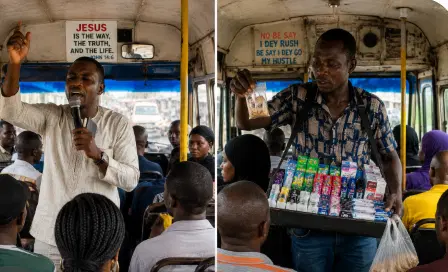
A single clause tucked inside a wide-ranging road safety bill has set off one of the sharpest public debates in Nigeria this year, pitting lawmakers seeking to curb distracted driving against religious bodies who see a threat to a practice older than the Fourth Republic itself.
The Senate on July 17, 2026 passed the Federal Road Safety Corps (Amendment) Bill, 2026, which proposes a N50,000 fine for anyone convicted of hawking, trading or preaching inside a commercial vehicle. The bill, which still requires the assent of President Bola Tinubu before it becomes law, forms part of a broader overhaul of the Federal Road Safety Corps Act aimed at tightening enforcement and raising penalties for a range of traffic offences. Under the same amendment, motorists who refuse to cooperate with FRSC officials during roadside breath tests conducted on reasonable suspicion face a N50,000 fine, six months’ imprisonment, or both, while the penalty for driving under the influence of alcohol or drugs rises from N5,000 to N100,000, with up to two years’ imprisonment attached. Fines for running red lights and other traffic light violations were also raised to N100,000.
Lawmakers have defended the preaching, hawking and trading clause as a road safety measure rather than a religious one. Facing an outcry after the bill’s passage, the Senate clarified that the provision was not a new invention but a restatement of a clause that has existed in the FRSC Act since 2007, and that the amendment mainly updates the penalty attached to it. The Senate maintains the intent is to reduce activities capable of distracting drivers on Nigeria’s commercial routes, alongside the bill’s other measures targeting speeding, drink driving and non compliance with enforcement officers.
That explanation has not settled the matter. The Christian Council of Nigeria, in a statement signed by its General Secretary, Rev. Evans Onyemara, said it supported road safety reforms but was “deeply concerned” that preaching had been grouped with hawking and trading as a punishable offence, arguing the clause raises questions about the constitutional guarantee of freedom of religion and expression. The council also criticised the fine attached to hawking, saying punitive measures do not address the poverty and unemployment that drive street trading in the first place, and called for alternatives such as designated trading zones and empowerment programmes. The Women’s Wing of the Christian Association of Nigeria and other Christian bodies issued similar objections, describing the provision as discriminatory. Some commentators and opposition voices have gone further, framing the clause as a targeted move against Christian evangelism, a characterisation the Senate rejects.
Nigeria’s road safety data offers a partial, though incomplete, backdrop to the debate. The FRSC’s 2025 annual report recorded 10,446 crashes nationwide and 5,289 deaths, an increase of roughly 9 percent in total crashes over the 9,570 recorded in 2024, even as fatalities eased slightly from the 5,421 deaths recorded that year. Corps Marshal Shehu Mohammed has repeatedly identified speed violations as the dominant cause of crashes, accounting for 41 percent of all identified causes in December 2025 alone, with what the FRSC calls the “Big Five” offences, comprising speeding, dangerous driving, drink or drug impaired driving, wrong way driving and overloading, responsible for more than 70 percent of fatal and serious crashes. National Bureau of Statistics figures show 2,720 crashes in the first quarter of 2026, a marginal year on year increase, while the World Health Organisation ranks Nigeria among the countries with the highest road traffic death rates globally, at roughly 22 deaths per 100,000 people annually. None of the FRSC’s published causation data isolates preaching, hawking or trading as a distinct contributor to crash figures, and the corps’ own enforcement priorities for 2026 centre on speed management, intelligence led policing and mandatory speed limiting devices for commercial vehicles rather than in vehicle conduct of this kind.
For now, the bill’s fate rests with the presidency. Until Tinubu either signs or declines to sign the amendment, the N50,000 fine for preaching, hawking and trading in commercial vehicles remains a legislative proposal rather than enforceable law, even as the argument over where road safety regulation ends and constitutional freedoms begin continues to play out between the National Assembly, religious organisations and the Nigerian public.