
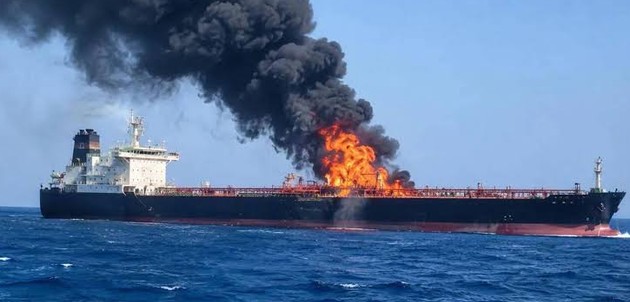
Iranian naval commanders announced on Saturday, 14 November 2026, that an oil tanker struck a naval mine and caught fire in the eastern Strait of Hormuz, marking the fifth such vessel hit within 24 hours. State media reported that the ship ignored strict Iranian transit warnings while attempting to cross an unauthorised southern passage. Separate announcements from the Islamic Revolutionary Guard Corps and the regular navy indicate a sharp escalation in maritime disruption across the world’s most vital oil chokepoint.
Mine warfare lets Tehran choke off global trade while preserving a thin veneer of plausible deniability. Rather than admitting direct missile strikes, Iranian forces claim commercial vessels simply wander into defensive minefields laid across prohibited waters. Tehran treats every uncoordinated transit as illicit oil smuggling, enforcing a simple rule that if Iran cannot export crude under American sanctions, no neighbour will ship freely either.
Washington’s naval presence has failed to deter these near-daily assaults on international shipping. Despite American claims of clearing main shipping lanes and providing military escorts along the Omani coast, commercial operators face soaring war-risk insurance premiums and physical danger. Iran’s Revolutionary Guard also claimed on Saturday to have shot down an American MQ-1 Predator drone over Qeshm Island, demonstrating that Tehran still contests both air and sea control.
Regional spillover continues to rattle neighbouring Arab capitals as fighting intensifies on multiple fronts. In Yemen, Houthi forces launched two ballistic missiles toward the interim government capital of Aden while pushing an offensive toward the Bab al-Mandeb strait. Simultaneously, Qatar and Turkey signed a new defence pact, signalling that Gulf states increasingly hedge their security bets rather than rely solely on Washington’s military umbrella.
Global diplomatic efforts appear badly outpaced by escalating kinetic strikes across the Middle East. United States President Donald Trump and his Chinese and Russian counterparts plan to discuss the Iran conflict next week at the Asia-Pacific Economic Cooperation summit in Shenzhen. Yet Tehran insists it will only reopen the Strait of Hormuz once Washington lifts its naval blockade and accepts seven stringent political conditions.
Energy markets now balance sluggish global demand against acute supply bottlenecks in the Persian Gulf. While rising American crude inventories recently cooled price spikes, losing five tankers in a single day reminds traders how quickly physical blockades tighten supply. Until major powers broker a maritime truce, every tanker entering the Gulf sails through a live minefield.