
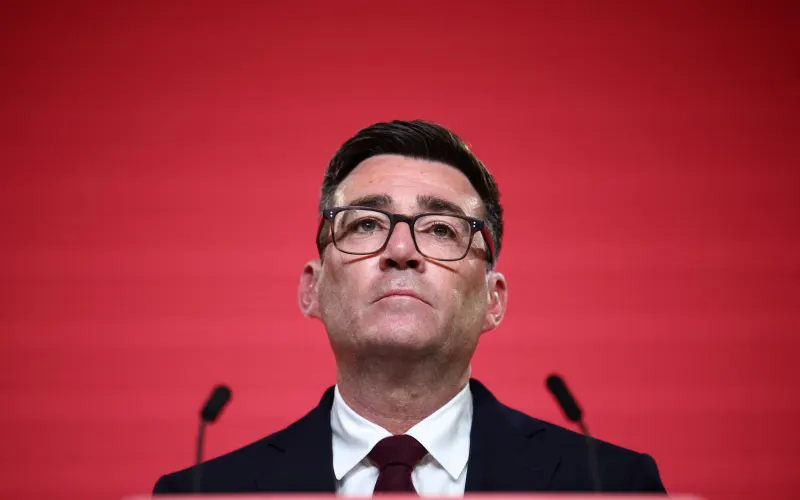
Andy Burnham will walk through the black door of 10 Downing Street on Monday as the United Kingdom’s seventh prime minister in ten years, inheriting a bruised governing party, a jittery bond market and an economy carrying some of the heaviest borrowing costs in a generation. The former mayor of Greater Manchester takes the keys from Keir Starmer, whose two year premiership collapsed under the weight of scandal, poor election results and a run of policy reversals that drained the confidence of his own MPs.
Burnham was formally declared leader of the governing Labour Party on Friday, July 17, at a special conference in London, clearing the last hurdle before entering office. He ran unopposed, securing nominations from 379 of the 403 Labour lawmakers in the House of Commons, a near unanimous endorsement that turned Friday’s announcement into a formality. “We’re going to give them hope back,” he told an audience of lawmakers, party activists and trade union leaders in his first speech as leader, pledging “hope in every heart” and “good growth in every post code.”
For a man about to lead the country, Burnham arrives largely unknown to voters outside the north of England. Nicknamed the “King of the North” for his combative advocacy during the pandemic, when he pressed Boris Johnson’s government for more support for regions under strict lockdown, he built a national profile from City Hall in Manchester rather than from Westminster. He was first elected to Parliament in 2001, served in the cabinets of Tony Blair and Gordon Brown, rose to health secretary in 2009, and lost Labour leadership contests in 2010 and 2015 before leaving the Commons in 2017 to run for mayor. He returned to Parliament only weeks ago, at 56, after winning a special parliamentary election in Makerfield, a seat engineered to carry him back to the national stage with the explicit aim of taking the top job.
The transition is the product of Labour’s own turmoil. Starmer announced his resignation on June 22, less than two years after leading the party to a landslide in July 2024 that ended 14 years of Conservative rule. His downfall was cumulative rather than sudden. His party suffered heavy losses in the May 7 local elections, and his authority never recovered from a string of controversies, including the fallout from his appointment of Peter Mandelson as ambassador to the United States, a decision reopened by scrutiny of Mandelson’s past association with Jeffrey Epstein. By the time he stepped aside, Starmer’s public standing had cratered, with pollster Ipsos recording net satisfaction ratings around minus 60, figures comparable to the lowest points of Johnson and Theresa May.
The economic inheritance is no gentler. Long term government borrowing costs have climbed to their highest levels in decades, with the yield on the benchmark 10 year gilt hovering around 4.85 percent and long dated gilts touching highs not seen since 1998 during the spring turbulence. Sterling has weakened to roughly 1.32 dollars, down about 3 percent since February, while the Bank of England has held its base rate at 3.75 percent. Chancellor Rachel Reeves is expected to unveil billions of pounds in fresh tax measures in her November budget, against a backdrop of subdued growth, weak productivity and a large borrowing requirement. Volatile energy prices, driven partly by the conflict between the United States and Iran, add another layer of risk to any recovery plan.
Politically, the ground beneath Burnham is contested. Nigel Farage’s populist Reform UK has led or run level with Labour in national polling for much of the year. An Ipsos survey conducted between June 25 and 30 put Reform on 26 percent and Labour on 24 percent, while other pollsters recorded a narrowing gap that commentators dubbed the “Burnham bounce.” A YouGov poll found 43 percent of respondents thought Burnham would make a better prime minister, against 23 percent for Farage, a lead his allies see as Labour’s clearest weapon against the insurgent right. The Makerfield contest also delivered an early sign of further fragmentation, with Rupert Lowe’s Restore Britain, positioned to the right of Reform, taking 7 percent of the vote. The next general election is expected in 2029, though Farage has urged his supporters to prepare for an earlier poll.
Burnham has wasted little time signalling a break from his predecessor. His first announced decision was to scrap Starmer’s flagship nationwide digital identity scheme, a programme estimated to cost 1.8 billion pounds over three years, with a spokesperson saying the money would be redirected “to where it’s most needed, such as helping with the cost of living.” He has promised to rewire what he calls an over centralised political system, floating a “Number 10 North” and an intention to split his time between London and Manchester. Deputy Labour leader Lucy Powell said his mayoral experience gave him an understanding of the “bigger, bolder measures” the party needs, telling the BBC that the mission was to give ordinary people “security in work, security in their home.”
His most immediate task is assembling a cabinet, with an announcement expected on Monday and intense focus on whether Reeves survives as chancellor. The chancellor remains deeply unpopular, with Ipsos recording net satisfaction ratings for her between minus 52 and minus 59 through the spring, while reports suggest Shabana Mahmood could stay on as home secretary. Investors have made clear that markets prize continuity in the Treasury, having watched borrowing costs spike each time Reeves’s position appeared in doubt.
For Nigerian readers, the change carries weight. The United Kingdom remains one of the largest destinations for Nigerian students, professionals and family migrants, and the debate that propelled Reform up the polls has centred heavily on immigration and small boat arrivals. How a Burnham government balances that pressure against Labour’s traditional openness will shape visa rules, study routes and diaspora ties that touch thousands of Nigerian households directly.
The wider pattern is one of chronic instability. Since the 2016 Brexit referendum, Britain has churned through David Cameron, Theresa May, Boris Johnson, Liz Truss, Rishi Sunak and Keir Starmer, and now Burnham. The memory of Truss’s 49 day premiership in 2022, when an unfunded mini budget sent gilt yields soaring, still governs how markets read every political tremor in Westminster, and it explains the caution now trained on the incoming government.
Burnham has cast his elevation as a final opportunity for his party, telling supporters his takeover was the “last chance” for Labour to get things right. With roughly three years before the next election and Reform tipped to be waiting, the King of the North enters Downing Street promising a moment of “reflection and resolution,” and precious little room to fail.