
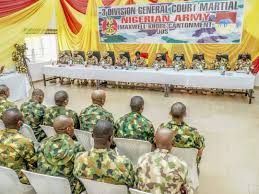
A colonel standing trial alongside 35 other military officers on charges of mutiny and alleged plot to overthrow President Bola Tinubu has filed a preliminary objection challenging the legal competence of the military tribunal hearing the case, raising fundamental questions about the limits of court martial jurisdiction under Nigerian law.
Colonel Mohammed Ma’aji, listed as the second accused in charge number DHQ/GAR/ABJ/49/ADM before the Defence Headquarters Garrison General Court Martial sitting in Asokoro, Abuja, is urging the tribunal to strike out all nine counts preferred against him, arguing the court lacks the jurisdiction to entertain them.
The objection, filed pursuant to Rules 36(1) and 37(1) of the Rules of Procedure Army 1972, advances three principal arguments. First, Ma’aji contends that the complainant, listed as the Armed Forces of Nigeria, is not a juristic person and therefore lacks the legal capacity to initiate or prosecute criminal proceedings. Citing Supreme Court and Court of Appeal authorities including Green v. Green, Fawehinmi v NBA, and Mothercat Nig Ltd v Reg. Trustees of the Full Gospel Assembly Nig, the defence maintains that only natural persons or entities expressly recognised by law can sue or be sued.
“The name ‘Armed Forces of Nigeria’ described as complainant in Charge No: DHQ/GAR/ABJ/49/ADM is unknown to law and destitute of any legal capacity to exercise prosecutorial powers in respect of the charges preferred against the 2nd Accused,” the written address states.
Second, Ma’aji challenges the substance of counts one through nine, which allege that he incited fellow officers to join a plot to topple Tinubu’s government. He argues that such allegations describe offences against the sovereign state and constitutional order rather than matters of military discipline or command structure, and therefore fall outside the jurisdiction conferred on a General Court Martial under Section 52(1)(b) of the Armed Forces Act, 2004.
Third, he contends that the phrase “plot to overthrow the government of the Federal Republic of Nigeria” cannot be equated with “lawful authority in the Federation” as defined under Section 52(3) of the same Act, insisting the court martial cannot expand its statutory powers beyond what the law expressly grants.
Quoting the Supreme Court decision in Nigerian Navy v. Lambert, the defence submitted that “penal statutes are to be construed strictly to the benefit of the accused person and that where there is a reasonable construction that avoids the penalty in any particular case, the court must adopt that construction.”
The objection further argues that for mutiny or incitement to mutiny charges to succeed, the prosecution must demonstrate concerted insubordination, defiance of military authority, refusal of lawful command, or organised rebellion against superior military command, ingredients the defence insists are absent from the prosecution’s particulars.
Meanwhile, in a parallel proceeding at the Federal High Court in Abuja, damaging testimony against Ma’aji has emerged. A witness, Zekeri Umoru, the fourth defendant in a related coup plot trial before Justice Joyce Abdulmalik, alleged in a video played in court that Ma’aji threatened to force his way into the Presidential Villa even if insiders refused to cooperate, warning that “there would be bloodshed.”
Umoru, who worked with Julius Berger on the Presidential Villa clinic project, alleged he was asked through Inspector Ahmed Ibrahim, the third defendant, to recruit between 18 and 19 insiders including soldiers, DSS personnel, and Julius Berger staff. Plans to cut electricity within the Villa to aid the operation were also allegedly discussed, while N100m was reportedly demanded to secure ambulance route access, an amount Ma’aji allegedly rejected as excessive.
Justice Abdulmalik adjourned the Federal High Court matter until May 21 for continuation of the trial within trial over the admissibility of the defendants’ extrajudicial statements.
All six defendants including Major General Mohammed Ibrahim Gana (retd), Captain Erasmus Victor (retd), Inspector Ahmed Ibrahim, Umoru, Bukar Kashim Goni, and Abdulkadir Sani had pleaded not guilty to all 13 counts when arraigned in April.
Colonel Mohammed Ma’aji, court martial jurisdiction, Tinubu coup plot, mutiny trial, Armed Forces of Nigeria, Defence Headquarters Garrison, Federal High Court Abuja, Presidential Villa, Nigerian military law, Armed Forces Act 2004