
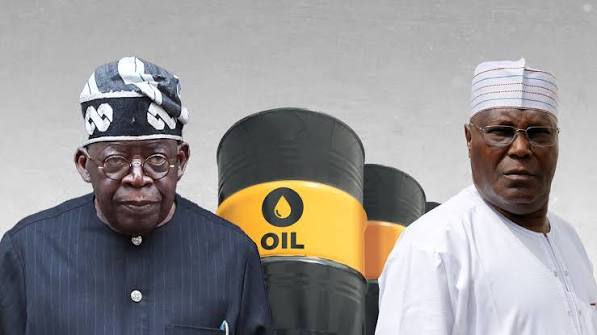
The cost of petrol has emerged as one of the earliest flashpoints of Nigeria’s 2027 election, with former Vice President Atiku Abubakar pressing President Bola Tinubu to intervene and bring energy prices down, even as the Tinubu camp insists the fuel subsidy scrapped in 2023 will not return. The quarrel, carried on through statements from both sides over several weeks, has turned a policy argument into an early test of the economic message each man will take to voters.
The latest round followed remarks in which Tinubu criticised Atiku’s call for lower energy costs and dismissed any return to subsidy. Atiku replied through his Senior Special Assistant on Public Communication, Phrank Shaibu, who said the former vice president would not be drawn into a personal contest and would keep defending measures aimed at easing the cost of living. Shaibu questioned why the administration was promising cheaper transport, more food and relief for the poor only after more than three years of hardship.
Atiku argues that lower energy costs would spread through the economy, cutting transport and production expenses and, in turn, the price of food and other essentials. He put it bluntly in one statement, saying, “You do not govern spreadsheets. You govern human beings.” His proposal, set out in a document his office calls the Atiku Economic Recovery Plan, would subsidise fuel refined inside Nigeria rather than imported products, under what Shaibu described as a capped, transparently budgeted and independently audited arrangement with safeguards against diversion.
Tinubu and his aides reject the plan. In a video address, the president called the push for a return to subsidy a sign of “serious ignorance” of governance and the economy. His spokesman, Bayo Onanuga, asked who would pay for a restored subsidy and what the new pump price would be, while the Minister of the Federal Capital Territory, Nyesom Wike, asked why a politician who once branded subsidy as fraud now wanted it back. The presidency maintains that reversing the reform would undo the gains it credits with steadying public finances.
The dispute carries weight because of what came before. On taking office on 29 May 2023, Tinubu announced that “subsidy is gone”, ending decades of fuel price support and sending pump prices sharply higher. Figures from the National Bureau of Statistics put the average price of petrol at N1,214.17 per litre in November 2024, before it eased to N1,061.35 by November 2025, about 12.6 per cent lower over the year.
The relief did not last. The bureau recorded an average of N1,034.76 per litre in January 2026, but by April the figure had climbed to N1,532.93, a rise of almost 19 per cent in a single month, driven largely by repeated changes to the price the Dangote refinery charges at its gantry and by swings in global crude costs. Prices have stayed unsettled since, leaving households exposed to sudden jumps.
The pressure shows in the wider economy. Headline inflation, measured on a rebased index, has fallen from above 24 per cent in mid-2025 but remains high, rising for three straight months between March and May 2026 to 15.93 per cent before easing to 15.43 per cent in July. The Central Bank of Nigeria had projected an average of about 12.94 per cent for the year, a mark that now looks hard to reach, while food inflation stays severe in states such as Kogi and Benue.
Atiku has also claimed that Nigeria’s pump prices rank among the highest of any oil-producing nation, a comparison the government disputes and one that is hard to measure because fuel is taxed and priced differently across countries. The fuel row runs beside a legal fight that has raised the stakes further. Atiku and the African Democratic Congress, the platform he joined after leaving the Peoples Democratic Party, have asked the Federal High Court in Abuja to bar Tinubu from the 2027 ballot over an alleged discrepancy in a National Youth Service Corps discharge certificate submitted to the Independent National Electoral Commission.
In that suit, marked FHC/ABJ/CS/1888/2026, Tinubu and the All Progressives Congress have denied the allegation and asked for the case to be struck out, while INEC has called it an abuse of court process. The court is due to rule on 20 November 2026 on the plaintiffs’ bid to amend their claim. For now the two sides remain far apart, and the questions that will frame the economic debate before 2027, whether Atiku’s plan truly differs from the old subsidy, what it would cost, and where pump prices finally settle, are still unanswered. it.