
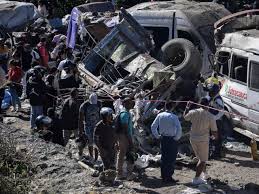
A deadly highway bombing in southwestern Colombia has intensified security concerns ahead of next month’s presidential election, with authorities confirming 21 fatalities and dozens injured in what is now described as one of the worst civilian attacks in decades.
The explosion, which occurred on Saturday in Cauca department, targeted a major road linking Cali and Popayán. Colombia’s Defence Minister Pedro Sanchez said 56 people were injured, while military officials reported that vehicles were overturned and a large crater left at the blast site.
Government authorities blamed the attack on a faction of former rebels opposed to the 2016 peace agreement with the Revolutionary Armed Forces of Colombia. The group is led by Ivan Mordisco, a fugitive whom President Gustavo Petro has publicly described as a major threat, drawing comparisons with late drug lord Pablo Escobar.
Military chief Hugo Lopez stated that attackers blocked the highway using vehicles before detonating the bomb, suggesting a planned operation aimed at maximising civilian casualties. At least 15 women were among those killed.
Security agencies recorded no fewer than 31 coordinated attacks across the southwest over the same weekend, pointing to a surge in violence in the lead-up to the May 31 election. The spike comes as political campaigns intensify, with insecurity emerging as a central issue.
Colombia remains the world’s largest producer of cocaine, with coca cultivation concentrated in regions such as Cauca. Armed groups rely heavily on drug trafficking for funding, complicating efforts to stabilise the region.
Officials have linked the recent violence to ongoing military offensives against rebel strongholds. Sanchez described the attacks as part of a “terrorism wave” and accused armed groups of committing war crimes in retaliation for intensified operations.
Political reactions have exposed sharp divisions ahead of the vote. Right-wing candidate Paloma Valencia blamed the government for rising insecurity, stating that “this government has allowed violence to grow.” She and fellow conservative Abelardo de la Espriella are currently trailing leftist senator Ivan Cepeda in opinion polls.
President Petro, Colombia’s first left-wing leader, is constitutionally barred from seeking a consecutive term but has ordered increased military pressure on armed groups following the collapse of peace efforts with dissident factions.
The Cauca bombing is the deadliest attack on civilians since 2003, when a FARC-linked explosion in Bogotá killed nearly 40 people. Recent months have also seen rising political violence, including the fatal shooting of conservative candidate Miguel Uribe Turbay during a campaign event last year.
With elections weeks away, the incident underscores growing fears about security, governance, and the durability of Colombia’s fragile peace framework.