
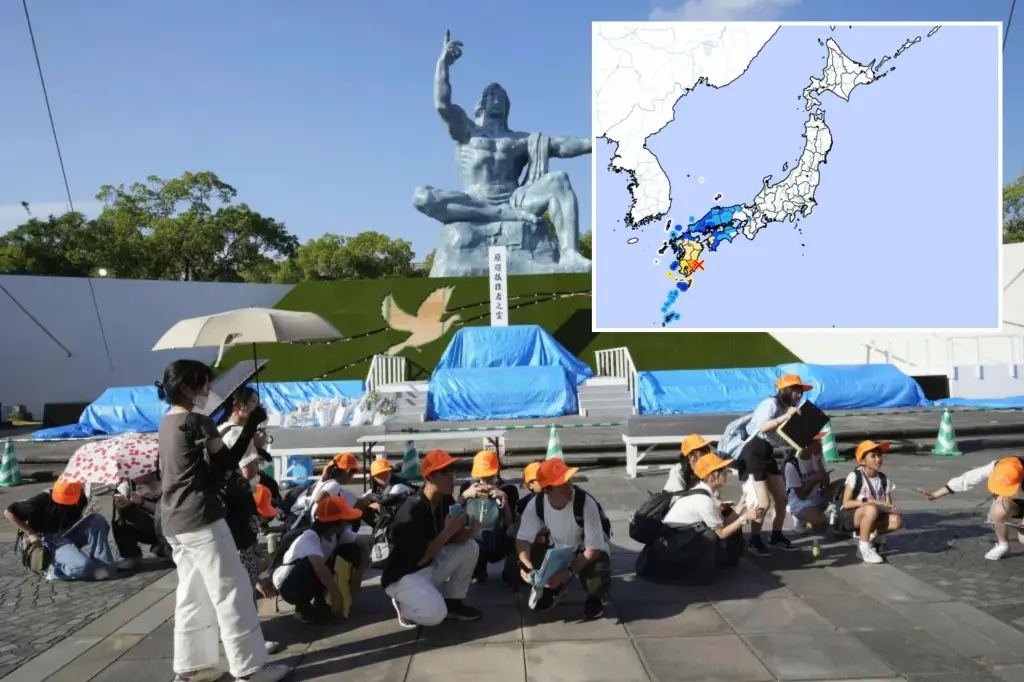
A powerful earthquake measuring 7.1 in magnitude struck Kumamoto Prefecture on Japan’s southern island of Kyushu on Tuesday afternoon, triggering a tsunami advisory, cutting power to tens of thousands of homes and sending residents scrambling for safety in one of the country’s most seismically active regions.
The Japan Meteorological Agency said the tremor hit at about 4:35 p.m. local time and registered the maximum reading of shindo 7 on the nation’s seismic intensity scale in parts of the affected area, the strongest possible level of shaking. The agency recorded the rare shindo 7 in the cities of Uki and Hikawa, where, at that intensity, people are unable to remain standing and unsecured furniture can be thrown into the air.
Authorities issued a tsunami advisory for coastal areas of the Ariake and Yatsushiro seas, warning of waves of up to one metre, and urged people to move away from the shoreline. The first wave was believed to have reached those waters shortly after the quake, with further surges anticipated. Emergency earthquake warnings were relayed across seven prefectures on Kyushu, namely Kumamoto, Nagasaki, Kagoshima, Fukuoka, Saga, Oita and Miyazaki.
An aftershock measuring a lower 5 on the intensity scale struck the same area roughly 30 minutes later, and the meteorological agency cautioned that further strong tremors could follow in the days ahead.
Kyushu Electric Power reported that about 48,300 households in Kumamoto Prefecture lost electricity, and appealed to residents not to touch fallen power lines. The utility said three nuclear reactors operating in the region at the time of the quake continued normal operations. The Nuclear Regulation Authority said no abnormalities were detected at nuclear facilities in the immediate aftermath.
There were no immediate reports of casualties or widespread structural damage, though officials said the assessment of roads, rail networks and public utilities was still under way. A staff member of public broadcaster NHK, reporting live while wearing a helmet, described the newsroom shaking so violently that it was difficult to stand.
The latest disaster revives painful memories in Kumamoto, which was devastated a decade ago. Two earthquakes struck the city in April 2016, a magnitude 6.5 tremor followed two days later by a magnitude 7.3 quake, killing more than 270 people and injuring over 2,800. Kumamoto Castle, one of the region’s most treasured landmarks, suffered heavy damage in those disasters, and restoration work is not expected to be completed until 2052.
Japan sits along the Pacific Ring of Fire, a belt of intense seismic and volcanic activity, and rests on four major tectonic plates at the western edge of the Pacific. The archipelago, home to roughly 125 million people, records hundreds of tremors each year and accounts for close to a fifth of the world’s earthquakes of magnitude 6.0 or greater. Most are mild, with the damage depending largely on their location and depth.
Tuesday’s quake is the latest in a run of strong jolts this year. On April 20, a magnitude 7.7 earthquake in northern Japan injured at least 10 people and shook tall buildings in Tokyo, prompting authorities to issue a special advisory warning of a heightened risk of a magnitude 8.0 or stronger quake. That advisory was lifted after a week. On June 25, a magnitude 7.2 tremor struck the north of the country without causing deaths or major damage.
The nation remains haunted by the catastrophe of March 2011, when a magnitude 9.0 undersea earthquake unleashed a tsunami that killed or left missing around 18,500 people and triggered the meltdown at the Fukushima nuclear plant, the worst atomic accident since Chernobyl.
Officials urged residents in the affected areas to stay clear of the coast, remain alert to aftershocks and follow updates issued through official channels as the situation continued to unfold.