
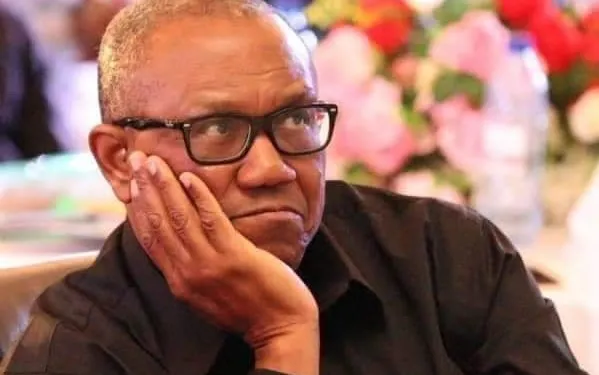
Public frustration over a biting cash squeeze and fuel scarcity, rather than any durable political followership, delivered Peter Obi his surprise gains in the 2023 presidential election, Senator Adams Oshiomhole has argued, insisting the former Anambra governor poses no serious threat to the ruling All Progressives Congress ahead of 2027.
The Edo North senator and former APC national chairman made the claim on Monday during an appearance on TVC News’ Beyond the Headlines, hosted by Nifemi Oguntoye. Asked whether his party was underrating Obi after his win in Lagos and strong showing in the South East three years ago, Oshiomhole was dismissive.
“Obi was produced by an unusual situation when a ruling party decided to destroy itself, making anybody running on its platform almost unelectable. It was that confusion that produced those votes,” he said.
He traced the discontent to the naira redesign policy introduced under former Central Bank Governor Godwin Emefiele during the final months of Muhammadu Buhari’s administration, saying it “virtually confiscated people’s money” and turned voters against the APC in Tinubu’s home state. “People had money in the bank but couldn’t access it. They queued all night at ATM machines just to withdraw ₦10,000, and after a week, even the ATMs were dry,” he said.
Recalling a conversation in his village, the senator quoted a constituent: “You said I should keep my money in the bank, but when I went to collect it, they said there was no money. At the POS, they deducted ₦2,000 from ₦5,000. How do I survive?” He maintained the hardship “was not APC policy.”
Oshiomhole went further, describing Obi as “a trader” with “short term calculations” and a “political wanderer” who abandoned the All Progressives Grand Alliance after leaving office as Anambra governor.
The official figures underline why Obi’s 2023 run unsettled the establishment. The Independent National Electoral Commission declared Bola Tinubu winner with 8,794,726 votes (36.61 percent), ahead of Atiku Abubakar of the Peoples Democratic Party with 6,984,520 (29.07 percent) and Obi with 6,101,533 (25.40 percent). Rabiu Kwankwaso of the New Nigeria Peoples Party trailed with 1,496,687. Total votes cast stood at about 24.9 million from 93.4 million registered voters.
Running for the first time on a third party platform, Obi swept much of the South East and won Lagos, Abuja and several other states. In Lagos, he defeated Tinubu on home turf, including in Alimosho, the state’s largest local government and a traditional APC stronghold. He polled 281,717 votes in the Federal Capital Territory, taking four of its six area councils, and recorded landslides in Anambra, Abia and Enugu.
The cash crisis he cited was rooted in the CBN’s October 2022 decision to redesign the ₦200, ₦500 and ₦1,000 notes. The rollout triggered severe scarcity in the weeks before the February 25, 2023 poll, sparking protests across several states as citizens struggled to access legal tender.
The political terrain has since shifted. Obi has left the Labour Party amid its protracted leadership crisis and now flies the flag of the Nigeria Democratic Congress for 2027, having reaffirmed a pledge to serve a single term if elected. He has also alleged that the federal government is targeting his business interests, a claim the presidency has rejected.
Analysts remain divided. Some contend that the conditions behind the 2023 protest vote have eased, while others note that Obi drew millions of votes without the backing of state governors, a sign that voter sentiment can diverge sharply from party structures.