
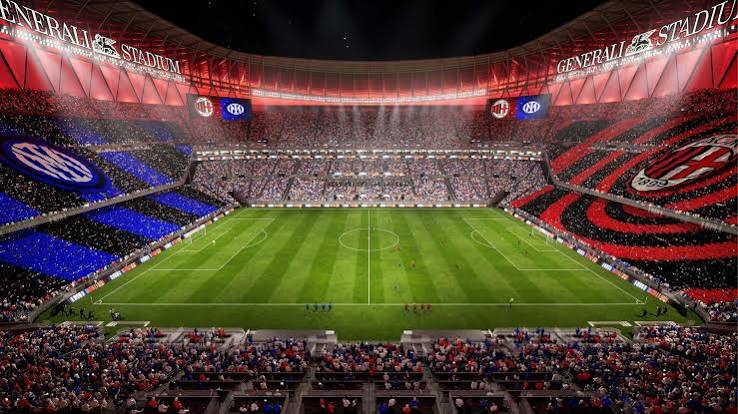
Inter Milan and AC Milan have unveiled plans for a new shared stadium, the Generali Stadium, which will replace the iconic San Siro from the 2031/32 season.
The design, presented in Milan on Thursday by architect Norman Foster and stadium specialist David Manica, will seat 71,500 spectators, slightly fewer than the current San Siro’s 75,000, and will cost the two clubs 1.2 billion euros. Both clubs paid 197 million euros to acquire the existing stadium and its adjacent parking areas, where the new arena will rise.
Foster and Manica, who previously worked together on London’s Wembley Stadium, said the guiding principle of the design is closeness. The building sits low in the body and rises at either end behind the goals, where the stands climb at a steep 37-degree incline, bringing supporters almost level with the play.
“The most important thing that we realised when we designed this project is that the San Siro is a feeling,” Manica said at the presentation. “It’s more than a building, it’s a feeling, and everything that we needed to do here was to carry it into the (new) building.”
He said the team started with proximity. “We brought all the seats as close as possible to the field. They could not be any closer, it’ll actually feel as though you’re sitting on the grass,” he said. “This building is steeper than many other new buildings are built today, and that’s intentional, because it allows us to bring those seats up and over the field as much as possible, and create that sense of intimacy and atmosphere.”
Sound received equal attention. The roof covers the stands and leaves only the pitch open to the sky, and it is designed to amplify the roar of the crowd back into the bowl. “I want the crowd to come to the new stadium and to feel that excitement that they felt before, and to feel the building, living and breathing with them as it does currently,” Manica said.
Sponsored by the Italian insurance giant Generali, the venue is built for more than football. It will be capable of hosting American football, rugby and concerts, giving the clubs a year-round source of income that the 1926 original was never designed to provide.
San Siro, officially the Giuseppe Meazza Stadium and often called a “concrete cathedral”, is the largest stadium in Italy and one of the most storied grounds in European football. It has hosted European Cup finals, World Cup matches and nearly a century of the Derby della Madonnina. But after decades of renovations, it no longer meets the needs of spectators or the clubs, and the two sides, whose rivalry is among the fiercest in football, have long shared the same home.
Under the plan, construction begins in 2028, with the first match targeted for the 2031/32 season, subject to the necessary approvals. San Siro will be largely demolished once work on the new stadium nears completion, meaning Milan will lose a landmark that has defined Italian football for a hundred years.
The project has not been universally welcomed. Opponents of the demolition gathered outside the presentation, with some chanting “hands off San Siro”, and heritage campaigners have fought the clubs’ stadium plans in the courts and the town halls for years. The purchase of the site, however, gives the two clubs firm legal ground to proceed.
For the clubs, the numbers explain the urgency. A modern 70,000-seat arena with premium seating, naming rights and non-football events is among the most profitable assets in world football, and both Milan clubs have watched rivals across Europe, from Tottenham to Real Madrid, open stadiums that earn far more than San Siro does. The Generali Stadium is their answer, and from 2031, football in Milan will have a new cathedral on the same ground where the old one stands.