
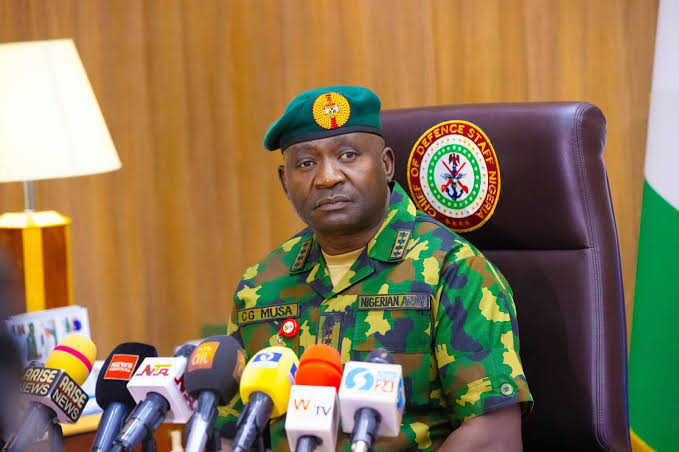
Nigeria’s rank-and-file soldiers now take home a minimum of N100,000 a month, more than double the N49,000 they earned only a couple of years ago, yet the country’s defence chief concedes that the money flowing into the armed forces still falls short of what the war against insurgency and banditry demands.
Defence Minister Christopher Musa disclosed the pay adjustment during an interview with News Central, aired on Wednesday ahead of the station’s NC Exclusive programme. Asked whether the current defence allocation was sufficient for the military’s operational needs, he gave a blunt answer. “It’s not enough,” Musa said. Recalling how far troop welfare had come, he added, “When they started, a soldier was collecting N49,000 monthly. We tried so hard, now he’s collecting N100,000.”
The revised salary floor is not entirely new. As far back as September 2025, Musa, then serving as Chief of Defence Staff, told the same broadcaster that no soldier earned below N100,000, describing the figure as still modest against the cost of living. The pay history is telling. In December 2023, Musa publicly lamented that some soldiers earned under N50,000 a month, while officers of every rank, himself included, received just N1,200 daily as operation allowance. The doubling of the base salary tracks the broader wage reset that followed President Bola Tinubu’s signing of the N70,000 national minimum wage into law in July 2024, up from N30,000.
The welfare concerns sit against a defence budget that looks large on paper but thin in real terms. The 2026 Appropriation Act earmarked N3.154 trillion for the Ministry of Defence, with roughly N2.392 trillion, about 76 per cent, swallowed by personnel costs. The Nigerian Army alone took N1.504 trillion. When wider security votes are folded in, the figure rises to around N5.41 trillion. Yet analysts at the International Institute for Strategic Studies noted that the 2026 allocation, though a nominal 2 per cent rise on 2025, actually contracts by 8.5 per cent once inflation is factored in. Headline inflation stood at 15.93 per cent in May 2026, its third straight monthly rise. Over 15 years, Nigeria has committed an estimated N32.88 trillion to defence and security.
Musa used the interview to push for tougher deterrence against kidnapping, backing the death penalty for convicted abductors. “There must be deterrence. The laws are soft, and that’s why people take advantage,” he said.
Turning to the abduction of schoolchildren in Oyo State, the minister alleged the captors were seeking leverage. “They feel taking these kids and holding them to ransom will make us release their commander,” he said, adding that the kidnappers had threatened to kill the children if troops closed in. The remarks come nearly eight weeks after gunmen seized 39 pupils and seven teachers from the Baptist Nursery and Primary School, Yawota.
He also dismissed viral claims of poorly fed troops, alleging that a soldier known online as Justice Crack staged a misleading video. “The soldier’s food was okay. There was meat and other items, but he told them to remove those things,” Musa said.
Nigeria’s forces remain stretched across insurgency in the North East, banditry in the North West, separatist agitation in the South East and kidnapping nationwide.