
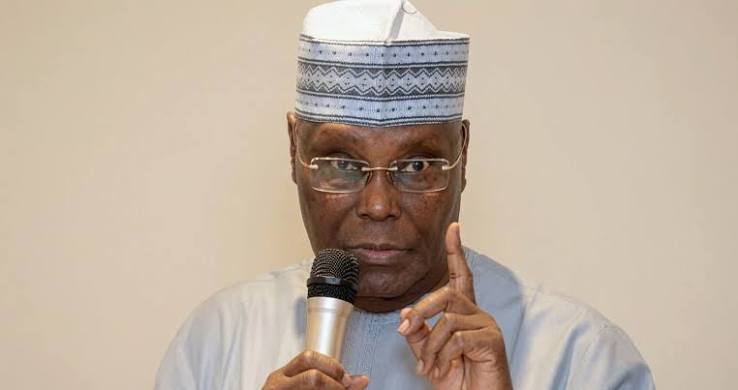
A single unsolicited bank transfer has pushed Nigeria’s fragile financial privacy regime back into national conversation, barely twelve days before campaigning formally opens for the 2027 presidential election.
Former Vice President Atiku Abubakar, presidential candidate of the African Democratic Congress, said on Friday that an unknown person paid money into one of his private accounts with the narration “Contribution Electioneering Campaign.” The disclosure came in a statement issued on August 7, 2026 by his Senior Special Assistant on Public Communication, Phrank Shaibu, who said the transaction originated from an individual unknown to the former vice president. Neither Atiku nor his campaign, according to the statement, solicited, authorised or has any knowledge of the individual or entity behind the unauthorised payment.
The complaint, as framed by the Atiku camp, is not principally about the money. It is about how the account was found. “The account is a strictly private one whose details are not in the public domain. This raises a fundamental question: How did unknown persons obtain the confidential banking details of a private citizen?” the statement read. It went further: “If the private banking information of a former Vice President and a leading presidential candidate can be accessed and deployed for reasons yet unknown then no Nigerian’s financial privacy is safe.”
The statement also raised the possibility of insider involvement, saying it was “even more disturbing” that such information “may have been obtained through persons with privileged access,” and warned that if established, “this would amount to a grave abuse of power capable of exposing the account holder to kidnappers, terrorists, bandits, fraudsters and other criminal elements.” Atiku said the public and security agencies had been notified, describing the episode as “this latest incident in a litany of suspicious activities leading up to next year’s general elections,” and urged Nigerians not to be distracted by “tired tactics that smack of character assassination.” Such “desperate antics have failed before and will fail again,” he added, saying “The Waziri Adamawa remains focused on offering Nigerians credible leadership and practical solutions to the nation’s challenges.”
The claim lands in a compressed electoral calendar. President Bola Tinubu signed the Electoral Act 2026 on February 18, 2026, and INEC subsequently brought forward the polls, fixing the presidential and National Assembly elections for January 16, 2027 and the governorship and state assembly elections for February 6, 2027, from the earlier dates of February 20 and March 6. Under the revised timetable, campaigns for the presidential and National Assembly elections commence on August 19, meaning any campaign contribution received today falls outside the statutory campaign window.
That window matters legally. Election expenses under Nigerian law are counted from the date INEC issues notice of election, and the new statute has substantially loosened the money rules. The Electoral Act 2026 raised the presidential spending ceiling from N5bn to N10bn, and lifted the individual donation cap tenfold, from N50m to N500m. The threshold above which a donor’s name and address must be recorded by a party also rose from N1m to N100m, a hundredfold increase that the Policy and Legal Advocacy Centre said “significantly narrows the disclosure net.” PLAC further noted that the 2022 requirement obliging parties to identify the source of donations above N50m to INEC has been removed in the 2026 Act.
The practical consequence is that an anonymous “electioneering contribution” into a candidate’s personal account now sits in a thinner regulatory net than it would have two years ago, while the penalty framework, in PLAC’s assessment, remains stronger on paper than in practice. The centre observed that INEC “has historically lacked the investigative capacity and prosecutorial leverage to pursue campaign finance violations at scale,” and that similar provisions in the 2022 Act “were rarely enforced.”
Atiku’s broader claim, that ordinary Nigerians are exposed, is testable against published figures. NIBSS data put registered Bank Verification Numbers at 68.6 million as at March 2026, while total active bank accounts stood at more than 320 million as at March 2025, with the BVN database reaching 69.55 million by July 5, 2026. That gap between verified identities and live accounts is the terrain on which identity abuse operates.
On fraud, the trend is of fewer but heavier incidents. Financial institutions recorded N25.85bn in fraud losses in 2025, down from N52.26bn in 2024, even as NIBSS identified insider abuse as the single greatest threat within social engineering fraud. The Financial Institutions Training Centre reported that employee related fraud cases fell to 63 in the first quarter of 2025 from 91 in the last quarter of 2024, with staff terminations dropping to 23, yet losses tied to those cases rose 137 per cent to N3.3bn despite 33.8 per cent fewer reported incidents. FITC also recorded 12,347 fraud cases in the first quarter of 2025, a 7.63 per cent rise, with 7,361 on web platforms, 2,875 via mobile and 1,559 through PoS terminals. Fraud through bank branches, a channel that typically requires insider access, climbed to nearly N8bn in the same quarter.
Nigerian law already contemplates precisely the scenario Atiku describes. Section 19(3) of the Cybercrimes Act obliges financial institutions to put in place effective counter fraud measures to safeguard sensitive customer information, and the banker’s implied duty of confidentiality remains a settled feature of the customer relationship. Enforcement of data protection has meanwhile tightened. The Nigeria Data Protection Commission said it concluded 246 investigations producing 11 enforcement actions under the Nigeria Data Protection Act 2023, and in August 2025 issued compliance notices to 1,369 organisations, including 795 financial institutions, giving them 21 days to show evidence of compliance. Fines for data controllers of major importance can reach the higher of N10m or two per cent of annual gross revenue, with penalties already imposed including N766,242,500 against MultiChoice Nigeria and N555.8m against Fidelity Bank for processing personal data without lawful basis and informed consent.
Atiku’s reference to a “litany” is consistent with earlier statements. On June 29, 2026, through the same spokesman, he alleged “credible information” of political and legal manoeuvres aimed at keeping the ADC off the 2027 ballot, and in May, after winning the party’s ticket, he accused the ruling party of using state institutions against the opposition, saying “Once a person joins the APC, the harassment by security and anti-corruption agencies ceases, and the charges against them magically disappear.” He polled 1,846,370 votes at the nationwide ADC primary declared in Abuja in late May, ahead of Rotimi Amaechi with 504,117 and Mohammed Hayatu-Deen with 177,120.
The week’s other financial controversy sharpened the framing. The EFCC moved against an Osun State Government account amid an investigation opened in March into the alleged fraudulent handling of about N11bn in Ecology Funds, Intervention Funds and FAAC allocations, prompting the state to file suit FHC/ABJ/CS/1762/2026 seeking N2bn in damages, and President Tinubu to direct the commission to return to court and vacate the order. Reacting through Shaibu, Atiku said, “It is impossible to ignore the implications of freezing a state’s principal operational account on the eve of a governorship election.”
No bank has been named publicly, no amount disclosed, and no regulator or security agency had confirmed an investigation as at the time of writing. The claim therefore remains, at this stage, an allegation by the candidate’s office. Verification would ordinarily turn on the audit trail: the sending account, the BVN behind it, and the internal logs showing who, if anyone, queried the account details.
Three institutions have standing to act. The NDPC can treat any confirmed leak as a breach under the 2023 Act; the CBN, which introduced a revised BVN framework in 2026 requiring banks to maintain a temporary watch list of BVNs linked to suspected fraudulent transactions, can compel institutional review; and the EFCC and police can pursue the criminal dimension. Whether any of them opens a file, and how quickly, will be the first real measure of the point Atiku has raised: not whether one politician received an unexplained credit, but whether the systems holding 320 million bank accounts can say with confidence who is looking at them.