
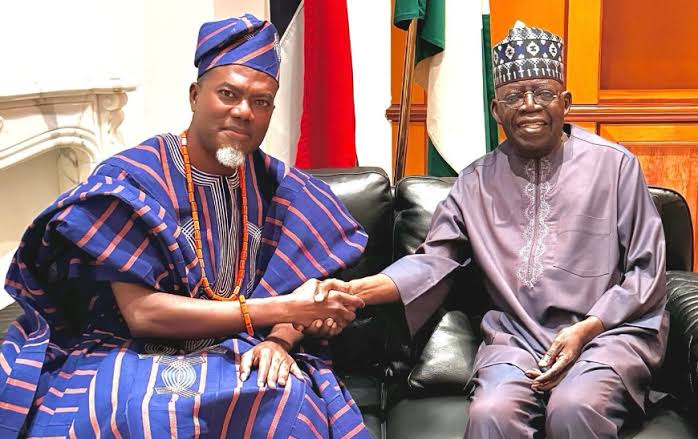
A senior Nigerian official has publicly acknowledged that a United States federal investigation involving people connected to President Bola Tinubu did take place, while insisting the President himself was never its target, adding a fresh voice to a controversy that has followed Tinubu for more than three decades and that has resurfaced through an ongoing records case in a Washington court.
Reno Omokri, Nigeria’s ambassador designate to Mexico, made the acknowledgement on Channels Television’s Politics Today programme, broadcast on Sunday. He said the matter had been distorted by what he described as a misleading interpretation of Tinubu’s link to funds that came under scrutiny by American authorities, arguing that the President was working as an accountant at the time and held money belonging to clients who were themselves under investigation. “There was an investigation. Bola Ahmed Tinubu was not the subject of that investigation,” Omokri said, repeating the point later in the interview. He said the funds were forfeited after being flagged as suspicious, and that the action was taken against the accounts rather than against Tinubu personally. He also cited a document he dated to 2003 which, he said, showed no criminal arrest record or outstanding warrant against Tinubu, while declining to name those investigated on the grounds of protecting their families.
Omokri’s comments are significant partly because of who is making them. For years he was among Tinubu’s most vocal critics and had, in a 2023 Arise News interview, claimed to hold documentary evidence that Tinubu was a drug dealer, a clip that resurfaced in January 2026 during activist Omoyele Sowore’s cybercrime trial. Omokri has since said withdrawn statements cannot be used to establish the truth of later allegations, and now serves as a government appointee.
The underlying facts of the 1990s matter are documented and largely undisputed in their essentials, even as their meaning remains fiercely contested. In July 1993, the US government filed a civil forfeiture action in the US District Court for the Northern District of Illinois, case number 93 C 4483, targeting funds in bank accounts connected to Tinubu, then a private businessman. The case rested on an affidavit by Internal Revenue Service Special Agent Kevin Moss, who alleged that money in accounts at First Heritage Bank and Citibank was tied to proceeds from a Chicago based heroin network run by Adegboyega Mueez Akande and Abiodun Agbele. American authorities had frozen more than 1.4 million dollars linked to Tinubu in January 1992. Tinubu contested the action, saying the money belonged legitimately to him, his wife Oluremi Tinubu and his foster mother, Alhaja Abibatu Mogaji.
The case never went to trial. It was resolved by settlement, and Judge John A. Nordberg ordered 460,000 dollars held in the First Heritage Bank account forfeited to the US government, with the remaining funds released back to Tinubu. Court records show the matter was dismissed with prejudice, formally closing it. Crucially, a civil forfeiture is an action against property rather than a criminal prosecution against a person, and it requires neither a charge nor a conviction. There is no record of Tinubu being indicted, tried or convicted in connection with the case.
That distinction became central to Nigerian law during the last election cycle. Atiku Abubakar, then of the Peoples Democratic Party, and Peter Obi of the Labour Party both argued before the Presidential Election Petition Court in 2023 that the forfeiture should have disqualified Tinubu. The court rejected the argument, holding that the petitioners had not shown that Tinubu was indicted, charged, tried, convicted or sentenced for any offence, and that civil forfeiture targets property rather than the owner. The Supreme Court subsequently upheld Tinubu’s election.
The current phase began not in Nigeria but in the United States. Between 2022 and 2023, American transparency campaigner Aaron Greenspan filed a series of Freedom of Information Act requests with six US agencies, including the FBI, the DEA, the IRS, the CIA, the State Department and the Executive Office for US Attorneys, seeking records tied to the early 1990s Chicago investigation and naming Tinubu among four individuals. Several agencies initially issued what is known as a Glomar response, declining to confirm or deny whether records existed. In April 2025, Judge Beryl Howell of the US District Court for the District of Columbia ruled that those responses were “neither logical nor plausible”, given that Tinubu’s name had already appeared in prior investigations, and ordered the FBI and DEA to process the records.
Those agencies later produced 399 pages, with sections withheld or redacted. According to a clarification issued on 3 September 2026 by the President’s Special Adviser on Information and Strategy, Bayo Onanuga, the agencies justified the redactions on five grounds under US law: grand jury secrecy, attorney client privilege, law enforcement sensitivity, personal privacy, and the protection of confidential sources and investigative techniques. Tinubu, who moved to intervene in the case in October 2023 citing his privacy interests, has separately invoked FOIA Exemption 7(C).
The Presidency has been firm on the character of the proceedings. Onanuga described the matter as “a civil records disclosure dispute” under FOIA, adding that it “is not a criminal case against President Bola Ahmed Tinubu, nor has the court found him guilty of any criminal wrongdoing”. He said the outstanding question before the court was narrow, namely whether the FBI and DEA redactions were lawful, and that the case remained under the control of Judge Howell. According to the Presidency, the plaintiff had until 11 September 2026 to file any opposition, with the FBI, DEA and Tinubu’s team given until 18 September to respond. Onanuga also disputed suggestions that Atiku or a US lobbyist, Karl von Batten of Von Batten Montague York, were parties to the case, stating that neither is formally involved. That lobbying firm has itself questioned the authenticity of the 2003 records check Omokri has relied on.
What is confirmed can be stated plainly. A US federal investigation existed. A civil forfeiture of 460,000 dollars took place in 1993 and was settled without a trial. Nigerian courts, up to the Supreme Court, have held that the forfeiture does not amount to a criminal conviction and does not disqualify Tinubu. A US court has ordered the release of related records, 399 pages have been produced, and the remaining legal question concerns whether the redactions are lawful. What is not established is anything beyond that: no US court has convicted Tinubu of a crime, and the contents of the withheld pages are not public.
The timing gives the matter its charge. The dispute is unfolding as the 2027 campaign takes shape, with Atiku, now the African Democratic Congress candidate, separately pursuing a suit at the Federal High Court in Abuja challenging Tinubu’s eligibility on unrelated grounds. That case has been adjourned to 28 September. For now, the FBI records controversy rests where Judge Howell’s court leaves it, and any further clarity will come from the pages still sealed and from a ruling yet to be delivered.