
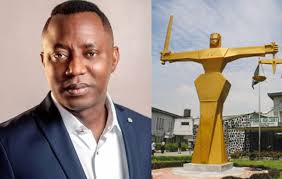
Publisher and activist Omoyele Sowore has informed the Federal High Court in Abuja that he will represent himself in his defence against alleged cyberbullying charges by the Department of State Services pending the reconstitution of a new legal team.
Sowore made the indication before Justice Mohammed Umar on Friday when the matter came up for the defendant to open his defence. The judge had on Thursday directed that the trial proceed on a day to day basis after declining a request for a long adjournment.
Sowore is facing prosecution over a social media post on his X and Facebook accounts in which he allegedly referred to President Bola Tinubu as a criminal. The DSS alleges the statement amounts to cyberbullying.
On Friday only the DSS counsel, Akinlolu Kehinde SAN, was in court when the case was called. Sowore’s lawyer, Marshall Abubakar, was absent. When asked about his counsel’s whereabouts, Sowore told the court that following the previous day’s ruling on day to day hearing his lawyers had indicated they were afraid to appear because of humiliation they suffered before the court.
He added that pending the time he reconstitutes a new legal team he would represent himself. Sowore noted it was his constitutional right to choose lawyers to represent him in any trial in Nigeria.
He informed the court of two applications he had filed, one of which was a motion on notice dated June 4 2026 for recusal on grounds of bias and humiliation. The DSS lawyer did not object to the defendant moving the application.
In support of the motion Sowore cited Section 36(1)(5) and (6) of the 1999 Constitution and prayed for an order directing the judge to recuse himself or withdraw from the case.
Kehinde opposed the application and described it as an abuse of court process meant to annoy and irritate the court. He argued the application was fundamentally incompetent because it lacked the name of the counsel who prepared it. The judge however noted from the court record that Marshall Abubakar had signed the copy in the file and stated he would not condone any technical move.
Kehinde further submitted that the court was bound by a letter from the Chief Judge dated May 22 directing that the matter proceed and that there was a subsisting order for the defence to commence that day or face foreclosure. He urged the court to refuse the application.
Justice Umar said he would go through the defendant’s process to do justice to the application and adjourned the matter to Monday for ruling. Sowore begged for more time to get lawyers in view of the Democracy Day celebration and noted he had attended the case from day one. The judge reminded him of the earlier order for day to day hearing and adjourned the case to June 15 for ruling on the recusal application and for the defence to open.
This hearing forms part of a broader pattern in which cybercrime laws have been invoked in matters involving public criticism and social media expression. Data from press freedom organisations show that Nigeria ranked 122 out of 180 countries in the 2025 World Press Freedom Index. Reports indicate that at least eight journalists and media workers have been arrested, prosecuted or detained under the Cybercrimes Act since its 2024 amendments despite efforts to address concerns over its application to legitimate reporting. Committee to Protect Journalists records note at least three journalists detained on cybercrime allegations in recent months and over 25 such prosecutions in earlier periods.
Section 36 of the 1999 Constitution guarantees the right to fair hearing within a reasonable time by an independent and impartial court. Applications for recusal on grounds of perceived bias are recognised mechanisms to uphold that guarantee. Court records in high profile matters frequently show procedural steps such as no case submissions, orders for day to day proceedings and requests for judicial withdrawal as parties navigate constitutional safeguards and case management directives.
The June 15 date will determine the next phase of the proceedings.