
Nine days before Osun State votes for a governor, a single line of instruction to a commercial bank has pulled the state’s finances, its politics and the limits of federal anti graft power into open conflict.
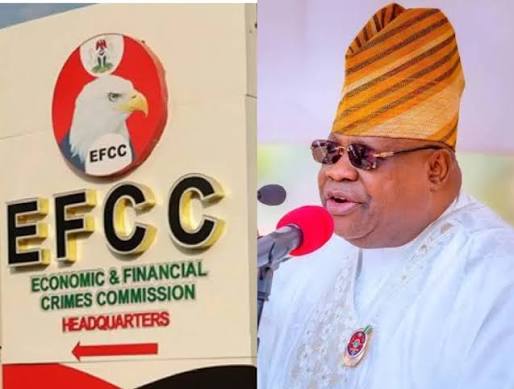
The Economic and Financial Crimes Commission on Wednesday, August 5, 2026, directed First Bank to place a post no debit restriction on an account designated “Osun State Government Statutory Allocation,” bearing account number 2017170947. The letter, referenced 3000/EFCC/ABJ/HQ/PFS/TA/OSUN/VOL.17/666 and signed by Assistant Commander Adenike Babalola for the Director of Investigation, was addressed to the bank’s Managing Director and made reference to earlier correspondence dated April 15, 2026.
By Thursday morning, the Osun State Government had issued its firmest rebuttal yet. Commissioner for Information and Public Enlightenment, Kolapo Alimi, in a statement posted on X, dismissed the commission’s reported claim of an ₦11bn loss as “a failed attempt to cover up illegal action through unfounded allegations.”
The EFCC’s Head of Media and Publicity, Dele Oyewale, said in a statement that the commission had been probing the state government since March 2026 over the alleged fraudulent handling of Ecology Funds, Intervention Funds and Federation Account Allocation Committee receipts totalling about ₦11bn, and that several officials, particularly the state’s Accountant General, had been interviewed.
Crucially, the commission said the probe alone did not trigger the restriction. “These ongoing investigations of the state government would not have warranted any placement of Post No Debit order on its account but for the precipitate and unwarranted movement of funds from the accounts to different suspicious accounts since August 2, 2026,” the statement read, adding that it “noticed huge transfers of funds into different corporate entities and had to swiftly halt the trend.”
The timing question was met head on. “While the commission is fully aware of the impending governorship election in Osun State, it has a responsibility to act in defence of the sanctity of the funds of the state,” it said, adding that other states were also on its investigative radar and urging the public “to ignore false narratives and deliberate demonization of the works of the EFCC.”
Speaking on Arise Television on Thursday, the commission’s Director of Public Affairs, Wilson Uwujaren, narrowed the scope of what had been done. “That restriction order does not mean that all the accounts of Osun State have been frozen. No. It is just a targeted restriction on one account of the Osun State Government,” he said, adding that it would be lifted once activity on the account no longer appeared suspicious. On legality, he cited “Section 34 of the EFCC Act and Section 7, Subsection 6 of the Money Laundering (Prohibition) Act 2022,” and said such an order “can last within 72 hours before we can come with a court order.”
The state government’s position rests on motive rather than mechanics. It alleged the commission acted at the instance of former Governor Gboyega Oyetola, now Minister of Marine and Blue Economy, to block a promised workers’ subsidy. “The real reason the commission froze the state account on the order of Gboyega Oyetola was to stop the payment of palliatives which the state government promised the workers some months ago,” the statement said, adding, “Fortunately, we have paid the palliatives to all Osun State workers,” and noting the subsidy “was not the first time such a cost of living subsidy was paid to Osun workers.” Premium Times reported that the state had begun transferring ₦20,000 each to civil servants and corps members.
The government further stated: “All material facts point to the fact that the commission is pursuing a hatchet job for the Osun APC by illegally freezing the state account and falsely accusing the government of looting ecological and other state funds,” and declared, “We don’t loot public funds in Osun State; we deliver on public goods and services.”
It described the probe as “a witch-hunting investigation since March, 2026, without any indicting evidence against top officials,” insisting that “there is no fund to loot in Osun State as the little resources we have are expended on the many mega projects, workers welfare and sectoral developments for the benefit of the masses.” On procedure, it argued: “Assuming but not conceding that the EFCC has any evidence of looting as posited, there are established procedures for bringing suspects to book instead of a politically motivated, unlawful freezing of government accounts without recourse to the rule of law.” It closed by calling the commission’s explanation “an afterthought.”
Attorney General and Commissioner for Justice, Oluwole Jimi-Bada, said he had the governor’s mandate to head to the Federal High Court, stating, “EFCC can investigate the accounts but it can’t freeze the accounts without order of court.”
Nigerian Bar Association President Afam Osigwe (SAN), in comments, said no agency may restrict withdrawals from a state’s account because “the order has the effect of grounding the activities of a government,” describing a blanket order as unconstitutional and possibly “an abuse of power.”
Adeyinka Olumide-Fusika (SAN) said courts “have been consistent on that: don’t do it without a court order.” Isiaka Olagunju (SAN) called the action “a serious infraction of the Constitution of the Federal Republic of Nigeria, 1999, as amended.”
Not all readings converged. Wolemi Esan (SAN) drew the same 72 hour line the commission relies on, stating that beyond that window “it ought to obtain an interim freezing order under Section 34 of the EFCC Act.” Professor Damilola Olawuyi (SAN) said the commission “has inherent statutory powers to take anticipatory measures,” while warning such powers “should not be used as a cudgel to settle political scores.”
The dispute is not new. When the EFCC restricted then Ekiti Governor Ayodele Fayose’s account in June 2016, the same argument, that a prior ex parte court order is a condition precedent under Section 34, dominated legal commentary.
Osun is not a wealthy state. FAAC records show its allocation fell from ₦141.48bn in 2023 to ₦97.21bn in 2024, recovered to ₦144.9bn in 2025, and stood at about ₦40.1bn in the first quarter of 2026, ranking it 31st among the 36 states over that quarter.
Layered on that is an unresolved council funding row. A review of FAAC data by SaharaReporters put statutory allocations withheld from Osun’s 30 local governments between March 2025 and May 2026 at ₦201.962bn, following the disputed February 22, 2025 council elections. Governor Ademola Adeleke, in a January 2026 statewide broadcast, had put the figure then at about ₦130bn, warning that the money funds “primary school teachers, nurses, and other health workers.”
INEC has confirmed 2,339,233 registered voters across 3,763 polling units in 332 registration areas and 30 local governments for the August 15 election, moved from an earlier August 8 date. Fourteen parties are on the ballot. Adeleke, who left the PDP in December 2025 and now flies the Accord flag, seeks a second term against the APC’s Bola Oyebamiji and the ADC’s Najeem Salaam, among others. He won in 2022 with 403,371 votes to Oyetola’s 375,027, a margin of 28,344.
Turnout is the quieter risk. Dataphyte’s analysis of past polls put 2022 participation at 42.09 per cent, the lowest in the state’s history.
The ADC, YPP, SDP, LP and NDC have condemned the restriction, with the ADC’s Bolaji Abdullahi calling it “political terrorism.” The APC’s Director of Publicity, Bala Ibrahim, countered that the commission “would not act outside the law,” noting the account belongs to the state, not the governor.
Whether the restriction lapses at 72 hours or is converted into a judicial order will now likely be settled at the Federal High Court, with the ballot only days away.