
The killing of a retired general in captivity has pushed the Senate to draw a firm line against one of Nigeria’s longest-running counter-insurgency tools, with lawmakers demanding that captured terrorists be prosecuted rather than resettled, even as the Army announced the surrender of two senior Boko Haram commanders barely a day before the resolution.
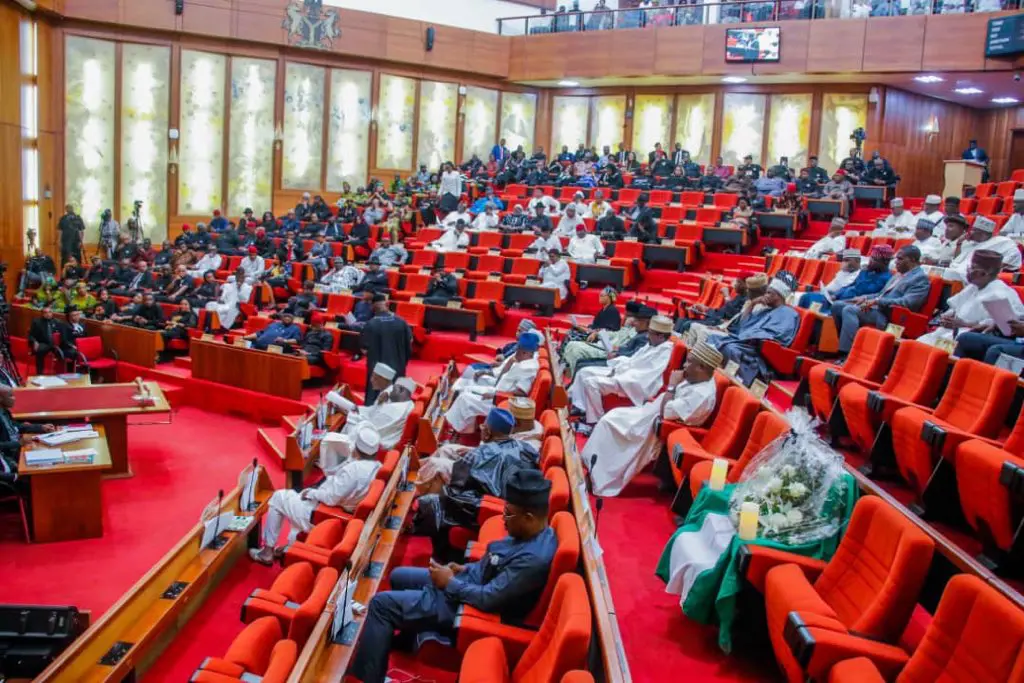
At plenary in Abuja on Tuesday, the upper chamber urged the Federal Government to suspend the rehabilitation and reintegration of former Boko Haram members and instead ensure that perpetrators of terrorism and banditry face the full weight of the law. The resolutions followed a motion of urgent national importance on the escalating attacks, abductions and killings of serving and retired military personnel, sponsored by the Chairman of the Senate Committee on Army, Senator Abdulaziz Yar’Adua, who represents Katsina Central.
Lawmakers described the country’s security situation as increasingly complex, persistent and alarming, warning that terrorism, insurgency, banditry and kidnapping had spread far beyond the traditional North East to touch nearly every geopolitical zone. The debate cut across party lines, a reflection of how deeply the crisis now weighs on the National Assembly.
The immediate trigger was the death of Major-General Rabe Abubakar, former Director of Defence Information, who was abducted alongside his wife by suspected terrorists in Katsina State on May 30, 2026, and later died in captivity. The Senate observed a minute of silence in his honour and resolved to send a delegation to his family, the Katsina State government and the Nigerian Army, while directing that the Senate leadership meet President Bola Tinubu to press for tougher measures.
Moving the motion, Yar’Adua said the killing of Abubakar and other retired officers “represents not only personal tragedy but also a painful national loss demanding urgent action.” He noted that retired officers remain attractive targets because of their former operational, intelligence and command roles, and warned that sustained attacks on security personnel erode troop morale and embolden criminal groups.
He listed a chain of assaults on senior officers since 2023: the abduction of retired Colonel Rabiu Garba Yandoto and his children in Zamfara in January 2023; the kidnap and killing of Major-General Richard Duru in Owerri in September 2023, despite a reported $50,000 ransom; the murder of retired Brigadier-General Uwem Udokwere in Abuja in June 2024; the abduction of former NYSC Director-General, retired Brigadier-General Maharazu Tsiga, in Katsina in February 2025; the death in captivity of retired Major Joe Ajayi, taken from Kogi in May 2025; and the abduction and later rescue of retired Colonel Joseph Ajanaku in Plateau in January 2026.
The push to halt rehabilitation came as an additional prayer by Senator Joseph Ikpea of Edo Central. “One of the issues we need to look at is the rehabilitation of Boko Haram members. My additional prayer is to stop the rehabilitation of Boko Haram,” he said. It was seconded by Senator Adams Oshiomhole of Edo North, who argued the policy defied logic while victims still grappled with the aftermath of attacks. “It does not make even common sense to grant pardon, rehabilitate and reintegrate criminals into society,” Oshiomhole said, calling for justice for victims and accountability for offenders.
The programme in the Senate’s sights is Operation Safe Corridor, launched in 2016 under former President Muhammadu Buhari after military commanders concluded the insurgency could not be defeated by force alone. Run from a Deradicalisation, Rehabilitation and Reintegration camp at Mallam Sidi in Gombe State, it processes defectors through screening, counselling and vocational training before resettlement. As recently as April 2026, the military said more than 700 fighters had completed the programme and were ready for reintegration, a disclosure that drew fresh public anger. Independent researchers have documented that host communities frequently distrust returnees, and critics have long argued the scheme amounts to amnesty by another name.
Beyond rehabilitation, the Senate pressed for a technology-driven overhaul of the security architecture, urging stronger intelligence gathering and sharing, better surveillance and early-warning systems, and deeper collaboration with traditional and religious leaders. It called for accelerated deployment of unmanned aerial systems, geo-spatial intelligence, integrated command and control platforms and advanced communications tools. Senator Abdul Ningi demanded intensified oversight of security agencies through reviews of casualty records and operational responses, while Senator Osita Izunaso, who seconded the main motion, called the recurring attacks “disturbing and unacceptable.”
Presiding over the session, Deputy Senate President Jibrin Barau urged a balanced view. “Our men and women in uniform are doing their best. They have been successful in decimating many criminal elements and deserve our continued support,” he said, noting that terrorism remains a global and regional challenge.
The debate collided almost immediately with events on the ground. The Nigerian Army disclosed that two senior terrorist commanders had surrendered to troops of Operation Hadin Kai in Geidam, Borno State, on July 4, arriving in Maiduguri the following evening for what the Acting Media Information Officer of the Joint Task Force North East, Captain Mohammed Goni, described as “detailed profiling, debriefing and intelligence exploitation.” The Army identified the pair as Munzirs within the terrorist leadership structure who “occupied influential positions and possess extensive knowledge of the group’s operational activities, command arrangements and logistics architecture.” It said the surrender marked “another major setback for the terrorist faction” and credited sustained land and air offensives for wearing down the insurgents.
That timing sharpens an unresolved tension at the heart of national policy. The Army has consistently maintained that surrendered commanders hold significant intelligence value and must be debriefed before any decision on their fate. Yet its statement gave no indication of whether the two men would ultimately be prosecuted or passed through the very rehabilitation pipeline the Senate now wants scrapped, saying only that debriefing was ongoing. How the Federal Government reconciles the intelligence argument with the growing political demand for prosecution is likely to define the next phase of this long and costly campaign.