
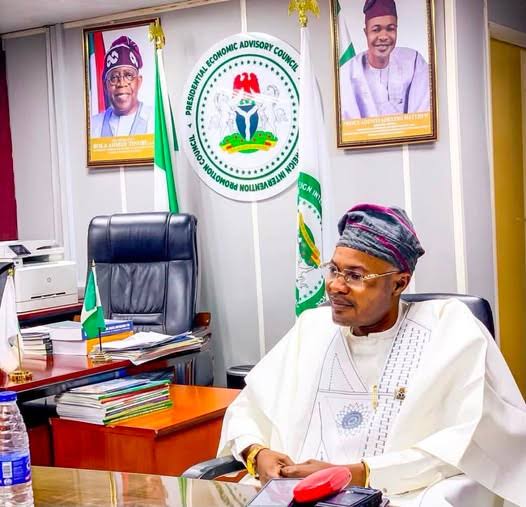
The man at the heart of one of the most bizarre controversies to hit the Tinubu administration is back in the spotlight, and this time it is his own words, on camera, doing the talking.
A video of Prince Adeniyi Adeyemi Matthew, who insists he is the Director-General of the disputed Presidential Foreign Intervention Promotion Council, recirculated online on Monday, reigniting public argument over how an entity the Presidency swears never existed still found its way into Nigeria’s official spending plan. The recording, taken from a press conference he addressed in late June 2026, captures Adeyemi in combative form, defending his claim to office while turning the questions back on the Presidency and the Office of the Chief of Staff, headed by Femi Gbajabiamila.
His central argument in the clip is deceptively simple. If the council he claims to lead is a fabrication, how did it survive the many gates a budget must pass through before it becomes law? “The national budget does not emerge in isolation,” Adeyemi said during the briefing. “It passes through multiple layers of technical drafting, executive coordination, ministerial inputs, Budget Office review, and finally legislative scrutiny by both chambers of the National Assembly.”
He pressed the point further, framing it as a test of the entire process rather than of himself alone. “The question becomes unavoidable: At what point in this process did references to a non-existent agency allegedly enter the official record? And if they are indeed present in official documentation, what does that imply about the integrity of the process that produced and approved those documents?” he asked.
That question has proved difficult to wave away, largely because the paper trail is real. A search of the 2026 Appropriation Act lists an entity described as the Presidential Economic Advisory Council/Presidential Foreign Intervention Promotion Council, carrying budget code 0111062001 and a total allocation of about N1.303bn. According to publicly available breakdowns of the figure, roughly N803m was earmarked for personnel, N200m for overhead and N300m for capital expenditure. It is the appearance of that line item, on the pages of a document signed into law, that has kept the scandal alive.
Adeyemi went further in the video, insisting the council was no phantom on paper alone. “The same acclaimed non-existent agency has a domiciliary account, a pounds sterling account and a Treasury Single Account, all domiciled in the Central Bank of Nigeria,” he said. “Is it even possible to open an account with fictitious documents in a commercial bank in Nigeria today, let alone the Central Bank of Nigeria?”
His most explosive claim, however, was personal. Adeyemi alleged that Gbajabiamila demanded 48 per cent of the council’s proposed take-off grant of N27,395,510,136, a demand he said he refused. He further alleged that N400m had already been collected on the Chief of Staff’s behalf through a proxy, with a balance of N200m still being sought to secure his appointment. “The major rationale behind the disagreement between myself and the Chief of Staff is that he allegedly requested 48 per cent of the take-off grant from the same agency, which he denies, which I rejected after he collected a total sum of N400m by proxy, with a remaining balance of N200m to secure the said appointment,” he said.
The Presidency has firmly rejected every strand of this account. In a statement issued by the Special Adviser to the President on Information and Strategy, Bayo Onanuga, the government described Adeyemi as a con artist who built an elaborate web of false claims to deceive officials, diplomats and ordinary Nigerians. “The case of Prince Adeniyi Adeyemi Matthew is a clear case of a con artist who appears to have built a web of false claims,” Onanuga said, adding that the man “has a history of fraudulent misrepresentation.”
By the Presidency’s telling, the story runs in almost the opposite direction. Officials say Adeyemi forged an appointment letter bearing Gbajabiamila’s purported signature, fabricated State House letterheads and reference numbers, and passed himself off as a senior government official. They say he operated from an office within Phase III of the Federal Secretariat Complex in Abuja, where he received government officials, diplomats and would-be investors while presenting himself as a Director-General.
The chronology offered by the government is detailed. It traces the first alarm to October 2025, when the Nigerian Investment Promotion Commission complained that another body appeared to be operating at cross-purposes with it. Around the same period, the Ministry of Foreign Affairs is said to have grown uneasy after Adeyemi hosted ambassadors at the Wells Carlton Hotel and Apartments in Asokoro on 10 October 2025 without any notification to the ministry. Gbajabiamila then petitioned the Department of State Services and the Nigeria Police on 17 October 2025 over what his office called an elaborate forgery and impersonation scheme. Ten days later, on 27 October 2025, Adeyemi was arrested at his Federal Secretariat office.
The police subsequently filed an eight-count charge against him and two others, identified only as Femi and Anu and said to be at large, at the Federal High Court in Abuja on 27 November 2025, under a charge marked FHC/ABJ/CR/2025. The counts border on conspiracy, forgery of presidential appointment documents, forgery of official State House letterheads, impersonation and operating a fictitious government agency. Investigators further allege that Adeyemi maintained as many as 34 bank accounts, nine of them opened in the names of non-existent entities, and that he managed to open a Central Bank account by misleading the Office of the Accountant-General of the Federation. The Presidency maintains that no government funds were ever paid into that account.
It was against this backdrop that Gbajabiamila issued a public disclaimer in June 2026, stating plainly that the Presidential Foreign Intervention Promotion Council did not exist under the Presidency and that no appointment had been made to it. Adeyemi rejected the disclaimer at his press conference, questioning why the Chief of Staff, rather than the President’s media team, had spoken on the matter, and challenging Gbajabiamila to release documents and communication trails from the President’s office for examination.
The affair has since spilled well beyond the two principals. Former Vice President Atiku Abubakar has called on President Bola Tinubu to suspend Gbajabiamila pending an independent investigation, describing the situation as one in which the government risked being held hostage by fraudsters. Human rights lawyer Femi Falana has argued that the Presidency lacks the constitutional authority to exonerate anyone and has pushed for an independent probe of both Gbajabiamila and Adeyemi. Opposition voices, including the National Democratic Coalition, have demanded the Chief of Staff’s removal to clear the way for what they call an unbiased inquiry. Each of these interventions has kept the pressure on a government that would clearly prefer the matter to rest quietly in court.
There are also darker threads that remain unresolved. Adeyemi has repeatedly referred to the death of an alleged middleman, Babatunde Tanimola, whom he says facilitated his contact with the Chief of Staff, and who died in a fire in the days before his own arrest. He has also alleged that he survived an assassination attempt along the Abuja-Kaduna Expressway on 7 September 2025, during which, he claims, documents and his phones were taken. None of these claims has been independently verified, and the Presidency has not acknowledged any threat against him.
For context, this is not the first time Adeyemi has drawn scrutiny over grand institutional claims. He previously fashioned himself as a leader of a body presented as an affiliate of the United Nations, a claim that later came under challenge when no such organ was found to exist in the form he described. That history forms part of the Presidency’s argument that his current posture fits an established pattern.
Yet even those unpersuaded by Adeyemi concede that the scandal raises uncomfortable questions about Nigeria’s public finance machinery. A budget line, as the government’s own account acknowledges, is meant to pass from an originating institution through the Budget Office of the Federation, the Federal Executive Council and both chambers of the National Assembly before a president signs it. How a supposedly fictitious council cleared those hurdles and secured N1.3bn remains, for now, unanswered.
For his part, Adeyemi has shown no intention of retreating. Speaking on a Channels Television programme after the press conference, he said he was ready to defend himself and expected to be cleared. “Definitely, sir. If I’m wrong, let the court of law do that, and if I’m right, let the court of law do that; do the right thing,” he said, insisting that the matter should be left to a court of competent jurisdiction.
That court is expected to take up the case on 27 July 2026. Until then, the resurfaced video, and the questions it revives, will continue to circulate, keeping a story the Presidency has tried to close firmly, and awkwardly, open.