
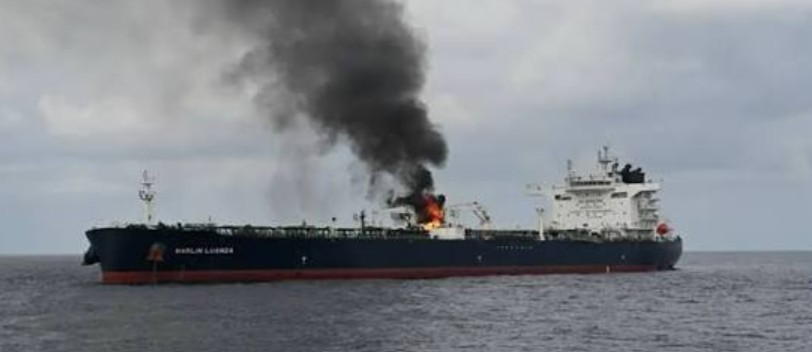
An Iranian strike on a Saudi crude supertanker killed two Filipino sailors in the Strait of Hormuz, dragging Riyadh into the middle of the regional naval war. Saudi national shipping carrier Bahri confirmed on Wednesday, 2 September 2026, that projectiles struck its vessel, the Sidr, late on Monday night as the ship steered out of the narrow waterway. The deadly attack shattered the diplomatic fiction that Gulf energy exporters could stay neutral while Washington and Tehran traded heavy blows. Maritime security agencies tracked the explosion roughly sixteen nautical miles northeast of Khasab off the Omani coast. Hostile projectiles hit the vessel around 11:40 pm local time, starting fires and cutting through operational cabins. The Saudi Foreign Ministry quickly pointed the finger at Iranian batteries, demanding an immediate halt to attacks on civilian trade corridors. Innocent merchant seamen pay the ultimate price when regional heavyweights fight. Geography offers oil monarchies no place to hide.
The stricken carrier had just taken on two million barrels of crude oil at the Juaymah export terminal on the eastern Saudi coastline. Satellite trackers show the vessel was navigating international transit corridors alongside a second crude carrier when the salvos landed. Iran’s Islamic Revolutionary Guard Corps insists that several ships ignored explicit warnings and strayed into prohibited mining lanes. Tehran now demands that merchant fleets pay transit fees and accept local navigation permits before entering the bottleneck. Any master who sails through the channel without Iranian permission faces direct missile fire or sea mines. The attack on the Sidr shows that Tehran intends to enforce its transit blockade by force. Commercial shipping firms cannot treat these warnings as empty posturing. Crossing the strait now carries mortal risks for commercial crews.
The deaths aboard the Sidr expose the failure of Western naval forces to secure merchant traffic through the Persian Gulf. Operation Prosperity Sentinel and American naval patrols cannot track every low-flying drone or shoreline rocket truck along the jagged Iranian coastline. Centcom bombers wiped out launch pads on Larak Island earlier on Monday, yet coastal units fired fresh barrages only hours later. The Pentagon burns through million-dollar interceptors while Iranian squads launch cheap shoulder-fired munitions and sea skimmers. Warships must protect themselves first, leaving merchant convoys vulnerable to sudden strikes from rocky coves. Naval convoys give shipowners a false sense of security in confined waterways. High-tech naval flotillas cannot shield every civilian hull.
Riyadh now faces an agonising strategic choice between military retaliation and delicate regional rapprochement. Crown Prince Mohammed bin Salman spent years repairing diplomatic ties with Tehran to protect his Vision 2030 domestic industrial plans. A return to open cross-border missile strikes would scare off foreign capital and wreck ambitious tourism projects across the kingdom. Yet the House of Saud cannot stand by while Tehran shuts down its primary maritime export gate. Oil receipts fund the entire royal balance sheet, and alternative overland pipelines to the Red Sea carry limited crude volumes. The Houthis already harass Bahri vessels in the southern Red Sea, leaving Saudi oil logisticians trapped from both flanks. Regional détente collapses when national balance sheets bleed. Diplomacy loses its charm when tankers burn at sea.
The Philippine government faces another painful crisis involving its massive overseas maritime workforce. Thousands of Filipino officers and deckhands staff the global merchant fleet, handling dirty and dangerous jobs across high-risk war zones. Manila had already urged international shipowners to reroute crews away from the Persian Gulf after earlier missile strikes killed civilian mariners. Yet many global shipping syndicates refuse to divert vessels around the Cape of Good Hope because the detour burns millions of dollars in extra bunker fuel. Shipping executives treat crew danger bonuses as acceptable operational costs while sailors run deadly gauntlets. Filipino labour unions will now demand total transit bans across the Gulf. Low-wage deckhands carry the real burden of global commerce. Boardrooms balance balance sheets while deckhands face missile fire.
Global energy markets reacted swiftly to the news of the fatal strike on Saudi tonnage. Benchmark Brent crude jumped past $90 a barrel as commodity desks priced in the growing danger to Middle Eastern crude supplies. Marine insurers in London immediately raised additional war-risk premiums, making unescorted Gulf runs prohibitively expensive. Independent tanker owners are instructing their vessels to drop anchor outside the Gulf of Oman until security guarantees improve. Every dollar added to a barrel of oil feeds fresh inflation into struggling economies across Europe and Africa. Energy consumers will soon pay higher prices at petrol pumps because of a missile strike near Khasab. War in the narrows taxes every corner of the global economy. An insecure strait guarantees expensive fuel for the world.
The attack proves that the regional confrontation has moved beyond symbolic military posturing into economic attrition. Tehran knows it cannot defeat the American navy in open fleet warfare, so it targets the commercial lifelines of American allies. By hitting a vessel owned by Saudi Arabia’s national carrier, Iran showed that no regional asset remains untouchable. The regime calculates that soaring shipping rates and nervous oil traders will force Washington to abandon its punishing sanctions. However, this aggressive gambit risks pushing Gulf monarchies back into a hard military alliance with the West. Desperate economic blackmail rarely builds reliable long-term security. Tehran is playing with fire in a crowded room.
The international community must recognise that the crisis in the Strait of Hormuz cannot be resolved through naval escorts alone. As long as the broader economic war between Washington and Tehran continues, merchant vessels will remain convenient targets. Regional mediators in Muscat and Doha must persuade both sides to establish safe transit corridors under international monitors. If those diplomatic efforts fail, the world must prepare for a prolonged energy shock that will drag down global growth. Empty political declarations about freedom of navigation mean nothing to the families of dead seafarers. Peace requires difficult compromises between bitter enemies. The alternative is a wider war that will leave the entire Persian Gulf in ruins.