
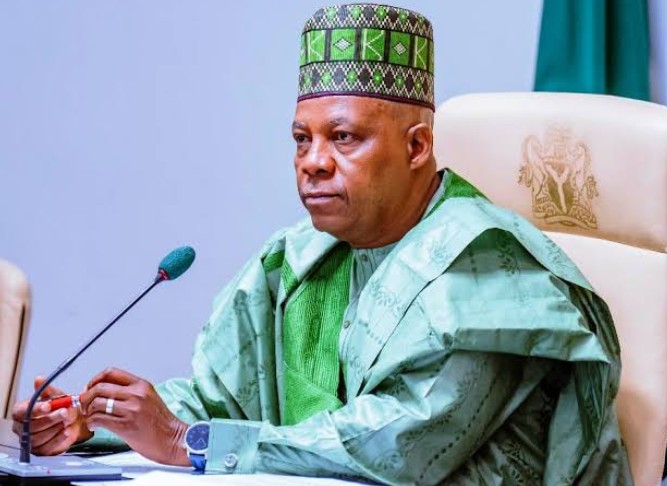
Vice President Kashim Shettima arrived in New Delhi on Friday to lead Nigeria’s delegation at the 18th BRICS Leaders’ Summit. Representing President Bola Tinubu, Shettima landed in the Indian capital with a senior ministerial team tasked with finding fresh trade, investment, and capital for an economy in transition. The summit convenes at the Bharat Mandapam complex this weekend under India’s chairship, carrying the banner of resilience, innovation, and cooperation. Nigeria joins the gathering not as a full voting member, but as an official partner country, a diplomatic perch it secured in January 2025. That status lets Abuja participate in high-level deliberations without shouldering the full geopolitical baggage of the core alliance. The trip reflects a calculated bid to diversify foreign partnerships beyond traditional Western capitals. Shettima wants deals that deliver real money. Nigeria cannot live on diplomatic courtesies alone.
The delegation Shettima leads carries the heavy artillery of Tinubu’s cabinet. Foreign Minister Bianca Odumegwu-Ojukwu joined Industry, Trade and Investment Minister Jumoke Oduwole alongside Communications, Innovation and Digital Economy Minister Bosun Tijani and Environment Minister Balarabe Abbas Lawal. Their joint presence signals that the New Delhi trip is an economic pitch rather than a ceremonial visit. Odumegwu-Ojukwu announced that Nigeria plans to hunt for deals in farming, artificial intelligence, and digital infrastructure while learning from India’s massive youth engagement models. Oduwole openly reminded her hosts that bilateral trade between Nigeria and India previously hit 14 billion dollars before slipping during recent global shocks. The trade minister is actively seeking out Indian industrial investors who might deploy capital into Nigerian processing plants and energy projects. Indian refiners used to buy vast quantities of Nigerian crude oil, and Abuja wants those purchase orders back. A diversified trade ledger remains Abuja’s primary ambition.
The summit takes place as BRICS marks two decades since an investment banker coined its famous acronym. The bloc has grown from its original quartet into an expanded club that counts regional heavyweights like Iran, Ethiopia, Egypt, and the United Arab Emirates among its members. By creating the intermediate partner country category during its 2024 Kazan meeting, BRICS built an outer orbit for emerging economies that want closer South-South trade without triggering direct confrontations with Washington. Nigeria entered that tier alongside nations like Malaysia, Thailand, and Kazakhstan to tap alternative sources of development finance. Access to the New Development Bank holds immense appeal for an administration trying to fund roads, rail, and electricity grids without suffocating under debt service costs. The multilateral lender offers credits free from the intrusive governance demands often attached to Western aid. Partner status provides a seat at the table. Nigeria must now turn that seat into concrete cash flows.
The central challenge facing Shettima in New Delhi is the widening gap between Nigerian diplomatic ambition and its domestic industrial reality. For years, Nigerian delegations have toured world capitals signing non-binding memoranda of understanding that produce few operational factories. Foreign direct investment into Nigeria fell over recent cycles because foreign firms struggled with erratic power supplies, port delays, and sudden foreign exchange shifts. While the central bank recently cleared contract backlogs and stabilised the currency, foreign boardrooms still treat African frontier markets with visible caution. Indian conglomerates know Nigeria well, having built extensive pharmaceutical, vehicle assembly, and plastic plants across Lagos and Ogun states over several decades. Yet those same manufacturers often grumble about multiple taxes and unpredictable customs rules that eat into operating profits. Courting fresh capital requires proving that domestic factories can actually move goods to market profitably. Speeches will not charm balance-sheet accountants.
Energy ties sit at the very heart of the discussions between the Nigerian team and their Asian counterparts. India imports more than 80 per cent of its crude oil requirements to feed its expanding industrial engine. In earlier years, light sweet crude from the Niger Delta served as a staple feed for Indian coastal refineries. That commercial relationship eroded when Nigerian oil output dropped, and Asian refiners turned to discounted Russian barrels following the outbreak of the war in Eastern Europe. The current conflict around the Strait of Hormuz and the Bab al-Mandeb has pushed global oil prices past 107 dollars per barrel, forcing Asian buyers to reconsider their supply security. Shettima’s delegation wants to convince Indian buyers that Nigerian terminals offer a reliable, alternative source of hydrocarbons away from vulnerable Middle Eastern waterways. Pitching Nigerian barrels in New Delhi makes sharp commercial sense. Securing long-term supply contracts will anchor the wider bilateral partnership.
Technology and farm output offer two additional avenues where Abuja hopes to secure rapid gains. India built a global services industry by training millions of software developers and automating public services through digital identity rails. Bosun Tijani hopes to mirror parts of that tech ecosystem by drawing Indian software firms into joint training ventures and data centres in Nigeria. On the agricultural front, Nigeria continues to spend billions of dollars importing processed foods that domestic soil could easily cultivate with modern mechanisation. India overcame its own severe food shortages decades ago through sustained investments in seed science, irrigation, and local tractor manufacture. Odumegwu-Ojukwu emphasised that adopting Indian farm implements and food storage systems could help tame the high food inflation currently battering Nigerian families. Importing technical expertise looks far smarter than importing grain. Technology transfers must lead the agenda.
The wider geopolitical backdrop gives Nigeria’s partner role added diplomatic weight. As Western powers impose trade tariffs and weaponise reserve currencies, major developing countries seek safety in alternative payment networks and regional trade pacts. BRICS champions the use of local currencies for bilateral trade, a mechanism that could help Nigeria save scarce hard currency when buying industrial inputs. Yet Abuja must handle its eastern pivot with extreme diplomatic care. Western capitals remain Nigeria’s largest bilateral creditors and primary buyers of non-oil exports. Aligning too closely with an anti-Western posture risks alienating trading partners in London, Paris, and Washington. Tinubu’s foreign policy seeks strategic autonomy, balancing old Western friends against hungry emerging economies in the global south. Walking that middle path requires discipline and political cool.
The true value of Shettima’s journey to New Delhi will depend entirely on what follows the photo opportunities at Bharat Mandapam. If the visit ends with generic joint communiques about mutual respect, the trip will merely add to the registry of forgotten foreign missions. If the delegation returns with binding equity investments in fertiliser plants, farm machinery assembly lines, and digital hubs, the partner strategy will prove its worth. Nigerians at home care little about multilateral acronyms or the high politics of the Global South. They care about steady jobs, affordable food, and stable light. Shettima has the stage, the ministers, and the international audience to plead Nigeria’s case. Delivering results requires relentless follow-through long after the aeroplanes leave India.